


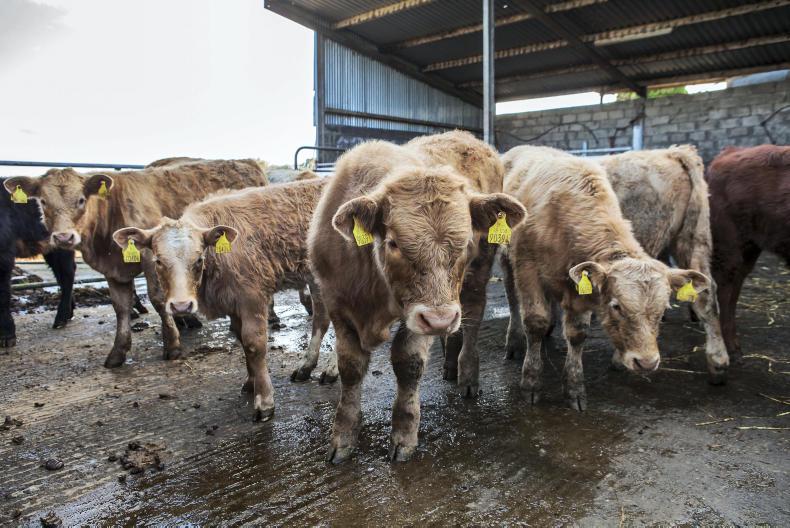
The Department of Agriculture AIM age analysis of the national beef and dairy herds recorded a year-on-year reduction of 23,693 and 18,207 head of cattle respectively on 1 August 2018.
As reflected in Table 1, the number of cattle in the zero- to six-month age category recorded a 58,794 head reduction.
This is driven by an increase in live exports of beef-sired calves in 2018 and a reduction in suckler births.
The latest ICBF birth registration records for the week ending 21 September 2018 shows a reduction in suckler births of 37,000 head. This tallies with the AIM data, which shows a reduction in suckler cows of 31,556 over the last 12 months.
Beef cattle spike
There is a spike in the number of beef cattle in the 12- to 18-month age bracket, which recorded an increase of 63,879.
This is stemming from a continued switch in dairy herds from Friesian genetics to Angus and Hereford sires, with a greater number of surplus cows not used to breed replacements served to beef bulls in recent years.
This is confirmed in the dairy tab in Table 1, with the zero- to six-month, 12- to 18-month and 18- to 24-month male dairy age categories all recording significant reductions, with almost half of the increase in beef cattle described above cancelled out by a reduction in Friesian cattle.
It is also marginally reducing the number of Friesian heifers on farms. In contrast, the size of the national dairy cow herd has recorded further growth, increasing 40,440 head to reach 1,451,454 cows.
Beef throughput
Looking closer to the market, there is 5,336 more male cattle in the 30- to 36-month age category and 3,191 fewer cattle in the 24- to 30-month age category, while there was 4,516 more beef heifers in the 24- to 30-month age category and 2,580 extra heifers in the 30- to 36-month age category.
A high percentage of these extra cattle are likely to have been processed in recent weeks given the higher throughput levels.
A number of agents have pointed to throughput possibly reducing this week, with farmers under less pressure and taking advantage of the fine week to complete field work.
While most plants are quoting a base of €3.70/kg for steers and €3.80/kg for heifers, there are a significant number of buyers trading at the top of the market and using this to their benefit to secure a base of €3.75/kg and €3.85/kg.
Bull prices are unchanged, with R grades selling from €3.70/kg to €3.75/kg, while U grades are moving, in general, from €3.80/kg to €3.85/kg.
Bulls less than 16 months and trading on the grid are trading at a base price of €3.70/kg to €3.75/kg, with carcase weight and fat cover the main concerns in negotiations.
Cow prices remain very variable, with numbers and the type of cow on offer having a big bearing on the prices negotiated.
P+3 grading cows are quoted anywhere from €2.85/kg to over €3.00/kg, while O grading Friesian cows are starting at €2.90/kg for lighter cows and rising to €3.15/kg to €3.20/kg for heavy-carcase cows.
R grades remain at a range of €3.25/kg to €3.40/kg at the top of the market, with U grades 10c/kg to 15c/kg higher.



SHARING OPTIONS