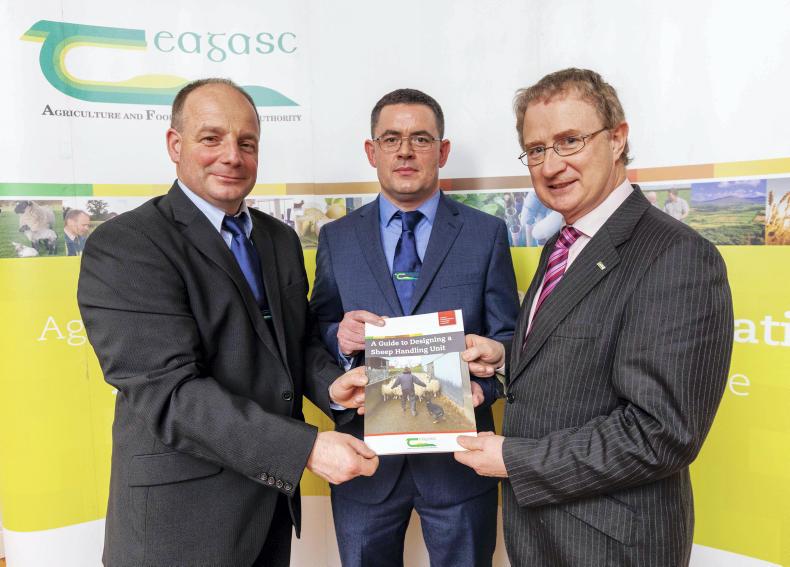
At the Teagasc National Sheep Conference 2020 at the Springhill Court Hotel Kilkenny were, from left, Michael Gottestin, Edward Egan and Prof Frank O Mara, Teagasc. \ Dylan Vaughan.
ADVERTISEMENT
Sheep enterprises are regularly perceived as requiring a high labour input. There are major differences, however, with numerous factors such as farm layout and land fragmentation, farm infrastructure and even breed type all having an influence on the volume of labour required.
A handling unit can deliver major labour savings, with research showing that a good handling unit can reduce the time worked with sheep by 1.28 hours per ewe. Over a 100-ewe flock, this amounts to 16 days work per year. This is a significant figure when you take into account many sheep enterprises are run on a part-time basis and for those that are not help is often limited.
Guide
ADVERTISEMENT
A new guide to designing a sheep handling unit compiled by Teagasc business and technology adviser Edward Egan was launched at the Teagasc sheep conference in Kilkenny last Thursday .
The guide is available to view and download for free on the Teagasc website.
It contains valuable information on designing a new handling unit and also contains advice where existing units are being upgraded. Edward has an extensive knowledge in sheep production and provides lots of practical and easy-to-implement tips for a range of handling options.
As well as improving efficiency, Edward says a good handling unit can make a huge difference to the health of the operator and reduce muscle strain and injuries linked with repetitive practices or poor handling techniques.
Register for free to read this story and our free stories.
This content is available to digital subscribers and loyalty code users only. Sign in to your account, use the code or subscribe to get unlimited access.
The reader loyalty code gives you full access to the site from when you enter it until the following Wednesday at 9pm. Find your unique code on the back page of Irish Country Living every week.
CODE ACCEPTED
You have full access to the site until next Wednesday at 9pm.
CODE NOT VALID
Please try again or contact support.
Sheep enterprises are regularly perceived as requiring a high labour input. There are major differences, however, with numerous factors such as farm layout and land fragmentation, farm infrastructure and even breed type all having an influence on the volume of labour required.
A handling unit can deliver major labour savings, with research showing that a good handling unit can reduce the time worked with sheep by 1.28 hours per ewe. Over a 100-ewe flock, this amounts to 16 days work per year. This is a significant figure when you take into account many sheep enterprises are run on a part-time basis and for those that are not help is often limited.
Guide
A new guide to designing a sheep handling unit compiled by Teagasc business and technology adviser Edward Egan was launched at the Teagasc sheep conference in Kilkenny last Thursday .
The guide is available to view and download for free on the Teagasc website.
It contains valuable information on designing a new handling unit and also contains advice where existing units are being upgraded. Edward has an extensive knowledge in sheep production and provides lots of practical and easy-to-implement tips for a range of handling options.
As well as improving efficiency, Edward says a good handling unit can make a huge difference to the health of the operator and reduce muscle strain and injuries linked with repetitive practices or poor handling techniques.
If you would like to speak to a member of our team, please call us on 01-4199525.
Link sent to your email address
We have sent an email to your address. Please click on the link in this email to reset your password. If you can't find it in your inbox, please check your spam folder. If you can't find the email, please call us on 01-4199525.
ENTER YOUR LOYALTY CODE:
The reader loyalty code gives you full access to the site from when you enter it until the following Wednesday at 9pm. Find your unique code on the back page of Irish Country Living every week.






SHARING OPTIONS