


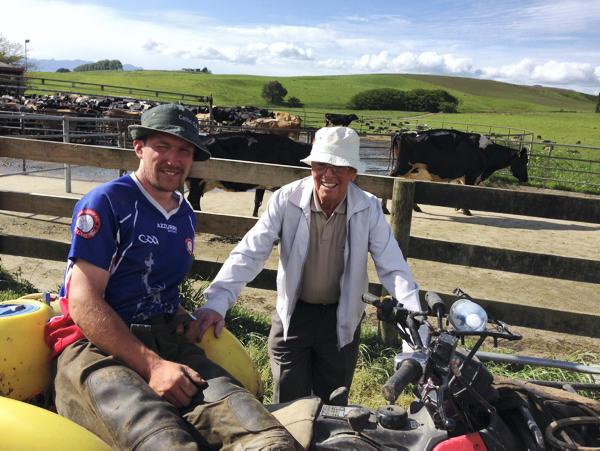
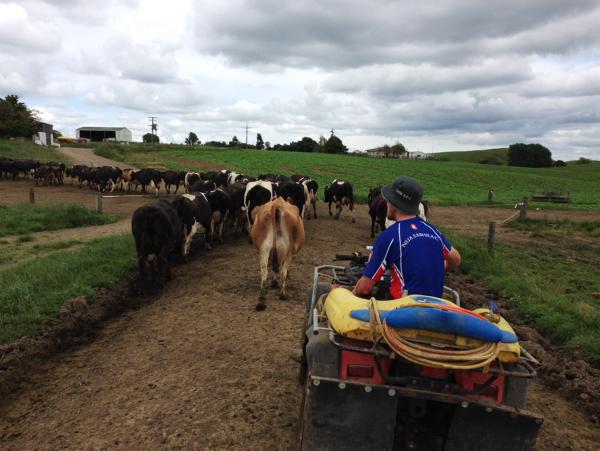
In July 2013, I travelled to New Zealand to complete six months work placement on a dairy farm, as part of the degree.
I was based on an 850 cow farm in the Waikato region of the North Island. It was a split milking herd with 500 spring calvers and 350 autumn calvers. The herd was made up of 60% Friesian and 40% Jersey cross.
It was a 100% pasture based system. Maize grown on the farm was used to buffer grass as needed and turnips were grazed in the paddock from the 1st of January onward as grass growth slowed. Dry cows and replacement heifers were wintered on an out farm about 20 minutes from the home block.
The grazing platform was 350ha, but only 312ha of this was effective at growing grass as the remaining 38ha was lost to steep contour and swampy ground.
There was a total of eight staff on the farm; three relief milkers, a calf rearer and a machinery operator/mechanic. I was employed as a Production Manager. I was responsible for the day to day running of the farm.
I arrived in New Zealand on the 15 July. I was landed into the calving straight away. I was lulled into a false sense of security in the first week, with two and three cows calving a day. After this it was typical to be collecting between 15 to 20 claves per day. We collected the calves every morning and placed them in a dry bed shed. We drafted the cows into a colostrum herd for four milkings, before moving them into the main herd. The milk from this herd was pooled and used to feed the calves. We sold all bull calves at four days old and only kept heifers with a high EBI for replacement. We ran a Hereford bull at the end of breeding season which meant we got some good beef calves towards the end of calving. We sold these at the sales for an average of $200 a head at two weeks old.
Calving a large herd outdoors in a wet north island spring is not for the faint hearted. Getting out of bed at 2am to jump on a quad and drive out in a gale to check on the cows can leave you wondering if an office job would be all that bad! Thinking back on it now, time flew by and it turned out to be a very enjoyable experience.
Once we finished up calving we had a few weeks respite before breeding started. We used AI for four weeks, using Kamars for heat detection and servicing 14 cows on average a day. Ten days before the end of the four weeks, we had a vet check any cow that had not come in heat. On the last day of AI we put 100 cows up for service using synchronisation. This took two AI technicians, a helper to load the straws and two of us to keep the cows coming. This took just over an hour.
Once we finished AI, we let in the Hereford bulls to clean up any repeats or missed heats. From this time onwards, the days became a lot more predictable. It was mostly milking the cows and making sure we kept good control of grass sward and weeds.
For anyone thinking of starting farming or starting milking post quota or even just wanting a new experience, I would highly recommend New Zealand as the place to go. I found it to be a great opportunity to farm in a professional, well structured environment, while at the same time learning a lot about time management and working efficiently.
My time in NZ was not all work; I was lucky enough to get a few weeks off in December to travel the country with some great lads from dairy business - but some stories are best left untold!



SHARING OPTIONS