This year's tillage conference is packed with information of relevance to growers including an update of the evolving disease situation and the confirmation of resistance in grass weeds.
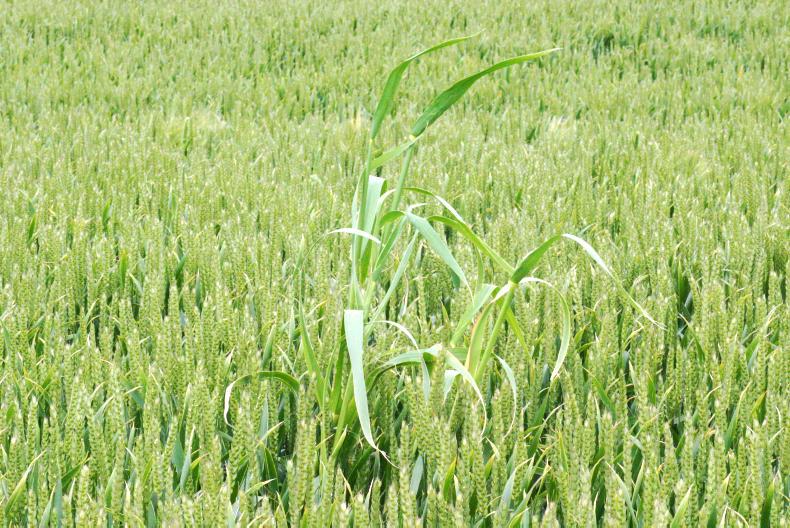
The survival of individual wild oat plants or clumps in treated crops is now of even greater concern given the confirmation of resistance.
ADVERTISEMENT
Teagasc’s National Tillage Conference takes place next week (26 January) at the Lyrath Hotel in Kilkenny. This year’s conference promises a broad range of subject matter, with a lot of short snappy papers targeted at growers.
Markets, prices and volatility are the theme for the morning session. The potential to use wheat for distilling, opportunities to increase market size for beans and oilseed rape and the new maize production and trading guide are all of direct interest to growers. Managing price volatility will also be discussed and David Walsh-Kemmis will give a grower’s perspective on the things he is doing to help add value to his farm produce.
Afternoon session
ADVERTISEMENT
The afternoon session will give an update on disease resistance across all our cereals and on disease control in barley. Monitoring appears to suggest no major change in the SDHI situation re septoria but there are some signs of problems in net blotch. It would also seem that ramularia is developing resistance to the strobilurins. And the work on disease control in barley would indicate that many growers could be spending too much for profitable production.
A separate presentation on variety evaluation assesses the usefulness, or otherwise, of some of the characteristics used on the recommended lists.
This year there is a series of short presentations which outline the range of research projects currently under way. These include an update on resistance in some of our major grassweeds and we have reason to be very concerned about blackgrass and wild oats. There is a project on planting systems, row width and seeding rates in oilseed rape.
An evaluation of the factors which influence eyespot. Work on aphids and BYDV control. An introduction to the new technology of gene editing and efforts to understand the basis of durable septoria resistance.
This content is available to digital subscribers and loyalty code users only. Sign in to your account, use the code or subscribe to get unlimited access.
The reader loyalty code gives you full access to the site from when you enter it until the following Wednesday at 9pm. Find your unique code on the back page of Irish Country Living every week.
CODE ACCEPTED
You have full access to the site until next Wednesday at 9pm.
CODE NOT VALID
Please try again or contact support.
Teagasc’s National Tillage Conference takes place next week (26 January) at the Lyrath Hotel in Kilkenny. This year’s conference promises a broad range of subject matter, with a lot of short snappy papers targeted at growers.
Markets, prices and volatility are the theme for the morning session. The potential to use wheat for distilling, opportunities to increase market size for beans and oilseed rape and the new maize production and trading guide are all of direct interest to growers. Managing price volatility will also be discussed and David Walsh-Kemmis will give a grower’s perspective on the things he is doing to help add value to his farm produce.
Afternoon session
The afternoon session will give an update on disease resistance across all our cereals and on disease control in barley. Monitoring appears to suggest no major change in the SDHI situation re septoria but there are some signs of problems in net blotch. It would also seem that ramularia is developing resistance to the strobilurins. And the work on disease control in barley would indicate that many growers could be spending too much for profitable production.
A separate presentation on variety evaluation assesses the usefulness, or otherwise, of some of the characteristics used on the recommended lists.
This year there is a series of short presentations which outline the range of research projects currently under way. These include an update on resistance in some of our major grassweeds and we have reason to be very concerned about blackgrass and wild oats. There is a project on planting systems, row width and seeding rates in oilseed rape.
An evaluation of the factors which influence eyespot. Work on aphids and BYDV control. An introduction to the new technology of gene editing and efforts to understand the basis of durable septoria resistance.
If you would like to speak to a member of our team, please call us on 01-4199525.
Link sent to your email address
We have sent an email to your address. Please click on the link in this email to reset your password. If you can't find it in your inbox, please check your spam folder. If you can't find the email, please call us on 01-4199525.
ENTER YOUR LOYALTY CODE:
The reader loyalty code gives you full access to the site from when you enter it until the following Wednesday at 9pm. Find your unique code on the back page of Irish Country Living every week.






SHARING OPTIONS