Dairygold’s financial results for 2025 show that the Munster co-op made a profit after tax of €1.4m, on turnover of €1,543m. Despite a 10% increase in turnover from the previous year, the profit after tax figure represents a 90% drop from 2024’s figure.
Members of the co-op supplied 1.44bn litres of milk for processing during the year, a 4% increase on 2024’s level. There was also an 0.8% year-on-year increase in milk solids which rose to 8.07% (3.68% protein and 4.39% butterfat). The total amount of milk processed was circa 1.5bn litres, when milk on behalf of other processors is included, which Dairygold said demonstrates the scale and efficiency of its processing facilities.
The average quoted base price for milk was 46.1c/l, including quality and grassroots payment plus VAT, which equates to a paid price of 53.8c/l, based on average solids as outlined above. This is an increase from the 52.1c/l price paid the previous year.
Tillage farmers delivered 106,000t of grain and beans to the co-op in 2025, with growers paid €188/t for barley and €198/t for wheat.
In total, the co-op said it paid close to €800m to members for milk and grain supplied during the year.
Dairygold CEO Michael Harte told the Irish Farmers Journal that “there were a lot of positives in 2025 for Dairygold, but there were also two negatives in the year. One was the significant decline in dairy markets which happened from August and had a significant impact on Dairygold’s financial results. The other was in tillage where the returns for growers was a real challenge in 2025. That is on the back of a number of years of challenges for the sector and the outlook for 2026 also a challenge”.
He added that Dairygold remains a supporter of its growers and the industry and that tillage farmers are very important for the co-op which is a big user of native grain.
“Overall, we feel that we have delivered a resilient financial performance,” he said. “Dairy markets from August onwards declined significantly and our exposure to cheese was the biggest factor in relation to our results.”
He said that the co-op had to balance the plunge in cheese prices with the price it was paying members for their milk.
“You can see in the results, at the bottom line, we generated a marginal level of profit after tax. We generated an EBITDA (earnings before interest, taxation, depreciation and amortisation) of €52.7m, back €12.7m, which is all down to dairy markets.”
Harte did add that he was generally pleased with the performance of the business during 2025.
“Generally, everything was good, with the exception of cheese, and that was the key factor and the key challenge we had in our business. Dairy markets from the end of August had an impact of about €70m on us.
“We recovered about €45m in milk price with [the balance of] €25m in a reduced level of profitability and a milk-price relativity challenge.”
Looking at the balance sheet of the co-op, net bank debt at the end of the year was at €135.3m, a €22m decrease over the 12 months.
This gave Dairygold a net bank debt to EBIDTA ratio of 2.6 times.
The net asset value of the society decreased by €44.3m to €422.4m, primarily driven by the valuation of the ‘put’ liability of €39.9m which relates to the future acquisition of the remaining 41% shareholding in Vita Actives.
Under accountancy rules the co-op had to recognise the estimated present value of the future acquisition of the outstanding share capital of Vita Actives.
Harte said that the option to purchase the balance of Vita Actives “will happen sometime between now and the 2030s” and that it is dependent on a number of metrics including the level of earnings.
“Our expectation is that this won’t crystalise for another two years.”
Sales
The co-op sold its Creamfields site in Cork in August 2025, generating proceeds of €25.6m, which it said were used to reduce net debt. Other properties sold during the year included sites in Killaloe, Co Clare, and Hollyford in Co Tipperary.
Planning permission was granted for a large-scale residential development at Parkmore Industrial Estate on the Long Mile Road in Dublin.
Dairygold said it is the intention to sell the property to a third party for further development. The profit and loss account for the co-op included an addition of €7.2m for the change in fair value of investment properties during the year, significantly related to the achievement of planning permission for that site.
Dairygold also sold other investments, with its holding of quoted shares ending the year at €2.8m, down from €16.3m at the start of 2025.
The annual report includes a note saying that the co-op would not have been able to attain the financial outcomes required under certain existing facility agreements with its banking syndicate, primarily due to the adverse market conditions during the year.
Agreement was reached with the long-standing banking syndicate prior to the end of the year, and the co-op has commenced a review of its banking facilities which is expected to conclude in the first half of 2026.
Peter O’Driscoll, interim chief financial officer, said: “These facilities will be more aligned to the co-op’s seasonal working capital requirements and provide flexibility to address global dairy market volatility.”
Optimisation
The ongoing business optimisation programme, launched last year, which is targeting €14m in cost savings to the end of 2027 “delivered €8.5m in savings in 2025”, Harte said. The programme to date has concentrated on driving efficiencies across the business from packing ingredients, energy consumables and across the whole supply chain.
“When we originally outlined the programme we were talking about potential headcount reductions and maybe potential store closures. We have made no decision in relation to store closures at this moment in time,” he said, adding that the position will be reviewed by the end of 2026.
A strategic review of Dairygold’s UK business is currently under way. While citing the profitability of both the formatted cheese business in Crewe and the soft cheese business in Leeds, the co-op notes that they operate in a challenging business environment and require on-going capital investment. The Crewe business, in particular, uses a significant amount of working capital.
“As a business, are need to ensure that we focus our resources in the right place for our members, so there is a review going on there, and that’s about as much as we’re going to say at this moment in time,” Harte said.
Dairygold dissolved its Chinese subsidiary Dairygold Asia Ltd in October 2025 following the failure of the Aerabo brand, launched in 2021 and expanded in 2023, to make headway into the market there. Dairygold still sells product into China though its agent in the country, Beijing Milkyway, with whom the co-op has been working for more than 25 years.
Outlook
Harte was significantly more positive about the outlook for Dairygold’s major diversification play, Vita Actives.
“It’s operating in a growth market, and is really benefitting from the health and wellness trends. Overall, the business is growing, we have opened up more sales offices across Europe and are mainly focused on the UK and European market. It’s a high margin business and it’s adding value for us, and we’re really focused on driving it on,” Harte said.
He added that Vita Actives remains profitable, and that the co-op is very happy with the performance of the investment.
Dairygold sales to Vita Actives during the year were just over half a million euro. The company provided a loan of €10m to Dairygold in 2025 on standard commercial terms, which Harte described as a cash management exercise.
Harte said that the key infrastructure investments “are now completed within Dairygold. The casein plant was the last investment. We commissioned that plant in 2025 and that allows us to put more milk into casein, which is the most profitable product that we have”.
He noted that as part of Dairygold’s demineralised whey facility, there is an investment being made which will allow the co-op to produce a small proportion of WPC (whey protein concentrate).
The average number of weekly employees at the co-op during 2025 was down 13 to 1,360, while total payroll costs remained relatively unchanged at €93.4m.
There was a €550,000 decrease in performance related pay to members of the senior management team in 2025 as there were no payments made under the annual performance bonus scheme.
Pat Clancy, chair of Dairygold, said “the business struggled and we didn’t hit our KPIs (key performance indicators).
“The senior leadership team agreed with [the board] that they would forego their bonuses because of the returns within the business”.
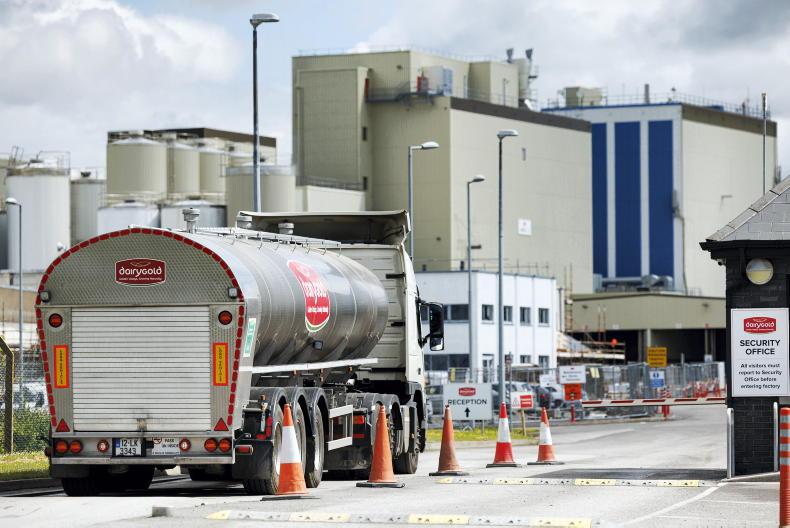
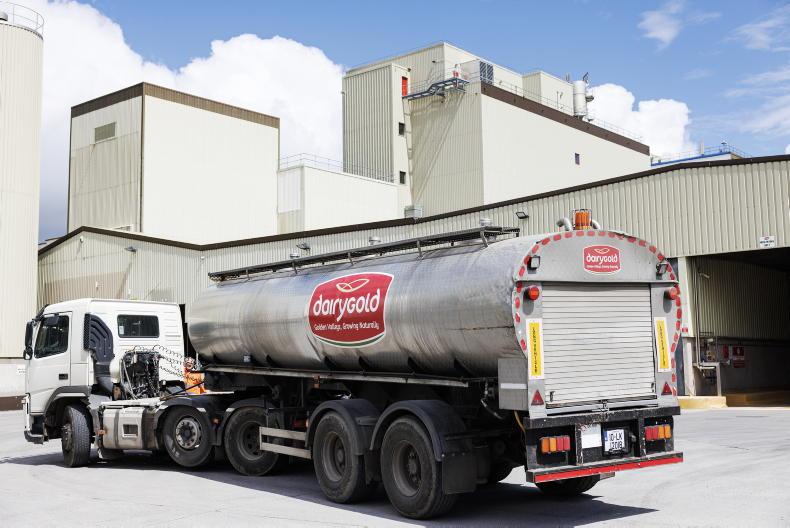
Unloading milk at the Dairygold plant in Mitchelstown, Co Cork. \ Donal O'Leary
Comment
Perhaps the biggest surprise in Dairygold’s 2025 financial report is that it managed to make a profit all. The co-op’s business is fundamentally in supplying dairy ingredients, so it is almost fully exposed to global market prices. The crash in those prices in the second half of the year was a serious challenge for the co-op.
Other processors in the country have some shelter from those moves by having consumer businesses, or a more diversified portfolio of subsidiaries, or even large holdings of shares which provide cashflow through dividend payments.
While Dairygold’s diversification move in Vita Actives is still in its early stages, management remain very confident about the return over the coming years. However, what the co-op really needs is for an increase in the price of its key products on global markets and to get its debt levels under control.
While there are concerns over the outlook for dairy commodities as global milk supply growth remain strong, there are early signs that some products are starting to turn – particularly demineralised whey and skim milk powder.
For management at Dairygold, the exposure to global market prices means that maximising future profitability means maximising efficiency at the co-op and a strict control of costs. From speaking to both CEO Michael Harte and chair Pat Clancy, it is clear that this is where the focus is.
It is positive to see the drop in bank loans in 2025, and this fall will have to be repeated in future years. The cost of interest payments in 2025 was over €22m, which is the equivalent to around 1.5c/l of milk which was processed during the year.
In the short term, members may wish for there to be a focus on paying more for milk, but it would be everyone’s long-term interest to see that money going to future milk payments every year through a reduction in interest costs, rather than adding to banks’ already substantial profits year after year.
Dairygold’s financial results for 2025 show that the Munster co-op made a profit after tax of €1.4m, on turnover of €1,543m. Despite a 10% increase in turnover from the previous year, the profit after tax figure represents a 90% drop from 2024’s figure.
Members of the co-op supplied 1.44bn litres of milk for processing during the year, a 4% increase on 2024’s level. There was also an 0.8% year-on-year increase in milk solids which rose to 8.07% (3.68% protein and 4.39% butterfat). The total amount of milk processed was circa 1.5bn litres, when milk on behalf of other processors is included, which Dairygold said demonstrates the scale and efficiency of its processing facilities.
The average quoted base price for milk was 46.1c/l, including quality and grassroots payment plus VAT, which equates to a paid price of 53.8c/l, based on average solids as outlined above. This is an increase from the 52.1c/l price paid the previous year.
Tillage farmers delivered 106,000t of grain and beans to the co-op in 2025, with growers paid €188/t for barley and €198/t for wheat.
In total, the co-op said it paid close to €800m to members for milk and grain supplied during the year.
Dairygold CEO Michael Harte told the Irish Farmers Journal that “there were a lot of positives in 2025 for Dairygold, but there were also two negatives in the year. One was the significant decline in dairy markets which happened from August and had a significant impact on Dairygold’s financial results. The other was in tillage where the returns for growers was a real challenge in 2025. That is on the back of a number of years of challenges for the sector and the outlook for 2026 also a challenge”.
He added that Dairygold remains a supporter of its growers and the industry and that tillage farmers are very important for the co-op which is a big user of native grain.
“Overall, we feel that we have delivered a resilient financial performance,” he said. “Dairy markets from August onwards declined significantly and our exposure to cheese was the biggest factor in relation to our results.”
He said that the co-op had to balance the plunge in cheese prices with the price it was paying members for their milk.
“You can see in the results, at the bottom line, we generated a marginal level of profit after tax. We generated an EBITDA (earnings before interest, taxation, depreciation and amortisation) of €52.7m, back €12.7m, which is all down to dairy markets.”
Harte did add that he was generally pleased with the performance of the business during 2025.
“Generally, everything was good, with the exception of cheese, and that was the key factor and the key challenge we had in our business. Dairy markets from the end of August had an impact of about €70m on us.
“We recovered about €45m in milk price with [the balance of] €25m in a reduced level of profitability and a milk-price relativity challenge.”
Looking at the balance sheet of the co-op, net bank debt at the end of the year was at €135.3m, a €22m decrease over the 12 months.
This gave Dairygold a net bank debt to EBIDTA ratio of 2.6 times.
The net asset value of the society decreased by €44.3m to €422.4m, primarily driven by the valuation of the ‘put’ liability of €39.9m which relates to the future acquisition of the remaining 41% shareholding in Vita Actives.
Under accountancy rules the co-op had to recognise the estimated present value of the future acquisition of the outstanding share capital of Vita Actives.
Harte said that the option to purchase the balance of Vita Actives “will happen sometime between now and the 2030s” and that it is dependent on a number of metrics including the level of earnings.
“Our expectation is that this won’t crystalise for another two years.”
Sales
The co-op sold its Creamfields site in Cork in August 2025, generating proceeds of €25.6m, which it said were used to reduce net debt. Other properties sold during the year included sites in Killaloe, Co Clare, and Hollyford in Co Tipperary.
Planning permission was granted for a large-scale residential development at Parkmore Industrial Estate on the Long Mile Road in Dublin.
Dairygold said it is the intention to sell the property to a third party for further development. The profit and loss account for the co-op included an addition of €7.2m for the change in fair value of investment properties during the year, significantly related to the achievement of planning permission for that site.
Dairygold also sold other investments, with its holding of quoted shares ending the year at €2.8m, down from €16.3m at the start of 2025.
The annual report includes a note saying that the co-op would not have been able to attain the financial outcomes required under certain existing facility agreements with its banking syndicate, primarily due to the adverse market conditions during the year.
Agreement was reached with the long-standing banking syndicate prior to the end of the year, and the co-op has commenced a review of its banking facilities which is expected to conclude in the first half of 2026.
Peter O’Driscoll, interim chief financial officer, said: “These facilities will be more aligned to the co-op’s seasonal working capital requirements and provide flexibility to address global dairy market volatility.”
Optimisation
The ongoing business optimisation programme, launched last year, which is targeting €14m in cost savings to the end of 2027 “delivered €8.5m in savings in 2025”, Harte said. The programme to date has concentrated on driving efficiencies across the business from packing ingredients, energy consumables and across the whole supply chain.
“When we originally outlined the programme we were talking about potential headcount reductions and maybe potential store closures. We have made no decision in relation to store closures at this moment in time,” he said, adding that the position will be reviewed by the end of 2026.
A strategic review of Dairygold’s UK business is currently under way. While citing the profitability of both the formatted cheese business in Crewe and the soft cheese business in Leeds, the co-op notes that they operate in a challenging business environment and require on-going capital investment. The Crewe business, in particular, uses a significant amount of working capital.
“As a business, are need to ensure that we focus our resources in the right place for our members, so there is a review going on there, and that’s about as much as we’re going to say at this moment in time,” Harte said.
Dairygold dissolved its Chinese subsidiary Dairygold Asia Ltd in October 2025 following the failure of the Aerabo brand, launched in 2021 and expanded in 2023, to make headway into the market there. Dairygold still sells product into China though its agent in the country, Beijing Milkyway, with whom the co-op has been working for more than 25 years.
Outlook
Harte was significantly more positive about the outlook for Dairygold’s major diversification play, Vita Actives.
“It’s operating in a growth market, and is really benefitting from the health and wellness trends. Overall, the business is growing, we have opened up more sales offices across Europe and are mainly focused on the UK and European market. It’s a high margin business and it’s adding value for us, and we’re really focused on driving it on,” Harte said.
He added that Vita Actives remains profitable, and that the co-op is very happy with the performance of the investment.
Dairygold sales to Vita Actives during the year were just over half a million euro. The company provided a loan of €10m to Dairygold in 2025 on standard commercial terms, which Harte described as a cash management exercise.
Harte said that the key infrastructure investments “are now completed within Dairygold. The casein plant was the last investment. We commissioned that plant in 2025 and that allows us to put more milk into casein, which is the most profitable product that we have”.
He noted that as part of Dairygold’s demineralised whey facility, there is an investment being made which will allow the co-op to produce a small proportion of WPC (whey protein concentrate).
The average number of weekly employees at the co-op during 2025 was down 13 to 1,360, while total payroll costs remained relatively unchanged at €93.4m.
There was a €550,000 decrease in performance related pay to members of the senior management team in 2025 as there were no payments made under the annual performance bonus scheme.
Pat Clancy, chair of Dairygold, said “the business struggled and we didn’t hit our KPIs (key performance indicators).
“The senior leadership team agreed with [the board] that they would forego their bonuses because of the returns within the business”.
Unloading milk at the Dairygold plant in Mitchelstown, Co Cork. \ Donal O'Leary
Comment
Perhaps the biggest surprise in Dairygold’s 2025 financial report is that it managed to make a profit all. The co-op’s business is fundamentally in supplying dairy ingredients, so it is almost fully exposed to global market prices. The crash in those prices in the second half of the year was a serious challenge for the co-op.
Other processors in the country have some shelter from those moves by having consumer businesses, or a more diversified portfolio of subsidiaries, or even large holdings of shares which provide cashflow through dividend payments.
While Dairygold’s diversification move in Vita Actives is still in its early stages, management remain very confident about the return over the coming years. However, what the co-op really needs is for an increase in the price of its key products on global markets and to get its debt levels under control.
While there are concerns over the outlook for dairy commodities as global milk supply growth remain strong, there are early signs that some products are starting to turn – particularly demineralised whey and skim milk powder.
For management at Dairygold, the exposure to global market prices means that maximising future profitability means maximising efficiency at the co-op and a strict control of costs. From speaking to both CEO Michael Harte and chair Pat Clancy, it is clear that this is where the focus is.
It is positive to see the drop in bank loans in 2025, and this fall will have to be repeated in future years. The cost of interest payments in 2025 was over €22m, which is the equivalent to around 1.5c/l of milk which was processed during the year.
In the short term, members may wish for there to be a focus on paying more for milk, but it would be everyone’s long-term interest to see that money going to future milk payments every year through a reduction in interest costs, rather than adding to banks’ already substantial profits year after year.






SHARING OPTIONS