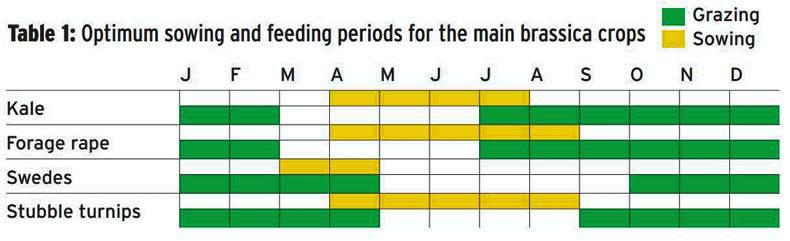
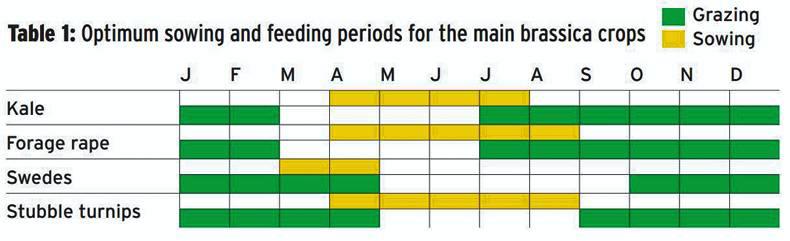
These can range from land availability and suitability to the type of crop and animal to be fed. The sowing dates for many of these crops has already passed or is approaching fast, as shown in Table 1 below. There are still limited opportunities for farmers to plant kale, with more opportunities for rape and stubble turnips or a kale/rape hybrid.
These crops can be used to graze animals over the winter and help conserve limited fodder supplies. Also, in the case of lambs and ewes especially, they can be used to help finish lambs.
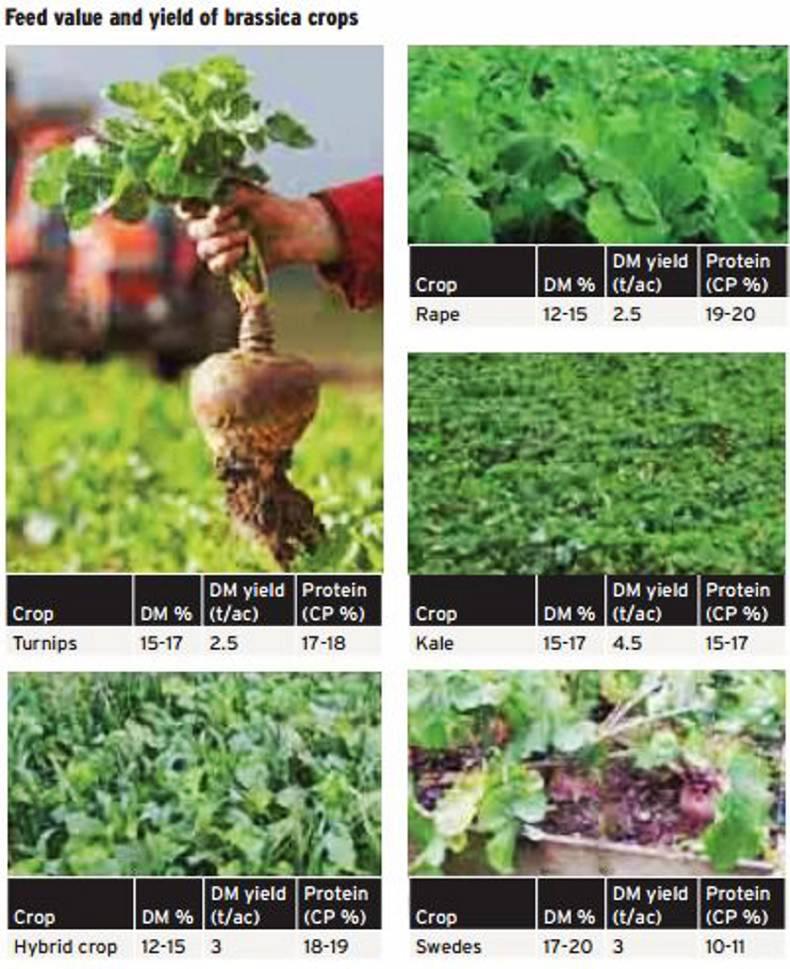
The advantages and disadvantages of each crop, and other relevant considerations, are summarised below.
ADVERTISEMENT
Managing and grazine forage crops
All forage crops are low in fibre and, as such, require animals to be supplemented. The general recommendation is to supplement about 25% of the diet with a fibre source.
Placing bales of silage or wrapped hay/straw strategically in the field will reduce soil traffic damage and compaction in the winter.
Mineral supplementation is required. Crops are low in magnesium, copper and iodine.
Introducing animals slowly and strip grazing is the preferred grazing method.
Variable in terms of labour needs.
Forage rape
Advantages
Can be sown later in the year eg. after a crop of winter barley, a wholecrop cereal or a late silage harvest.
Suitable for finishing lambs.
Known to take in a rougher seedbed and acts as a good crop to break up marginal grassland.
More suited to young stock than kale.
Disadvantages
Lower crop yield potential.
Less winter hardy and ideally should be grazed by the end of year.
Needs decent soil fertility.
Forage kale
Advantages
Little to no specialised equipment required.
Relatively easy to manage and graze.
It can be planted in late spring, thus allowing early grazing of grassland or silage harvesting before sowing.
Disadvantages
Needs rotation as consecutive growing will leave it susceptible to club root (a yield-robbing root disease).
May need active management in terms of herbicide and insecticide.
Planting after mid-June reduces yield potential.
Only suitable for dry free-draining soils as normally grazed in situ.
Forage turnips
Advantages
Like rape, provides a source of winter dry matter after a relatively short growing period, compared to Swedes.
Can be grazed in-situ or supplemented to animals.
Need decent soil fertility.
Can be sown later in the season meaning area is out of production for shorter timeframe.
Disadvantages
Utilisation can suffer if sown in heavy soils and more suitable to sheep than cattle.
This content is available to digital subscribers and loyalty code users only. Sign in to your account, use the code or subscribe to get unlimited access.
The reader loyalty code gives you full access to the site from when you enter it until the following Wednesday at 9pm. Find your unique code on the back page of Irish Country Living every week.
CODE ACCEPTED
You have full access to the site until next Wednesday at 9pm.
CODE NOT VALID
Please try again or contact support.
These can range from land availability and suitability to the type of crop and animal to be fed. The sowing dates for many of these crops has already passed or is approaching fast, as shown in Table 1 below. There are still limited opportunities for farmers to plant kale, with more opportunities for rape and stubble turnips or a kale/rape hybrid.
These crops can be used to graze animals over the winter and help conserve limited fodder supplies. Also, in the case of lambs and ewes especially, they can be used to help finish lambs.
The advantages and disadvantages of each crop, and other relevant considerations, are summarised below.
Managing and grazine forage crops
All forage crops are low in fibre and, as such, require animals to be supplemented. The general recommendation is to supplement about 25% of the diet with a fibre source.
Placing bales of silage or wrapped hay/straw strategically in the field will reduce soil traffic damage and compaction in the winter.
Mineral supplementation is required. Crops are low in magnesium, copper and iodine.
Introducing animals slowly and strip grazing is the preferred grazing method.
Variable in terms of labour needs.
Forage rape
Advantages
Can be sown later in the year eg. after a crop of winter barley, a wholecrop cereal or a late silage harvest.
Suitable for finishing lambs.
Known to take in a rougher seedbed and acts as a good crop to break up marginal grassland.
More suited to young stock than kale.
Disadvantages
Lower crop yield potential.
Less winter hardy and ideally should be grazed by the end of year.
Needs decent soil fertility.
Forage kale
Advantages
Little to no specialised equipment required.
Relatively easy to manage and graze.
It can be planted in late spring, thus allowing early grazing of grassland or silage harvesting before sowing.
Disadvantages
Needs rotation as consecutive growing will leave it susceptible to club root (a yield-robbing root disease).
May need active management in terms of herbicide and insecticide.
Planting after mid-June reduces yield potential.
Only suitable for dry free-draining soils as normally grazed in situ.
Forage turnips
Advantages
Like rape, provides a source of winter dry matter after a relatively short growing period, compared to Swedes.
Can be grazed in-situ or supplemented to animals.
Need decent soil fertility.
Can be sown later in the season meaning area is out of production for shorter timeframe.
Disadvantages
Utilisation can suffer if sown in heavy soils and more suitable to sheep than cattle.
If you would like to speak to a member of our team, please call us on 01-4199525.
Link sent to your email address
We have sent an email to your address. Please click on the link in this email to reset your password. If you can't find it in your inbox, please check your spam folder. If you can't find the email, please call us on 01-4199525.
ENTER YOUR LOYALTY CODE:
The reader loyalty code gives you full access to the site from when you enter it until the following Wednesday at 9pm. Find your unique code on the back page of Irish Country Living every week.





SHARING OPTIONS