



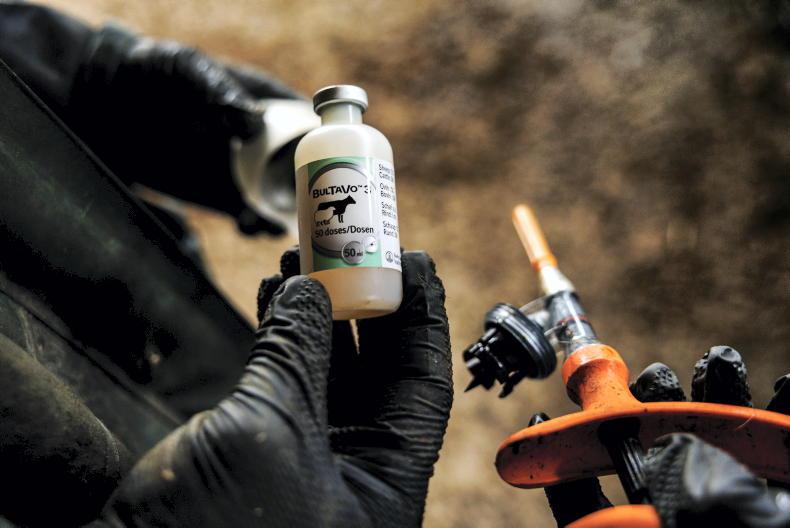
Delaying the administration of bluetongue virus serotype 3 (BTV-3) vaccines by a matter of mere weeks could be the difference between staving off the disease or facing massive losses from mortality.
That is the advice English farmer Jerry Sanders-Carr has for Irish farmers after he wrangled with the disease in August.
The advice follows the confirmation of clinical bluetongue 3 symptoms, including abortion, in cattle across at least three counties over recent weeks.
Sanders-Carr lost 15% of his ewes to bluetongue after vaccinating at the end of July in the belief that the vaccines would have sufficient time to take effect before the disease landed at his gate.
The virus did not affect rams or lambs to the same extent it did ewes on his farm.
“We vaccinated at the end of July and three or four days later, we started seeing clinical signs – ewes off their feet and just very depressed,” the north Devon-based farmer told the Irish Farmers Journal.
“The virus could have been here earlier but there were no clinical signs.”
The farmer expressed deep frustration with the speed of authorities’ sharing of information on the spread of the virus, saying that vaccination could have been done sooner had he known it was closer to his farm than data at the time suggested.
Once bluetongue strikes
The advice of Sanders-Carr for farmers in the throes of an outbreak is to “act quickly on treatment” and to remain aware of the many symptoms with which the virus can present itself.
“We were around the sheep three times a day going in with antibiotics and anti-inflammatories with anything that looked vaguely sore.”
He drew attention to the one ram the farm lost to the disease in underscoring the need for haste in treating the bluetongue virus.
“One morning, he just looked a little bit off-colour. We treated him immediately but he was gone by the afternoon. That is how quickly bluetongue kills.”
Although the flock’s body condition has recovered, the virus “stripped flesh off sheep”.
The flock did not witness many of the drooling mouth or swollen tongue-type symptoms typical of the disease.
Sanders-Carr reports that while the vaccine requires three weeks from administration to give its highest level coverage, from 10 days post-vaccination, his losses plummeted to zero.
Hotspots
It also appears that in virus hotspots in England, such as Devon, infected sheep were hit far worse than cattle.
The impact of infections on scanning and the success of calving or lambing post-infection will be slower to gauge.
Reports of low scanning percentages, deformed or stillborn calves and abortion are numerous as farmers learn how to deal with the virus.
For Sanders-Carr, a recent fertility scanning of 20 rams that were to be sold returned results of nine being infertile and two sub-fertile, representing another major loss of income due to the virus.




SHARING OPTIONS