Parklands Vets, Co Tyrone – in association with Provita – held a demonstration last week to discuss lameness problems on farm.
Over 70 farmers turned up to the farm of Ramsey and Henry Stewart near Stewartstown, Co Tyrone, to listen to Parklands vets explain the different issues associated with lameness in the dairy herd.
Vet Philip Abernethy opened the farm walk explaining why Parklands organised the walk and some of the key messages. He said: “The intention is to prevent rather than cure. We need to look at lameness in the herd a bit like we look at mastitis. For example, if you have digital dermatitis in your herd, all you can do is control it – you won’t get rid of it. The disease is spread by new and chronic cases and you have to talk about control rather than eradication.”
Philip further explained that when you lift a cow’s foot you are too late because the disease, at that stage, is causing the cow discomfort. He suggested you need a lameness plan for your herd from the calf stage right up to the milking cow stage. When cows are indoors all year round on slats and concrete, lameness can be a big issue, as the Parklands survey shows.
Mobility scoring
Demo one was led by vet David McKinstry and he explained what mobility scoring is all about. He said: “Over the last two weeks, we have mobility scored 13 farms around Northern Ireland and the results show there is quite a bit of lameness in herds that is going unseen.’’
So, why mobility score? The intention is to pick out how many lame cows are in each herd.
Scoring will allow you to do this and it will help to sharpen your focus on picking up lame cows earlier rather than later. How is it done? Ideally, watch from the side as the cows are passing or from behind as the cows walk away from you.
David said: “You will see cows with short strides – where the back foot is not landing where the front foot has taken off from, you will see a cow with uneven weight bearing and you will see cows humped up when they are walking.”
There are two main scoring systems used across the world; one is from zero to five and the other is from zero to three. The system of zero to three seems more common so David used that system and explained each score.
Score zero is a cow walking perfectly sound, with a nice stride and setting her back foot in the place where the front foot has just left. Score one is a cow which could be described as ‘a wee bit feely on her feet’. You can’t be sure what foot is causing the problem.Score two is a lame cow and it is possible to pick out which leg is lame.A score three cow is very lame and not able to keep up with the herd. The results of David’s visits on 13 farms can be seen in Figure 1. It shows that, on average, only 32% of cows in the survey herds scored zero or were completely sound when assessed. Another 30% were score one, which means cows were a little tender on their feet but exactly what foot is lame was not possible to distinguish simply by watching them walking. If these cows were lifted, it might be a small issue that would fix the problem.
These 13 farms were randomly chosen for the survey. The vet attended the best-performing farm on almost a monthly basis specifically for lameness treatment. We must remember on most of the farms cows are inside for at least six months of the year, usually from October to March at least.
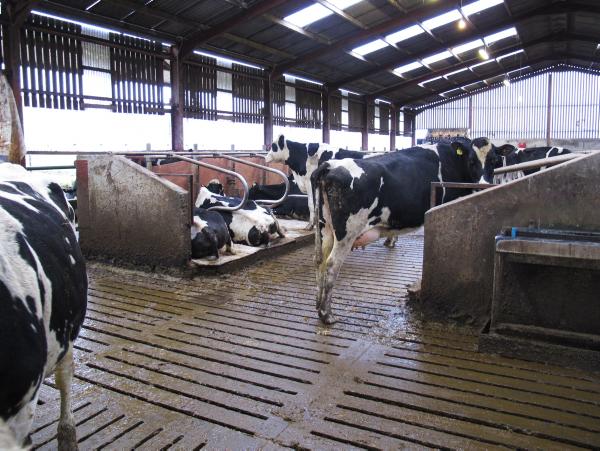
Hard concrete, slats and slurry are hard on cows’ hooves. Cows that are indoors for so long, no matter what the management, will have a higher incidence of lameness issues than cows that are out on paddocks more often. All farmers strive to keep yards scraped and slats clean, but no matter what happens, once indoors, cows’ hooves are always going to be wetter and have more access to slurry. This will induce more problems such as slurry heel and means disease, such as mortellaro/digital dermatitis, is easier to spread.
Watching and scoring your cows for mobility can help pick up cows before they actually go lame.
Footbath session
Vet John Grant and Tommy Armstrong from Provita led this demonstration. There were a couple of clear messages:
If you have a black plastic trough with grooves in the bottom, you are advised to change it because cows don’t like walking through these types of troughs with an uneven surface. Know the size of your footbath, so you can calculate the dilution rate (see Figure 2). Footbathing is like teat dipping. It’s not a treatment, it’s preventative. Remember, cows will kick out a few inches as they walk through so if you need 10cm then make up to 15cm because there needs to be 10cm at the end once all the cows have walked through.As a rule of thumb, there should be one litre for every cow passing. Therefore, for 100 cows going through it twice in one day, you need 200 litres at least in the footbath. What to use: All products will work if used properly at the right dilution rate and if the bath is kept clean. Farmers at this walk were either using copper sulphate, formaldehyde or Provita Hoofcare Endurance. Tommy said Provita Endurance can be used at a 3:1 dilution rate, if spot spraying. Trial results have shown an 85% reduction in active cases when this happens.
Digital dermatitis
Philip filled up a row of cows in the parlour and explained about identifying and treating digital dermatitis. Like mobility scoring, there are different stages of digital dermatitis and they are scored from zero to four.
Stage zero: The perfect cow; no skin reaction between the claws. Stage one: Not yet lame but some lesion on skin between claws.Stage two: Best described as like a red strawberry in between the claws at the back of the hoof and the strawberry can be the size of a fingernail or the size of the palm of your hand. At this stage, the cow is lame or will become lame very soon. Stage three: When there is acute erosion and a black colour on the hoof post treatment. It’s a bigger and uglier swelling on the skin of the foot close to the heel. Stage four: When there is a hard-wearing healing scab over the wound and when there is a real hard growth or a much larger growth. David said that, up to recently, some expected to be able to heal stage four cows. The thinking now is that once they are at stage four, the heel is thickened and they are almost impossible to heal. He said: “They are still spreading bacteria and this is what everyone should be trying to avoid through regular hoof baths and trimming.”
In terms of treatment, a number of farmers asked questions. David said: “Firstly, it is important to understand that footbathing is preventative and it will not cure digital dermatitis. Then, depending on the stage at which you identify digital dermatitis, treatment will be different.
‘‘If you diagnose stage one early, a continuous spot spray with an aerosol, terramycin or oxytetracycline or the application of a gel will normally cure. It’s not difficult to cure if caught early. If it’s a bit more advanced (stage two onwards) then, on assessment, we might have to bandage the hoof with Lincospectin powder and perhaps also use an injectable antibiotic,” David concluded.
Parklands Veterinary Group comprises 26 vets working across four branches – Aughnacloy, Coalisland, Cookstown and Dungannon – in Northern Ireland. Twenty-one vets work primarily on the farm-vet rota, offering a comprehensive service across all farm species, including sick calls, routine work, certification and TB testing across mid-Ulster. The practice also provides specialist veterinary services to equine, sheep and cattle (such as fertility, AI and embryo transfer), as well as investigative and diagnostic work to pig and poultry clients across Northern Ireland.
Parklands is unique in that it is the only practice with LANTRA-accredited educational trainers in Northern Ireland delivering a variety of courses covering a range of farm species. Events, such as the one held at Stewartstown, are used to optimise the level of service available to clients.
Parklands Vets, Co Tyrone – in association with Provita – held a demonstration last week to discuss lameness problems on farm.
Over 70 farmers turned up to the farm of Ramsey and Henry Stewart near Stewartstown, Co Tyrone, to listen to Parklands vets explain the different issues associated with lameness in the dairy herd.
Vet Philip Abernethy opened the farm walk explaining why Parklands organised the walk and some of the key messages. He said: “The intention is to prevent rather than cure. We need to look at lameness in the herd a bit like we look at mastitis. For example, if you have digital dermatitis in your herd, all you can do is control it – you won’t get rid of it. The disease is spread by new and chronic cases and you have to talk about control rather than eradication.”
Philip further explained that when you lift a cow’s foot you are too late because the disease, at that stage, is causing the cow discomfort. He suggested you need a lameness plan for your herd from the calf stage right up to the milking cow stage. When cows are indoors all year round on slats and concrete, lameness can be a big issue, as the Parklands survey shows.
Mobility scoring
Demo one was led by vet David McKinstry and he explained what mobility scoring is all about. He said: “Over the last two weeks, we have mobility scored 13 farms around Northern Ireland and the results show there is quite a bit of lameness in herds that is going unseen.’’
So, why mobility score? The intention is to pick out how many lame cows are in each herd.
Scoring will allow you to do this and it will help to sharpen your focus on picking up lame cows earlier rather than later. How is it done? Ideally, watch from the side as the cows are passing or from behind as the cows walk away from you.
David said: “You will see cows with short strides – where the back foot is not landing where the front foot has taken off from, you will see a cow with uneven weight bearing and you will see cows humped up when they are walking.”
There are two main scoring systems used across the world; one is from zero to five and the other is from zero to three. The system of zero to three seems more common so David used that system and explained each score.
Score zero is a cow walking perfectly sound, with a nice stride and setting her back foot in the place where the front foot has just left. Score one is a cow which could be described as ‘a wee bit feely on her feet’. You can’t be sure what foot is causing the problem.Score two is a lame cow and it is possible to pick out which leg is lame.A score three cow is very lame and not able to keep up with the herd. The results of David’s visits on 13 farms can be seen in Figure 1. It shows that, on average, only 32% of cows in the survey herds scored zero or were completely sound when assessed. Another 30% were score one, which means cows were a little tender on their feet but exactly what foot is lame was not possible to distinguish simply by watching them walking. If these cows were lifted, it might be a small issue that would fix the problem.
These 13 farms were randomly chosen for the survey. The vet attended the best-performing farm on almost a monthly basis specifically for lameness treatment. We must remember on most of the farms cows are inside for at least six months of the year, usually from October to March at least.
Hard concrete, slats and slurry are hard on cows’ hooves. Cows that are indoors for so long, no matter what the management, will have a higher incidence of lameness issues than cows that are out on paddocks more often. All farmers strive to keep yards scraped and slats clean, but no matter what happens, once indoors, cows’ hooves are always going to be wetter and have more access to slurry. This will induce more problems such as slurry heel and means disease, such as mortellaro/digital dermatitis, is easier to spread.
Watching and scoring your cows for mobility can help pick up cows before they actually go lame.
Footbath session
Vet John Grant and Tommy Armstrong from Provita led this demonstration. There were a couple of clear messages:
If you have a black plastic trough with grooves in the bottom, you are advised to change it because cows don’t like walking through these types of troughs with an uneven surface. Know the size of your footbath, so you can calculate the dilution rate (see Figure 2). Footbathing is like teat dipping. It’s not a treatment, it’s preventative. Remember, cows will kick out a few inches as they walk through so if you need 10cm then make up to 15cm because there needs to be 10cm at the end once all the cows have walked through.As a rule of thumb, there should be one litre for every cow passing. Therefore, for 100 cows going through it twice in one day, you need 200 litres at least in the footbath. What to use: All products will work if used properly at the right dilution rate and if the bath is kept clean. Farmers at this walk were either using copper sulphate, formaldehyde or Provita Hoofcare Endurance. Tommy said Provita Endurance can be used at a 3:1 dilution rate, if spot spraying. Trial results have shown an 85% reduction in active cases when this happens.
Digital dermatitis
Philip filled up a row of cows in the parlour and explained about identifying and treating digital dermatitis. Like mobility scoring, there are different stages of digital dermatitis and they are scored from zero to four.
Stage zero: The perfect cow; no skin reaction between the claws. Stage one: Not yet lame but some lesion on skin between claws.Stage two: Best described as like a red strawberry in between the claws at the back of the hoof and the strawberry can be the size of a fingernail or the size of the palm of your hand. At this stage, the cow is lame or will become lame very soon. Stage three: When there is acute erosion and a black colour on the hoof post treatment. It’s a bigger and uglier swelling on the skin of the foot close to the heel. Stage four: When there is a hard-wearing healing scab over the wound and when there is a real hard growth or a much larger growth. David said that, up to recently, some expected to be able to heal stage four cows. The thinking now is that once they are at stage four, the heel is thickened and they are almost impossible to heal. He said: “They are still spreading bacteria and this is what everyone should be trying to avoid through regular hoof baths and trimming.”
In terms of treatment, a number of farmers asked questions. David said: “Firstly, it is important to understand that footbathing is preventative and it will not cure digital dermatitis. Then, depending on the stage at which you identify digital dermatitis, treatment will be different.
‘‘If you diagnose stage one early, a continuous spot spray with an aerosol, terramycin or oxytetracycline or the application of a gel will normally cure. It’s not difficult to cure if caught early. If it’s a bit more advanced (stage two onwards) then, on assessment, we might have to bandage the hoof with Lincospectin powder and perhaps also use an injectable antibiotic,” David concluded.
Parklands Veterinary Group comprises 26 vets working across four branches – Aughnacloy, Coalisland, Cookstown and Dungannon – in Northern Ireland. Twenty-one vets work primarily on the farm-vet rota, offering a comprehensive service across all farm species, including sick calls, routine work, certification and TB testing across mid-Ulster. The practice also provides specialist veterinary services to equine, sheep and cattle (such as fertility, AI and embryo transfer), as well as investigative and diagnostic work to pig and poultry clients across Northern Ireland.
Parklands is unique in that it is the only practice with LANTRA-accredited educational trainers in Northern Ireland delivering a variety of courses covering a range of farm species. Events, such as the one held at Stewartstown, are used to optimise the level of service available to clients.





SHARING OPTIONS