At Dairy Day 2025, the Irish Farmers Journal will be looking at how to build lower cost infrastructure which is a particularly hot topic at the moment across the industry, with the recent publication of the draft nitrates action programme.
This session is aimed at a farmer thinking about extra slurry storage or looking to develop additional facilities.
With tight margins, building expensive facilities will be out of reach of many farmers.
The landscape of building on farms has changed in recent years, with the cost of both labour and supplies having practically doubled.
Coupled with this, is the uncertainty that exists around derogation and the new slurry storage regulations.
This has left farmers cautious when considering any development work.
While we wait for confirmation on derogation status, the increase in slurry storage requirement has been announced for public consultation.
The proposed regulations would see storage increases of 21% for slurry and a 43% increase in soiled water storage.
To develop these additional facilities is not cheap and takes careful planning to ensure the investment is future proof and compliant.
The Irish Farmers Journal has assembled a panel of experts, that will discuss these potential developments and determine the best options that can be practically applied in any farm business.
Speaking on the panel we have Bertie Troy, managing director of Grasstec.
The Grasstec business is synonymous with all areas of the dairy farming from yard planning to livestock trading and infrastructure layout.
Bertie will be able to offer the audience an insight into the costs of different investments, the pros and cons of each based on his experience and a view of what the future might hold when it comes to regulatory changes.
Joining Bertie on the panel will be John Mulcahy, owner and director of Mulcahy Steel Ltd, a Cork based company that offers a start-to-finish service on all types of construction projects.
Designs
John has extensive experience in all types of agricultural builds, with new projects being completed every day. While a builder, John is also a dairy farmer with a substantial herd based in Conna, east Cork.
John will guide the audience through a breakdown of the costs for a number of different shed designs and builds on the day giving up-to-date pricing on the different specs.
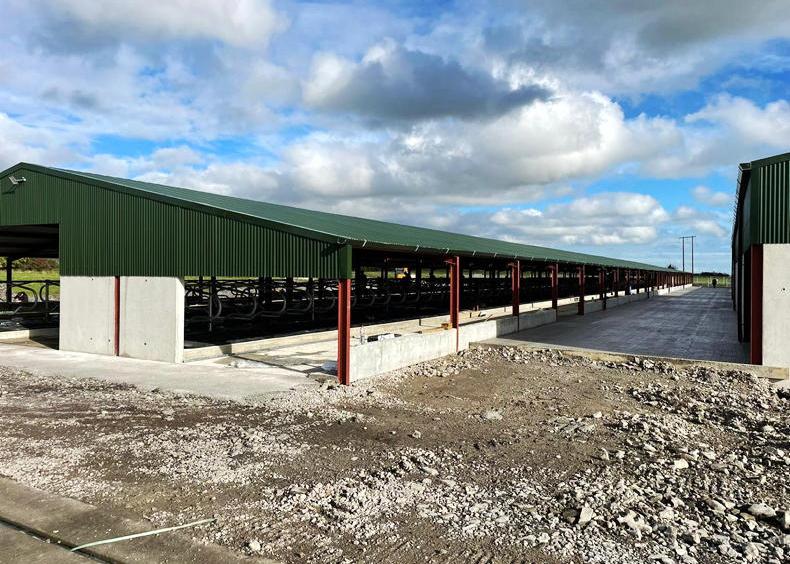
One of the shed designs that will be discussed on the day, is a low roof build that offers a cheaper alternative to a standard design, such as in the above photo.

Open slurry storage covering options.
While effectively commanding the same footprint as other sheds, the roof is much lower mening there is a lot less steel used in construction.
John and Bertie will compare the pricing of this particular shed to the more standard design and the discussion will involve audience interaction on the potential upsides and downsides of the build.
In terms of slurry storage, four types will be assessed; underground slatted tank, overground slurry store, lined lagoon and open concrete tank.
Each of the options will be priced with the pros and cons of each discussed.
At Dairy Day 2025, the Irish Farmers Journal will be looking at how to build lower cost infrastructure which is a particularly hot topic at the moment across the industry, with the recent publication of the draft nitrates action programme.
This session is aimed at a farmer thinking about extra slurry storage or looking to develop additional facilities.
With tight margins, building expensive facilities will be out of reach of many farmers.
The landscape of building on farms has changed in recent years, with the cost of both labour and supplies having practically doubled.
Coupled with this, is the uncertainty that exists around derogation and the new slurry storage regulations.
This has left farmers cautious when considering any development work.
While we wait for confirmation on derogation status, the increase in slurry storage requirement has been announced for public consultation.
The proposed regulations would see storage increases of 21% for slurry and a 43% increase in soiled water storage.
To develop these additional facilities is not cheap and takes careful planning to ensure the investment is future proof and compliant.
The Irish Farmers Journal has assembled a panel of experts, that will discuss these potential developments and determine the best options that can be practically applied in any farm business.
Speaking on the panel we have Bertie Troy, managing director of Grasstec.
The Grasstec business is synonymous with all areas of the dairy farming from yard planning to livestock trading and infrastructure layout.
Bertie will be able to offer the audience an insight into the costs of different investments, the pros and cons of each based on his experience and a view of what the future might hold when it comes to regulatory changes.
Joining Bertie on the panel will be John Mulcahy, owner and director of Mulcahy Steel Ltd, a Cork based company that offers a start-to-finish service on all types of construction projects.
Designs
John has extensive experience in all types of agricultural builds, with new projects being completed every day. While a builder, John is also a dairy farmer with a substantial herd based in Conna, east Cork.
John will guide the audience through a breakdown of the costs for a number of different shed designs and builds on the day giving up-to-date pricing on the different specs.
One of the shed designs that will be discussed on the day, is a low roof build that offers a cheaper alternative to a standard design, such as in the above photo.
Open slurry storage covering options.
While effectively commanding the same footprint as other sheds, the roof is much lower mening there is a lot less steel used in construction.
John and Bertie will compare the pricing of this particular shed to the more standard design and the discussion will involve audience interaction on the potential upsides and downsides of the build.
In terms of slurry storage, four types will be assessed; underground slatted tank, overground slurry store, lined lagoon and open concrete tank.
Each of the options will be priced with the pros and cons of each discussed.







SHARING OPTIONS