Determining the volume of fertiliser a farmer is allowed to apply on an annual basis has become a tricky task, with significant changes introduced in recent years.
A number of changes were introduced under the fifth Nitrates Action Plan (NAP), which farmers are still coming to terms with, while more have been introduced since 1 January under the sixth NAP, and mainly affect dairy farmers.
There is also a spotlight on volumes of fertiliser applied, with the National Fertiliser Database providing an account of fertiliser purchases and fertiliser use.
Phosphorus limits
This article focuses on fertiliser allowances for grassland, with a different set of allowances for tillage crops.
For many livestock farmers phosphorus (P) allowances are much more limiting than nitrogen allowances. There are two critical pieces of information required when determining allowances – the farm’s stocking rate in the previous calendar year and soil analysis results.
The previous year’s stocking rate can be accessed through your Myagfood.ie account. Soil samples also have a lifespan for nitrates purposes of four years.
Where soil samples are not available, then farms with a grassland stocking rate in excess of 130kg organic nitrogen (N)/ha in 2025 must assume index 4 for P. It is important to stress that this means such farms will have no allowance to purchase fertiliser containing P.
Farms with a grassland stocking rate of less than 130kg organic N/ha must assume index 3 for P in the absence of soil samples. Table 1 details the permitted levels of P for grassland farmers with livestock.
Account should also be taken of the level of concentrates fed, as this may also further reduce allowances. An allowance of 300kg of concentrates can be fed per 92kg organic nitrogen produced in the previous year, but for each tonne of concentrate fed above this level, then the available P allowance must be reduced by 5kg – unless a P analysis of the concentrate determines otherwise.
There are different allowances for farming enterprises with no livestock, which are primarily based on producing grass-based forage crops for sale and these are detailed in Table 5. It is also important to add that phosphorus imported on to the farm via organic manures must be deducted from the farm’s allowance.
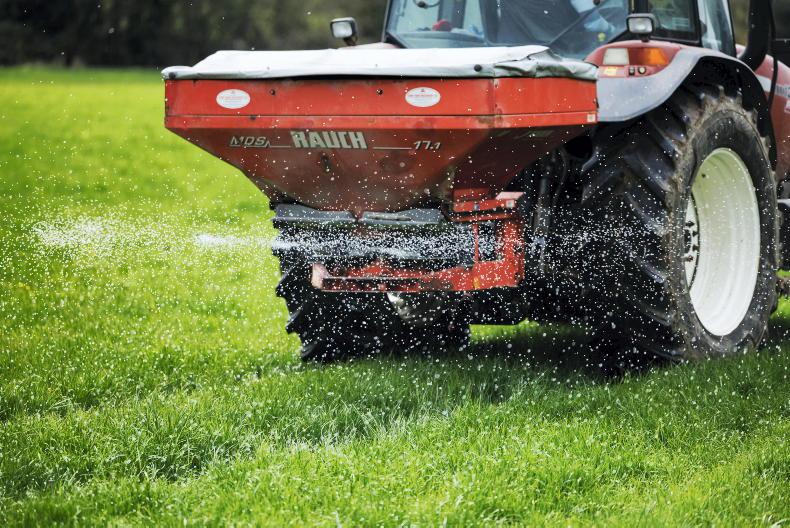
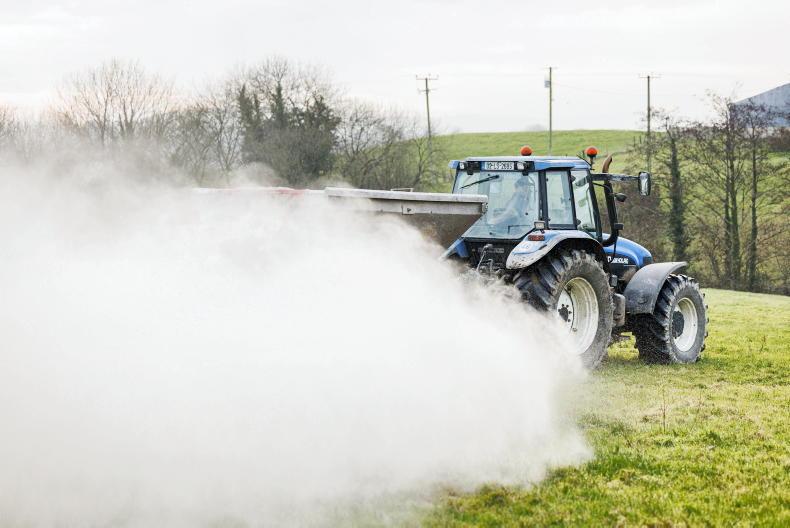
New nitrogen allowances have been introduced for farmers with no livestock or a low stocking rate and selling grass-based forage and for dairy farmers on the milking platform. \ Donal O' Leary
P build-up
There is one other situation where P limits may differ, termed the P build-up allowance, that allows grassland farmers stocked at greater than 130kg organic N/ha to apply additional phosphorus fertiliser to improve soil fertility.
The measure is aimed at improving nitrogen use efficiency, along with providing a more favourable environment for actions such as incorporating clover. As demonstrated in Table 2, the measure permits a higher P allowance on Index 1 and 2 soils.
Farmers wishing to avail of such a measure must submit a nutrient management plan prepared by a Farm Advisory Service (FAS) adviser. Soil analysis is a requirement as is determining the soil organic matter content. The latter ensures excessive levels of P are not applied to organic soils such as peat soils.
Nitrogen allowances
A new chemical nitrogen stocking rate category was introduced in 2025 for grassland farmers with a stocking rate of less than 85kg N/ha, with the maximum volume of available nitrogen permitted set at 90kg/ha. This is detailed in Table 3, with additional regulations specific to nitrogen allowances detailed in the footnotes for Table 3.
There is new nitrogen allowances on holdings where hay or silage is being cut for sale where no livestock are present, or a previous year grassland stocking rate of
There is also a new minefield to contend with in 2026 for dairy farmers concerning nitrogen allowances on the milking platform. These allowances are based on the stocking rate and movement of organic nitrogen to lands outside the milking platform. Advisers are still coming to terms with these regulations, not to mind farmers, with the new criteria detailed in Table 6.
Footnotes for Tables 1, 2 and 5
1. Total annual nitrogen (kg) excreted by grazing livestock averaged over the eligible grassland area (grazing and silage area). Stocking rate refers to grassland area only.
2. The fertilisation rates for soils which have more than 20% organic matter shall not exceed the amounts permitted for Index 3 soils, subject to the provisions in Article 16(3)(f).
3. Manure produced by grazing livestock on a holding may be applied to index 4 soils on that holding in a situation where there is a surplus of such manure remaining after the phosphorus fertilisation needs of all crops on soils at phosphorus indices 1, 2 or 3 on the holding have been met by the use only of such manure produced on the holding.
4. The maximum phosphorus/nitrogen fertilisation of grassland shall not exceed that specified for stocking rates less than or equal to 170kg/ha/year unless a minimum of 5% of the eligible area of the holding is used to grow crops other than grass or a derogation applies in respect of the holding. For Table 3, for a new derogation applicant they may apply the derogation rate of 225kg/ha for the first year only and from year two onwards must use rates as per stocking rate on the holding.
5. This table does not imply any departure from Article 20(1) which prohibits the application to land on a holding of livestock manure in amounts which exceed 170kg nitrogen per hectare per year, including that deposited by the animals themselves (or 250kg in the case of a holding to which a derogation has been granted in accordance with the Nitrates Directive).
6. An additional 15kg of phosphorus per hectare may be applied on soils at phosphorus indices 1, 2, or 3 for each hectare of pasture establishment undertaken.
Footnotes for Table 5 only
7. The fertilisation rates apply to grassland where there is no grazing livestock on the holding and also to those areas of farms where hay or silage is produced for sale off the holding on farms stocked <85kg grassland stocking rate.
Footnotes for Table 3 only
1. Total annual nitrogen (kg) excreted by grazing livestock averaged over the eligible grassland area (ha). Stocking rate refers to grassland area only.
2. The maximum nitrogen fertilisation of grassland shall not exceed that specified for stocking rates less than or equal to 170 kg/ha/year unless a minimum of 5% of the eligible area of the holding is used to grow crops other than grass, or a derogation applies in respect of the holding. Where a derogation applies on the holding derogation rates apply based on stocking rate of the holding. For a new derogation applicant they may apply the derogation rate of 214 kg/ha for the first year only, and from year two onwards must use rates as per the previous year’s Grassland Stocking Rate on the holding.
3. This table does not imply any departure from Article 20(1) which prohibits the application to land on a holding of livestock manure in amounts which exceed 170kg nitrogen per hectare per year, including that deposited by the animals themselves (or the appropriate higher limit in the case of a holding to which a derogation has been granted (as per the nitrates directive).
4. These fertilisation rates are only applicable where the fertiliser type specified by the Minister for Agriculture, Food and the Marine is used.
5. The application of nitrogen from livestock manure (including that deposited by the animals themselves) to the eligible grassland area shall not exceed the maximum allowable nitrogen per hectare per year, as appropriate, in the case of a holding to which a derogation has been granted, in accordance with the nitrates directive.
Footnotes for Table 6 only
1. The milking platform stocking rate for the year 2026 will be based on the current year. For subsequent years, it will be based on the preceding year’s milking platform stocking rate. For new dairy entrants it will be based on the current year.
2. Kg of organic N/ha of land constituting the milking platform, that shall be moved in the form of organic manure collected from the dairy cow during the year.
3. The chemical nitrogen allowance on a per hectare basis for the milking platform shall not exceed the holding’s overall chemical nitrogen allowance on a per hectare basis as set out in Table 6.
Determining the volume of fertiliser a farmer is allowed to apply on an annual basis has become a tricky task, with significant changes introduced in recent years.
A number of changes were introduced under the fifth Nitrates Action Plan (NAP), which farmers are still coming to terms with, while more have been introduced since 1 January under the sixth NAP, and mainly affect dairy farmers.
There is also a spotlight on volumes of fertiliser applied, with the National Fertiliser Database providing an account of fertiliser purchases and fertiliser use.
Phosphorus limits
This article focuses on fertiliser allowances for grassland, with a different set of allowances for tillage crops.
For many livestock farmers phosphorus (P) allowances are much more limiting than nitrogen allowances. There are two critical pieces of information required when determining allowances – the farm’s stocking rate in the previous calendar year and soil analysis results.
The previous year’s stocking rate can be accessed through your Myagfood.ie account. Soil samples also have a lifespan for nitrates purposes of four years.
Where soil samples are not available, then farms with a grassland stocking rate in excess of 130kg organic nitrogen (N)/ha in 2025 must assume index 4 for P. It is important to stress that this means such farms will have no allowance to purchase fertiliser containing P.
Farms with a grassland stocking rate of less than 130kg organic N/ha must assume index 3 for P in the absence of soil samples. Table 1 details the permitted levels of P for grassland farmers with livestock.
Account should also be taken of the level of concentrates fed, as this may also further reduce allowances. An allowance of 300kg of concentrates can be fed per 92kg organic nitrogen produced in the previous year, but for each tonne of concentrate fed above this level, then the available P allowance must be reduced by 5kg – unless a P analysis of the concentrate determines otherwise.
There are different allowances for farming enterprises with no livestock, which are primarily based on producing grass-based forage crops for sale and these are detailed in Table 5. It is also important to add that phosphorus imported on to the farm via organic manures must be deducted from the farm’s allowance.
New nitrogen allowances have been introduced for farmers with no livestock or a low stocking rate and selling grass-based forage and for dairy farmers on the milking platform. \ Donal O' Leary
P build-up
There is one other situation where P limits may differ, termed the P build-up allowance, that allows grassland farmers stocked at greater than 130kg organic N/ha to apply additional phosphorus fertiliser to improve soil fertility.
The measure is aimed at improving nitrogen use efficiency, along with providing a more favourable environment for actions such as incorporating clover. As demonstrated in Table 2, the measure permits a higher P allowance on Index 1 and 2 soils.
Farmers wishing to avail of such a measure must submit a nutrient management plan prepared by a Farm Advisory Service (FAS) adviser. Soil analysis is a requirement as is determining the soil organic matter content. The latter ensures excessive levels of P are not applied to organic soils such as peat soils.
Nitrogen allowances
A new chemical nitrogen stocking rate category was introduced in 2025 for grassland farmers with a stocking rate of less than 85kg N/ha, with the maximum volume of available nitrogen permitted set at 90kg/ha. This is detailed in Table 3, with additional regulations specific to nitrogen allowances detailed in the footnotes for Table 3.
There is new nitrogen allowances on holdings where hay or silage is being cut for sale where no livestock are present, or a previous year grassland stocking rate of
There is also a new minefield to contend with in 2026 for dairy farmers concerning nitrogen allowances on the milking platform. These allowances are based on the stocking rate and movement of organic nitrogen to lands outside the milking platform. Advisers are still coming to terms with these regulations, not to mind farmers, with the new criteria detailed in Table 6.
Footnotes for Tables 1, 2 and 5
1. Total annual nitrogen (kg) excreted by grazing livestock averaged over the eligible grassland area (grazing and silage area). Stocking rate refers to grassland area only.
2. The fertilisation rates for soils which have more than 20% organic matter shall not exceed the amounts permitted for Index 3 soils, subject to the provisions in Article 16(3)(f).
3. Manure produced by grazing livestock on a holding may be applied to index 4 soils on that holding in a situation where there is a surplus of such manure remaining after the phosphorus fertilisation needs of all crops on soils at phosphorus indices 1, 2 or 3 on the holding have been met by the use only of such manure produced on the holding.
4. The maximum phosphorus/nitrogen fertilisation of grassland shall not exceed that specified for stocking rates less than or equal to 170kg/ha/year unless a minimum of 5% of the eligible area of the holding is used to grow crops other than grass or a derogation applies in respect of the holding. For Table 3, for a new derogation applicant they may apply the derogation rate of 225kg/ha for the first year only and from year two onwards must use rates as per stocking rate on the holding.
5. This table does not imply any departure from Article 20(1) which prohibits the application to land on a holding of livestock manure in amounts which exceed 170kg nitrogen per hectare per year, including that deposited by the animals themselves (or 250kg in the case of a holding to which a derogation has been granted in accordance with the Nitrates Directive).
6. An additional 15kg of phosphorus per hectare may be applied on soils at phosphorus indices 1, 2, or 3 for each hectare of pasture establishment undertaken.
Footnotes for Table 5 only
7. The fertilisation rates apply to grassland where there is no grazing livestock on the holding and also to those areas of farms where hay or silage is produced for sale off the holding on farms stocked <85kg grassland stocking rate.
Footnotes for Table 3 only
1. Total annual nitrogen (kg) excreted by grazing livestock averaged over the eligible grassland area (ha). Stocking rate refers to grassland area only.
2. The maximum nitrogen fertilisation of grassland shall not exceed that specified for stocking rates less than or equal to 170 kg/ha/year unless a minimum of 5% of the eligible area of the holding is used to grow crops other than grass, or a derogation applies in respect of the holding. Where a derogation applies on the holding derogation rates apply based on stocking rate of the holding. For a new derogation applicant they may apply the derogation rate of 214 kg/ha for the first year only, and from year two onwards must use rates as per the previous year’s Grassland Stocking Rate on the holding.
3. This table does not imply any departure from Article 20(1) which prohibits the application to land on a holding of livestock manure in amounts which exceed 170kg nitrogen per hectare per year, including that deposited by the animals themselves (or the appropriate higher limit in the case of a holding to which a derogation has been granted (as per the nitrates directive).
4. These fertilisation rates are only applicable where the fertiliser type specified by the Minister for Agriculture, Food and the Marine is used.
5. The application of nitrogen from livestock manure (including that deposited by the animals themselves) to the eligible grassland area shall not exceed the maximum allowable nitrogen per hectare per year, as appropriate, in the case of a holding to which a derogation has been granted, in accordance with the nitrates directive.
Footnotes for Table 6 only
1. The milking platform stocking rate for the year 2026 will be based on the current year. For subsequent years, it will be based on the preceding year’s milking platform stocking rate. For new dairy entrants it will be based on the current year.
2. Kg of organic N/ha of land constituting the milking platform, that shall be moved in the form of organic manure collected from the dairy cow during the year.
3. The chemical nitrogen allowance on a per hectare basis for the milking platform shall not exceed the holding’s overall chemical nitrogen allowance on a per hectare basis as set out in Table 6.






SHARING OPTIONS