Follow best practice when it comes to handling fertiliser during the spreading season. \ Odhran Ducie
ADVERTISEMENT
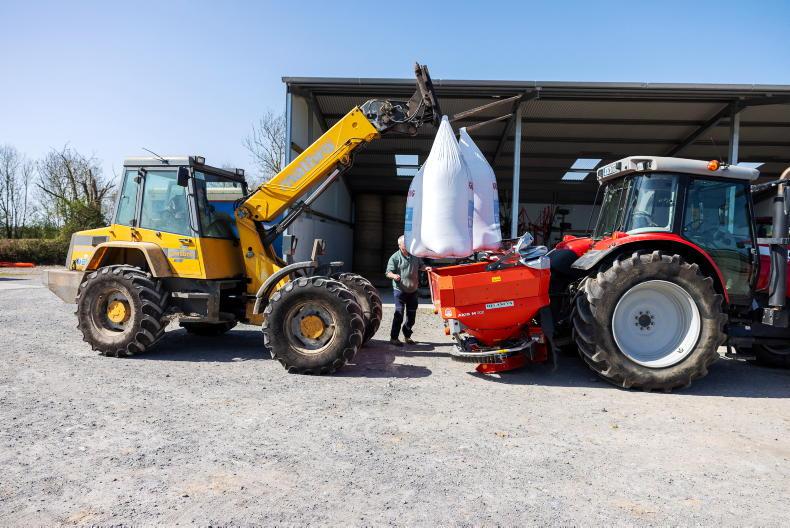
Fertiliser plays a vital role in crop nutrition and productivity, but improper handling can pose risks to safety and the environment. Farmers should follow best practices to ensure safe storage, application and disposal of fertilisers. Fertiliser spreading involves hazardous tasks, including tractor and machine operation, mechanically or physically lifting loads and handling chemical substances. Identifying hazards and controlling risks is crucial to prevent injury and ill health.
General safety principles
Wear protective gear: always use gloves, long sleeves, and eye protection when handling fertilisers to prevent skin irritation and accidental contact. Take steps to avoid direct contact of fertiliser products with skin and eyes. The corrosive nature of fertiliser can irritate skin especially where you have cuts or grazes. Always wear appropriate protective gloves when exposed to fertiliser.
Avoid inhalation: fertiliser dust or vapours can irritate the respiratory system. Use masks when handling powdered products.
Keep away from children and animals: store fertilisers in a secure, dry location away from living areas and feed storage. Avoid exposure to moisture, as fertiliser, especially urea, is highly hygroscopic and will absorb water, reducing its effectiveness.
Ensure all farm workers are trained in safe handling procedures: follow manufacturer instructions and local regulations for fertiliser use and storage.
Spreading equipment
ADVERTISEMENT
It is important to carry out a thorough check of your fertiliser spreader. Check the general structural integrity of the machine. While this will vary from machine to machine the following should be checked:
Tractors forward speed and PTO speed indicators working or tachometer working with speed chart.
Adequate front ballast for stability.
Spreader attached securely to tractor; level from side to side and centred (link arm stabilisers); top link in correct position to minimise spreader angle changes and correct length for required spreader angle.
Lift controls set to allow correct disc height (as determined by the manufacturer) from crop or ground.
PTO guard intact and secure and all other guards in place.
Check vanes, discs, agitators and shutters/outlets for wear.
Lubricate as per instruction manual.
Register for free to read this story and our free stories.
This content is available to digital subscribers and loyalty code users only. Sign in to your account, use the code or subscribe to get unlimited access.
The reader loyalty code gives you full access to the site from when you enter it until the following Wednesday at 9pm. Find your unique code on the back page of Irish Country Living every week.
CODE ACCEPTED
You have full access to the site until next Wednesday at 9pm.
CODE NOT VALID
Please try again or contact support.
Fertiliser plays a vital role in crop nutrition and productivity, but improper handling can pose risks to safety and the environment. Farmers should follow best practices to ensure safe storage, application and disposal of fertilisers. Fertiliser spreading involves hazardous tasks, including tractor and machine operation, mechanically or physically lifting loads and handling chemical substances. Identifying hazards and controlling risks is crucial to prevent injury and ill health.
General safety principles
Wear protective gear: always use gloves, long sleeves, and eye protection when handling fertilisers to prevent skin irritation and accidental contact. Take steps to avoid direct contact of fertiliser products with skin and eyes. The corrosive nature of fertiliser can irritate skin especially where you have cuts or grazes. Always wear appropriate protective gloves when exposed to fertiliser.
Avoid inhalation: fertiliser dust or vapours can irritate the respiratory system. Use masks when handling powdered products.
Keep away from children and animals: store fertilisers in a secure, dry location away from living areas and feed storage. Avoid exposure to moisture, as fertiliser, especially urea, is highly hygroscopic and will absorb water, reducing its effectiveness.
Ensure all farm workers are trained in safe handling procedures: follow manufacturer instructions and local regulations for fertiliser use and storage.
Spreading equipment
It is important to carry out a thorough check of your fertiliser spreader. Check the general structural integrity of the machine. While this will vary from machine to machine the following should be checked:
Tractors forward speed and PTO speed indicators working or tachometer working with speed chart.
Adequate front ballast for stability.
Spreader attached securely to tractor; level from side to side and centred (link arm stabilisers); top link in correct position to minimise spreader angle changes and correct length for required spreader angle.
Lift controls set to allow correct disc height (as determined by the manufacturer) from crop or ground.
PTO guard intact and secure and all other guards in place.
Check vanes, discs, agitators and shutters/outlets for wear.
If you would like to speak to a member of our team, please call us on 01-4199525.
Link sent to your email address
We have sent an email to your address. Please click on the link in this email to reset your password. If you can't find it in your inbox, please check your spam folder. If you can't find the email, please call us on 01-4199525.
ENTER YOUR LOYALTY CODE:
The reader loyalty code gives you full access to the site from when you enter it until the following Wednesday at 9pm. Find your unique code on the back page of Irish Country Living every week.







SHARING OPTIONS