Methane emissions from enteric fermentation, a natural by-product of feed digestion in cattle and sheep, account for the majority of greenhouse gas (GHG) emissions from the Irish livestock sector.
In recent years, research has focused on identifying measures to reduce methane emissions specific to Irish conditions.
Methane emission solutions
Feed additives
Feed additives have been widely researched as a means of reducing methane emissions from ruminant livestock.
Several additives have demonstrated promising results when fed in indoor systems, where they can be mixed into conserved forage and consumed within every mouthful of feed.
Under these conditions, methane reductions of more than 20% have been reported when compared to diets without additives.
However, delivering feed additives in grazing environments presents significant challenges. At present the most applicable method of administering additives in grazing systems is through incorporation into concentrate feed.
Generally, the reductions achieved under these conditions have been moderate to low. The only notable additive to show substantial reductions at grazing being red seaweed (~20%), although its commercial availability at present is limited.
Meaning at present, the winter housing period when animals are fed conserved forage offers the main opportunity to achieve substantial methane reductions using feed additives under Irish conditions.
Grazing management and sward type
Improving forage quality through good grazing management also has an important role to play in reducing methane emissions.
Research in dairy systems has shown that high-quality spring grass, which is more digestible and lower in fibre, can lead to large reductions in methane emissions than summer and autumn grass. Reducing silage feeding during spring further improves diet digestibility.
Therefore, getting animals out to grass earlier in spring and reducing silage supplementation all help to reduce methane emissions.
During the main grazing season, methane emissions per litre of milk on dairy farms and per unit of daily gain on dry stock farms can be lowered by maintaining highly digestible swards.
This can be achieved by targeting optimal pre-grazing covers of around 1,400 kg DM/ha.
On dry stock farms the increased animal performance associated with improved sward quality can also reduce the number of days to slaughter, leading to lower lifetime emissions per animal.
Maintaining grass quality also reduces the need for concentrate supplementation, thereby cutting the off-farm emissions associated with the growth, manufacture, and transport of these feeds.
Studies comparing animals grazing alternative sward species with those on grass-only swards have shown mixed results. For example, including clover in perennial ryegrass grazing swards has sometimes increased total methane output in dairy cows but reduced it in sheep.
The major environmental benefit of incorporating white clover into grazing swards is the displacement of nitrous oxide emissions associated with the application of synthetic fertilizer.
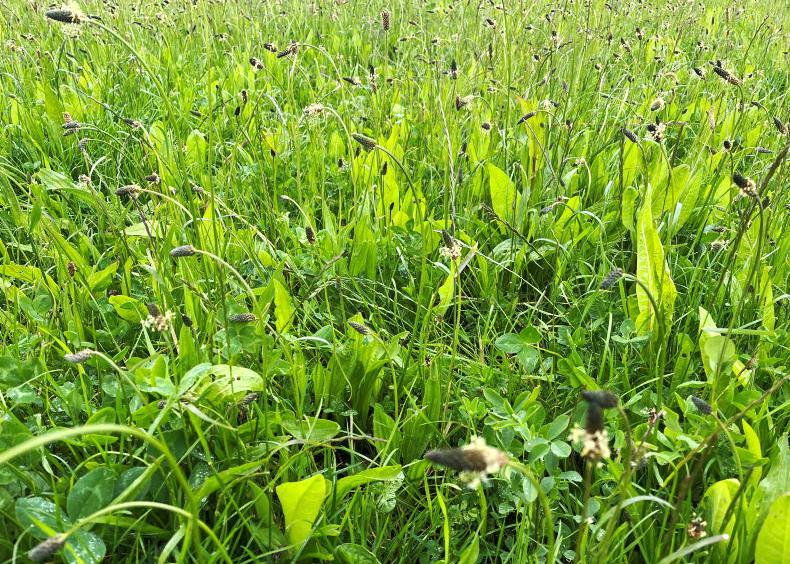
More recently, mixed-species swards containing grass, clover, plantain, and chicory have shown potential to reduce methane output in sheep systems and in dairy systems when emissions are expressed relative to milk production.
Whereas, research with beef cattle has shown no methane mitigating benefit of incorporating such sward species.
Animal breeding
Animal breeding offers a cumulative and permanent strategy to reduce methane emissions.
Research has shown that higher genetic merit dairy cows, sheep, and beef cattle produce less methane for every kilogram of milk or meat they generate compared to animals of lower genetic merit.
This is because high genetic merit animals convert feed into product more efficiently and tend to live and produce for longer periods. A carbon sub-index has also been introduced into the dairy and beef indexes and is being developed for sheep.
These sub-indexes rank animals based on their GHG emissions and indirectly reduce emissions by placing more emphasis on traits that reduce emissions such as days to slaughter, liveweight and calving interval while placing less emphasis on traits that increase emissions.
It may also be possible to directly select animals for lower methane output within the carbon sub-indexes in the future.
As research has also found that within a single group of animals, methane emissions can vary considerably between individuals.
In sheep and beef cattle, a significant portion of this variation is attributed to genetics, which has enabled for the development of breeding values for methane emissions.
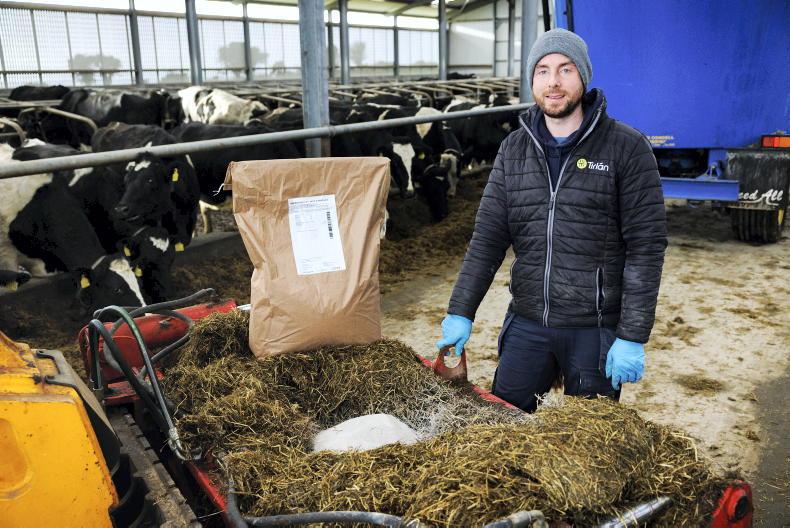
Shane Fitzgerald, Co Waterford adding Bovaer 3NOP methane inhibitor to a grab of silage before mixing it with with the rest of the silage in the diet feeder. Shane was feeding 120g per head to his cows and is one of eighteen Signpost farmers that fed the product to their cows to help reduce emissions. \ Donal O' Leary
While work is ongoing to develop breeding values for methane in dairy cows. The most effective methods of reducing enteric methane output on farm at present are through improved grazing management and selection for higher genetic merit animals.
Work is ongoing to improve the efficacy and practicality of feeding methane mitigating additives within pasture-based settings.
Feed additives at present are best suited to indoor conditions.Grassland management and sward type have a significant impact on enteric methane output.Breeding indexes are currently selecting for more environmentally efficient animals – it may also be possible to directly select for cattle and sheep with lower methane output within breeding indexes in the future.
Methane emissions from enteric fermentation, a natural by-product of feed digestion in cattle and sheep, account for the majority of greenhouse gas (GHG) emissions from the Irish livestock sector.
In recent years, research has focused on identifying measures to reduce methane emissions specific to Irish conditions.
Methane emission solutions
Feed additives
Feed additives have been widely researched as a means of reducing methane emissions from ruminant livestock.
Several additives have demonstrated promising results when fed in indoor systems, where they can be mixed into conserved forage and consumed within every mouthful of feed.
Under these conditions, methane reductions of more than 20% have been reported when compared to diets without additives.
However, delivering feed additives in grazing environments presents significant challenges. At present the most applicable method of administering additives in grazing systems is through incorporation into concentrate feed.
Generally, the reductions achieved under these conditions have been moderate to low. The only notable additive to show substantial reductions at grazing being red seaweed (~20%), although its commercial availability at present is limited.
Meaning at present, the winter housing period when animals are fed conserved forage offers the main opportunity to achieve substantial methane reductions using feed additives under Irish conditions.
Grazing management and sward type
Improving forage quality through good grazing management also has an important role to play in reducing methane emissions.
Research in dairy systems has shown that high-quality spring grass, which is more digestible and lower in fibre, can lead to large reductions in methane emissions than summer and autumn grass. Reducing silage feeding during spring further improves diet digestibility.
Therefore, getting animals out to grass earlier in spring and reducing silage supplementation all help to reduce methane emissions.
During the main grazing season, methane emissions per litre of milk on dairy farms and per unit of daily gain on dry stock farms can be lowered by maintaining highly digestible swards.
This can be achieved by targeting optimal pre-grazing covers of around 1,400 kg DM/ha.
On dry stock farms the increased animal performance associated with improved sward quality can also reduce the number of days to slaughter, leading to lower lifetime emissions per animal.
Maintaining grass quality also reduces the need for concentrate supplementation, thereby cutting the off-farm emissions associated with the growth, manufacture, and transport of these feeds.
Studies comparing animals grazing alternative sward species with those on grass-only swards have shown mixed results. For example, including clover in perennial ryegrass grazing swards has sometimes increased total methane output in dairy cows but reduced it in sheep.
The major environmental benefit of incorporating white clover into grazing swards is the displacement of nitrous oxide emissions associated with the application of synthetic fertilizer.
More recently, mixed-species swards containing grass, clover, plantain, and chicory have shown potential to reduce methane output in sheep systems and in dairy systems when emissions are expressed relative to milk production.
Whereas, research with beef cattle has shown no methane mitigating benefit of incorporating such sward species.
Animal breeding
Animal breeding offers a cumulative and permanent strategy to reduce methane emissions.
Research has shown that higher genetic merit dairy cows, sheep, and beef cattle produce less methane for every kilogram of milk or meat they generate compared to animals of lower genetic merit.
This is because high genetic merit animals convert feed into product more efficiently and tend to live and produce for longer periods. A carbon sub-index has also been introduced into the dairy and beef indexes and is being developed for sheep.
These sub-indexes rank animals based on their GHG emissions and indirectly reduce emissions by placing more emphasis on traits that reduce emissions such as days to slaughter, liveweight and calving interval while placing less emphasis on traits that increase emissions.
It may also be possible to directly select animals for lower methane output within the carbon sub-indexes in the future.
As research has also found that within a single group of animals, methane emissions can vary considerably between individuals.
In sheep and beef cattle, a significant portion of this variation is attributed to genetics, which has enabled for the development of breeding values for methane emissions.
Shane Fitzgerald, Co Waterford adding Bovaer 3NOP methane inhibitor to a grab of silage before mixing it with with the rest of the silage in the diet feeder. Shane was feeding 120g per head to his cows and is one of eighteen Signpost farmers that fed the product to their cows to help reduce emissions. \ Donal O' Leary
While work is ongoing to develop breeding values for methane in dairy cows. The most effective methods of reducing enteric methane output on farm at present are through improved grazing management and selection for higher genetic merit animals.
Work is ongoing to improve the efficacy and practicality of feeding methane mitigating additives within pasture-based settings.
Feed additives at present are best suited to indoor conditions.Grassland management and sward type have a significant impact on enteric methane output.Breeding indexes are currently selecting for more environmentally efficient animals – it may also be possible to directly select for cattle and sheep with lower methane output within breeding indexes in the future. 






SHARING OPTIONS