The past year was like no other in Irish forestry due to storm Éowyn. The total area damaged in one night was 25,922ha, carrying a volume of 9.08 million ha, which represents well over two years’ harvest. This represents a major harvesting and marketing challenge for both Coillte and private forest owners.
Private growers don’t have the same harvesting infrastructure or cohesive marketing expertise as Coillte. Their forests are also fragmented, so timber removal will continue to the end of 2027 and longer, while Coillte expects to remove storm-damaged trees by the end of this year. These estimates were made before a plethora of felling and road licence appeals were lodged with the Forestry Appeals Committee (FAC). Unless dealt with quickly by FAC, many of these objections will result in timber being left to rot, while replanting will be delayed indefinitely.
However, windblown material is being removed and markets are being found. Within four months of the storm, all the major sawmills had moved over 80% of their harvesting operations into windblown sites. While sawmills are interested in medium to large sawlog from mature crops, blown areas in the 15- to 25-year age bracket will depend to a large extent on lower value pulp, energy and stake markets. Private growers are turning to the export market mainly for small sawlog and pulpwood material but also for large sawlog. Irish logs are being exported to countries such as Poland, Belgium, Germany, France and even China, in addition to the UK market.
Time will tell if these are sustainable outlets, but the speed at which forestry companies moved after the storm in exploring European markets was commendable. While global pulpwood markets are uncertain, sawn timber is selling reasonably strong in Ireland, but the UK market is weak. European markets are vital in capitalising on sawlog exports, but because of haulage distances, surplus logs and the extra cost of harvesting windblow – 35% higher than standing sales – margins are extremely tight.
Right now exports are the only markets for some growers, but in the long-term the domestic market is likely to prove lucrative, if Ireland is to build the required 44,000 housing units annually “to keep pace with structural demand,” according to the Economic and Social Research Institute (ESRI).
The final report of the Timber in Construction Steering Group (TCSG) report Timber in Construction in Ireland outlined how timber, as a low-embodied carbon construction material, offers a scalable and sustainable solution to address both housing and climate goals, but it needs to be focussed.
“Rather than advocating for timber use across all building types, the focus should be on applications where it offers the greatest value: low- to mid-rise residential buildings, modular housing, public infrastructure, and retrofit projects,” the report maintained.
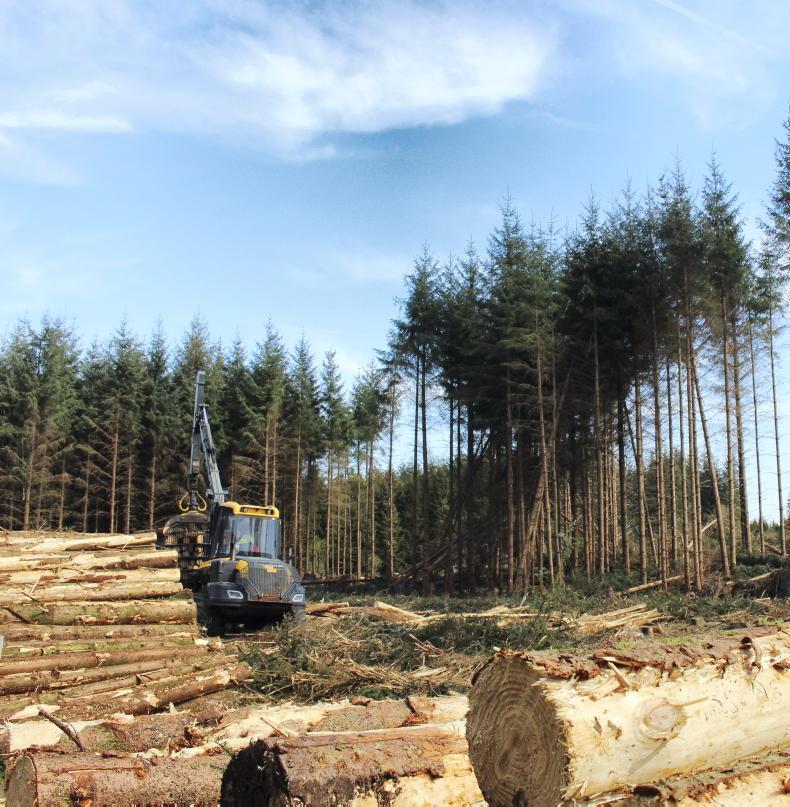
Harvesting windblow in Castlerea, where excellent returns were achieved on this 32 year old crop, which produced 80% sawlog. The remaining standing trees will also need to be removed as they are vulnerable to windblow. \ Donal Magner
Current and medium supply
There is concern that there may be a shortfall of timber after the windblow is cleared. This is unlikely, as some forest owners have learned the lesson of delaying final harvest.
Despite difficulties in getting licence approvals in some areas, the volume licensed exceeds demand.
For example, during the period 2019 and 2025, 56.8 million m³of timber was licensed (Table 1, see right) while the total volume removed was estimated at 35.3 million m³. The storm has taken a chunk of 9.08 million out of this, but there is sufficient volume available to the market post-2026, when most of the blown timber will be harvested.
We harvest less than half the annual increment, which may be just as well, because if the private sector was cutting to mean maximum increment – or overcutting – then there could be a serious supply problem after such a devastating storm, especially as Coillte supply has plateaued in recent years.
The products supplied to the market shows a steady increase in large sawlog forest removals from 0.9 million m³ in 2015 to 1.5 million in 2024. Small sawlog and pulpwood have remained static, while the overall product value has fluctuated widely from €168 million as recently as 2020 to €236.2 million in 2024.
Long-term log supply
There is sufficient volume of timber available in the medium term, but there are major questions about long-term supply, mainly due to underperforming afforestation, which has been in decline for 20 years, since 2005.
In his 2024 report Impact of Forest Policy and Forest Regulations on Future Commercial Timber Supply and the Sustainability of Timber Processing, Henry Phillips forecasts a shortfall of 18.7 m³ in timber production by 2024 if current forestry policy continues.
This results from a dramatic fall in afforestation to 1,651ha in 2023, when only 636ha of Sitka spruce was planted. This fell to 611ha in 2024 and while the trend was partially addressed in 2025 when 2,527ha were planted, afforestation is well short of the minimum area of 8,000ha required to achieve a long-term viable timber supply.
“The collapse in the afforestation programme since 2010, combined with a future significant loss in the commercial productive area of mainly spruce forests will result in a reduction in future timber supply of sawlog and pulpwood material of 18.7 million m³ by 2040 if current afforestation levels do not improve,” Phillips maintains.”
To achieve a sustainable afforestation programme will require a new approach including the need “for an independent Forestry Development Agency (FDA) to lead the sector”, says Phillips. Forestry is the only natural resource without such a body.
Forestry as a land use post-storm
While confidence in forestry as a land use will be tested in the aftermath of storm Éowyn, the damage to the national forest estate – public and private – needs to be put in perspective.
While 9.08 million m³ of storm-damaged timber is a disaster, most will be eventually salvaged and sold. It should be remembered that the total volume blown is marginally less than the annual volume increment of Irish forests, which is 10.02 million m³ as estimated in Ireland’s National Forest Inventory (NFI) 2022. The NFI estimated 142 million m³ of standing timber, prior to the windblow, so storm damage would have accounted for 7% of total volume.
Strong interest
There is still strong interest in forest sales especially in the 15-year plus category. This indicates that while our forests are at risk from windblow, they aren’t as vulnerable to fire, insect, disease and drought damage as is the case in continental Europe.
The State’s laissez-faire approach in helping private forest owners and timber processors meet the challenges of the windblow crisis was criticised for much of last year but the sector received a massive confidence boost in December when Minister of State at the Department of Agriculture, Food and the Marine with special responsibility for Forestry announced a State reconstitution grant (See Table 2, below).
Owners won’t recoup losses but grants of between €3,858/ha and €6,744/ha) to replant windblown forests allow them to start all over and bank whatever revenue they receive from their damaged crops.
The past year was like no other in Irish forestry due to storm Éowyn. The total area damaged in one night was 25,922ha, carrying a volume of 9.08 million ha, which represents well over two years’ harvest. This represents a major harvesting and marketing challenge for both Coillte and private forest owners.
Private growers don’t have the same harvesting infrastructure or cohesive marketing expertise as Coillte. Their forests are also fragmented, so timber removal will continue to the end of 2027 and longer, while Coillte expects to remove storm-damaged trees by the end of this year. These estimates were made before a plethora of felling and road licence appeals were lodged with the Forestry Appeals Committee (FAC). Unless dealt with quickly by FAC, many of these objections will result in timber being left to rot, while replanting will be delayed indefinitely.
However, windblown material is being removed and markets are being found. Within four months of the storm, all the major sawmills had moved over 80% of their harvesting operations into windblown sites. While sawmills are interested in medium to large sawlog from mature crops, blown areas in the 15- to 25-year age bracket will depend to a large extent on lower value pulp, energy and stake markets. Private growers are turning to the export market mainly for small sawlog and pulpwood material but also for large sawlog. Irish logs are being exported to countries such as Poland, Belgium, Germany, France and even China, in addition to the UK market.
Time will tell if these are sustainable outlets, but the speed at which forestry companies moved after the storm in exploring European markets was commendable. While global pulpwood markets are uncertain, sawn timber is selling reasonably strong in Ireland, but the UK market is weak. European markets are vital in capitalising on sawlog exports, but because of haulage distances, surplus logs and the extra cost of harvesting windblow – 35% higher than standing sales – margins are extremely tight.
Right now exports are the only markets for some growers, but in the long-term the domestic market is likely to prove lucrative, if Ireland is to build the required 44,000 housing units annually “to keep pace with structural demand,” according to the Economic and Social Research Institute (ESRI).
The final report of the Timber in Construction Steering Group (TCSG) report Timber in Construction in Ireland outlined how timber, as a low-embodied carbon construction material, offers a scalable and sustainable solution to address both housing and climate goals, but it needs to be focussed.
“Rather than advocating for timber use across all building types, the focus should be on applications where it offers the greatest value: low- to mid-rise residential buildings, modular housing, public infrastructure, and retrofit projects,” the report maintained.
Harvesting windblow in Castlerea, where excellent returns were achieved on this 32 year old crop, which produced 80% sawlog. The remaining standing trees will also need to be removed as they are vulnerable to windblow. \ Donal Magner
Current and medium supply
There is concern that there may be a shortfall of timber after the windblow is cleared. This is unlikely, as some forest owners have learned the lesson of delaying final harvest.
Despite difficulties in getting licence approvals in some areas, the volume licensed exceeds demand.
For example, during the period 2019 and 2025, 56.8 million m³of timber was licensed (Table 1, see right) while the total volume removed was estimated at 35.3 million m³. The storm has taken a chunk of 9.08 million out of this, but there is sufficient volume available to the market post-2026, when most of the blown timber will be harvested.
We harvest less than half the annual increment, which may be just as well, because if the private sector was cutting to mean maximum increment – or overcutting – then there could be a serious supply problem after such a devastating storm, especially as Coillte supply has plateaued in recent years.
The products supplied to the market shows a steady increase in large sawlog forest removals from 0.9 million m³ in 2015 to 1.5 million in 2024. Small sawlog and pulpwood have remained static, while the overall product value has fluctuated widely from €168 million as recently as 2020 to €236.2 million in 2024.
Long-term log supply
There is sufficient volume of timber available in the medium term, but there are major questions about long-term supply, mainly due to underperforming afforestation, which has been in decline for 20 years, since 2005.
In his 2024 report Impact of Forest Policy and Forest Regulations on Future Commercial Timber Supply and the Sustainability of Timber Processing, Henry Phillips forecasts a shortfall of 18.7 m³ in timber production by 2024 if current forestry policy continues.
This results from a dramatic fall in afforestation to 1,651ha in 2023, when only 636ha of Sitka spruce was planted. This fell to 611ha in 2024 and while the trend was partially addressed in 2025 when 2,527ha were planted, afforestation is well short of the minimum area of 8,000ha required to achieve a long-term viable timber supply.
“The collapse in the afforestation programme since 2010, combined with a future significant loss in the commercial productive area of mainly spruce forests will result in a reduction in future timber supply of sawlog and pulpwood material of 18.7 million m³ by 2040 if current afforestation levels do not improve,” Phillips maintains.”
To achieve a sustainable afforestation programme will require a new approach including the need “for an independent Forestry Development Agency (FDA) to lead the sector”, says Phillips. Forestry is the only natural resource without such a body.
Forestry as a land use post-storm
While confidence in forestry as a land use will be tested in the aftermath of storm Éowyn, the damage to the national forest estate – public and private – needs to be put in perspective.
While 9.08 million m³ of storm-damaged timber is a disaster, most will be eventually salvaged and sold. It should be remembered that the total volume blown is marginally less than the annual volume increment of Irish forests, which is 10.02 million m³ as estimated in Ireland’s National Forest Inventory (NFI) 2022. The NFI estimated 142 million m³ of standing timber, prior to the windblow, so storm damage would have accounted for 7% of total volume.
Strong interest
There is still strong interest in forest sales especially in the 15-year plus category. This indicates that while our forests are at risk from windblow, they aren’t as vulnerable to fire, insect, disease and drought damage as is the case in continental Europe.
The State’s laissez-faire approach in helping private forest owners and timber processors meet the challenges of the windblow crisis was criticised for much of last year but the sector received a massive confidence boost in December when Minister of State at the Department of Agriculture, Food and the Marine with special responsibility for Forestry announced a State reconstitution grant (See Table 2, below).
Owners won’t recoup losses but grants of between €3,858/ha and €6,744/ha) to replant windblown forests allow them to start all over and bank whatever revenue they receive from their damaged crops.






SHARING OPTIONS