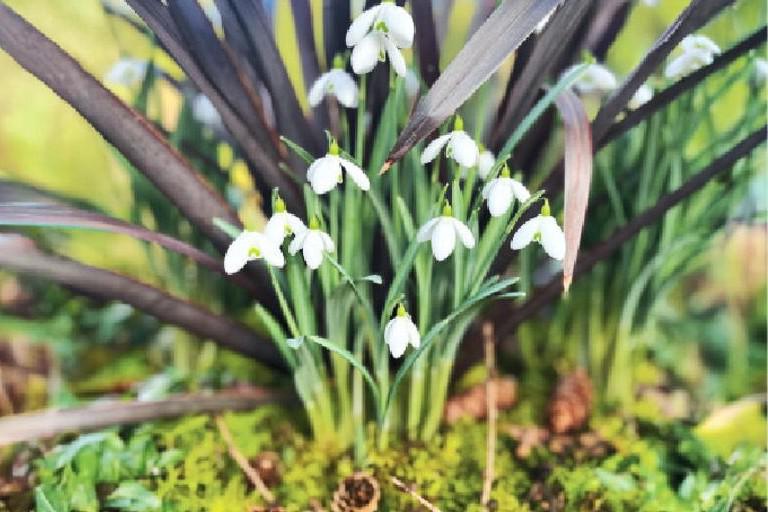
The passion for snowdrop growing is reaching fever pitch right now. In deep winter, the appearance of snowdrops brings with it an upsurge of excitement when flowering begins. Articles in gardening columns, posts on social media spread the word of the first flowers as they appear. It is not an exaggeration to say it is the pinnacle of the gardening year for some.
Snowdrops are unassuming and easy to grow. Once established they spread naturally in grassland or woodland edges. Galanthus as a name derives from ancient Greek, Gala meaning milk and Anthos, meaning flower, so it got the common name Milk Flower.
Their natural distribution extends from the eastern Mediterranean as far as the Middle East. Galanthus nivalis is naturalised in Ireland on woodland edges and river banks, but as the result of dumping or clearance of garden rubbish, it is a garden escape rather than a native. However, it displays the plant’s ability to easily survive harsh treatment. G. nivalis f.pleniflorus is a double form with a cluster of inner petals increasing its beauty. We grow this in our garden and it increases every year.
Galanthus ‘Mrs Macnamara’ is notable as one of the earliest to flower, usually before Christmas. It is a strong grower and the clumps enlarge well.
The grey-green leaves are a perfect foil for the flower stem holding pure white flowers, growing to 25cm. The inner petals have a green blotch on them, in the shape of an inverted V, as in most Galanthus. G. ‘Castlegar’ is another pre-Christmas performer.
It was discovered by Dr Keith Lamb, the great Irish gardener, in Castlegar Estate, Ahascragh Co Galway. It grows to 20cm in height when established and is a striking with plump pure white flowers and a green marking on the inner petals.
Galanthus ‘Wendy’s Gold’ brings a surprise when flowering in January. It grows to 20cm and brings a yellow colour to the group. The ovary which is the oval shaped section on top of the petals, is yellow and this is a wonderful change in colour tone. The flower has a yellow tint as well. A similar yellow tint is found on G. ‘Primrose Warburg growing to a similar height however the flower is plumper.
Galanthus ‘Cicely Hall’ selected in the garden of Primrose Hill in Lucan, Co Dublin by the late Cicely Hall, and her son Robin. It is very distinct with its olive-green ovary on top and almost fully green inner petals. It is statuesque, growing to 25cm.
G. ‘Emerald Isle’ is another Irish cultivar discovered in Drew’s Court, Co Limerick by Megan Morris and named by Dr Charles Nelson, taxonomist at the National Botanic Gardens, Glasnevin, Co Dublin. The colour is described as being greenish-white with dark green inner petals. Both flower in February, therefore extending the season.
I’m passionate about the idea of getting children interested in gardening and having specific plants for them to focus on does just that. Galanthus ‘Grumpy’ is a good one for the spring garden because it is very well named. The flower looks like a grumpy moustached old man peering between curtains.
Cultivation: snowdrops are easy to cultivate with a few basic principles observed. They need bright winter light and deciduous cover during the summer. Woodland edges or the base of hedgerows or large shrubs is best. Make sure the site is never waterlogged. They appreciate soil that is on the dry side during summer, their dormant season. They are happiest in soil that is rich in humus and if that is not available, you will need to dig in leaf mould or good garden compost.
Sourcing plants or bulbs: snowdrop specialists will tell you the best way to acquire plants is to buy them ‘in the green’, which means just after flowering and their foliage is present. They do better never drying out. If you source your plants this way, planting is easy as you set them at the same level where the green stem meets the white underground part, they will barely notice the difference. If you purchase bulbs, then buy from a reputable source and make sure bulbs are healthy. Plant in September-October, 8 to 10cm deep and the same distance apart. You must plant in clumps, not in straight rows, they will not look right.
To naturalise them in grassland plant in clumps. To do this, take a large handful of bulbs and throw them as far as you can across your lawn. Then place four or five more bulbs close to each of them and water well.
Q&A: Can I cut the leaves off the roses?

A Lenten rose blooming in spring. \iStock
My Lenten roses are starting to flower but the leaves are unsightly, is it okay to cut them off? Tommy, Co Tipperary.
The Lenten rose, botanically known as Helleborus x hybridus is starting to produce their flower stems now for a wonderful spring display. Your foliage is more than likely showing signs of hellebore leaf spot, which is a fungal infection specifically attacking hellebores and very prevalent in our climate.
If allowed, this will persist on the foliage through the summer season infecting new leaves perpetuating the infection.
Remove all foliage and bring to a recycling centre. Good garden hygiene will lessen the effects of this by removing all old and decaying foliage enhancing flowering.
Trees, shrubs and roses: Check all plants after the heavy rainfall. Check plant ties and secure if loosened. Suspend bare root planting until soil dries out.
Seeds: Prepare for seed sowing,
place orders and wash all pots
and pans in soapy water.
Lawn: In waterlogged areas use a digging fork to create a means of escape for water.
Fruit, vegetables and herbs:
Keep fruit planting when soil dries, fork over vegetable plots to stay weed free, and start ordering seed potatoes.
The passion for snowdrop growing is reaching fever pitch right now. In deep winter, the appearance of snowdrops brings with it an upsurge of excitement when flowering begins. Articles in gardening columns, posts on social media spread the word of the first flowers as they appear. It is not an exaggeration to say it is the pinnacle of the gardening year for some.
Snowdrops are unassuming and easy to grow. Once established they spread naturally in grassland or woodland edges. Galanthus as a name derives from ancient Greek, Gala meaning milk and Anthos, meaning flower, so it got the common name Milk Flower.
Their natural distribution extends from the eastern Mediterranean as far as the Middle East. Galanthus nivalis is naturalised in Ireland on woodland edges and river banks, but as the result of dumping or clearance of garden rubbish, it is a garden escape rather than a native. However, it displays the plant’s ability to easily survive harsh treatment. G. nivalis f.pleniflorus is a double form with a cluster of inner petals increasing its beauty. We grow this in our garden and it increases every year.
Galanthus ‘Mrs Macnamara’ is notable as one of the earliest to flower, usually before Christmas. It is a strong grower and the clumps enlarge well.
The grey-green leaves are a perfect foil for the flower stem holding pure white flowers, growing to 25cm. The inner petals have a green blotch on them, in the shape of an inverted V, as in most Galanthus. G. ‘Castlegar’ is another pre-Christmas performer.
It was discovered by Dr Keith Lamb, the great Irish gardener, in Castlegar Estate, Ahascragh Co Galway. It grows to 20cm in height when established and is a striking with plump pure white flowers and a green marking on the inner petals.
Galanthus ‘Wendy’s Gold’ brings a surprise when flowering in January. It grows to 20cm and brings a yellow colour to the group. The ovary which is the oval shaped section on top of the petals, is yellow and this is a wonderful change in colour tone. The flower has a yellow tint as well. A similar yellow tint is found on G. ‘Primrose Warburg growing to a similar height however the flower is plumper.
Galanthus ‘Cicely Hall’ selected in the garden of Primrose Hill in Lucan, Co Dublin by the late Cicely Hall, and her son Robin. It is very distinct with its olive-green ovary on top and almost fully green inner petals. It is statuesque, growing to 25cm.
G. ‘Emerald Isle’ is another Irish cultivar discovered in Drew’s Court, Co Limerick by Megan Morris and named by Dr Charles Nelson, taxonomist at the National Botanic Gardens, Glasnevin, Co Dublin. The colour is described as being greenish-white with dark green inner petals. Both flower in February, therefore extending the season.
I’m passionate about the idea of getting children interested in gardening and having specific plants for them to focus on does just that. Galanthus ‘Grumpy’ is a good one for the spring garden because it is very well named. The flower looks like a grumpy moustached old man peering between curtains.
Cultivation: snowdrops are easy to cultivate with a few basic principles observed. They need bright winter light and deciduous cover during the summer. Woodland edges or the base of hedgerows or large shrubs is best. Make sure the site is never waterlogged. They appreciate soil that is on the dry side during summer, their dormant season. They are happiest in soil that is rich in humus and if that is not available, you will need to dig in leaf mould or good garden compost.
Sourcing plants or bulbs: snowdrop specialists will tell you the best way to acquire plants is to buy them ‘in the green’, which means just after flowering and their foliage is present. They do better never drying out. If you source your plants this way, planting is easy as you set them at the same level where the green stem meets the white underground part, they will barely notice the difference. If you purchase bulbs, then buy from a reputable source and make sure bulbs are healthy. Plant in September-October, 8 to 10cm deep and the same distance apart. You must plant in clumps, not in straight rows, they will not look right.
To naturalise them in grassland plant in clumps. To do this, take a large handful of bulbs and throw them as far as you can across your lawn. Then place four or five more bulbs close to each of them and water well.
Q&A: Can I cut the leaves off the roses?
A Lenten rose blooming in spring. \iStock
My Lenten roses are starting to flower but the leaves are unsightly, is it okay to cut them off? Tommy, Co Tipperary.
The Lenten rose, botanically known as Helleborus x hybridus is starting to produce their flower stems now for a wonderful spring display. Your foliage is more than likely showing signs of hellebore leaf spot, which is a fungal infection specifically attacking hellebores and very prevalent in our climate.
If allowed, this will persist on the foliage through the summer season infecting new leaves perpetuating the infection.
Remove all foliage and bring to a recycling centre. Good garden hygiene will lessen the effects of this by removing all old and decaying foliage enhancing flowering.
Trees, shrubs and roses: Check all plants after the heavy rainfall. Check plant ties and secure if loosened. Suspend bare root planting until soil dries out.
Seeds: Prepare for seed sowing,
place orders and wash all pots
and pans in soapy water.
Lawn: In waterlogged areas use a digging fork to create a means of escape for water.
Fruit, vegetables and herbs:
Keep fruit planting when soil dries, fork over vegetable plots to stay weed free, and start ordering seed potatoes.








SHARING OPTIONS