


The MGX is the latest series to be introduced and features just two models — the 109.5hp M110GX and 135hp M135GX. Both feature Kubota’s own four-cylinder engines with four valves per cylinder and common rail fuel injection.
The latest round of exhaust emission regulations Tier4/Stage3b are met using a cooled Exhaust Gas Recirculation (EGR) unit and a Diesel Particulate Filter integrated into the exhaust system. So, the Kubota M110GX is a ‘single fuel’ tractor as John Deere would describe it.
The transmission is a 24 forward x 24 reverse unit with electrically operated power-shuttle. The 24 speeds are broken into three synchromesh ranges with eight powershift speeds in each range. This is a very high specification for a tractor that falls into the 110hp with loader ‘bread & butter’ class.
Kubota use a four pillar cab on the MGX series to offer better all-round visibility. There is a clear panel in the roof as well to offer some visibility operating the front end loader at height. The specification in the cab is high.
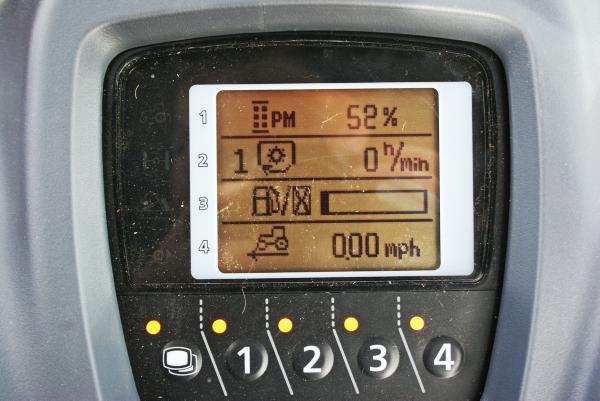
Many of the control functions are integrated into the arm rest. A display on the right hand console can display four functions at a time out of a possible 30.
Spools are mechanical which would suit most prospective purchasers in this class. One pair is occupied by the telescopic element of the Dromone pick-up hitch. Not available though is an ECO-pto speed option, only 540 or 1,000rpm is available.
First impressions
This is a high visibility tractor! Its bright livery almost glows, even in the dark and your whereabouts will always be known by neighbours and the wife. Joking aside, it does stand out and in a busy yard or on the road that’s not a bad thing.
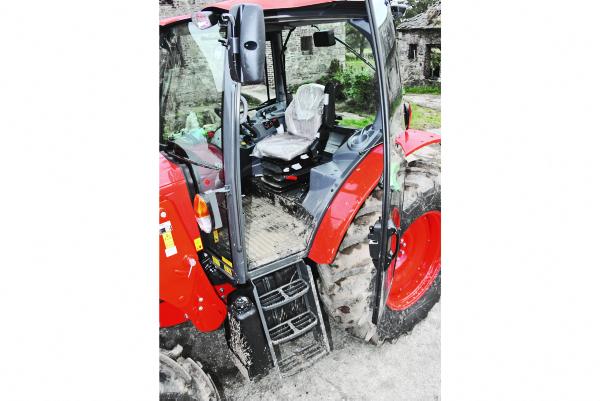
Access up into the cab is excellent. The steps are wider than anything I have used and there is no twisting or contortion required to get into the seated position. At 6’2”, this was a big plus for me.
Visibility was excellent all round. Our tractor was fitted with Kubota’s own LA1954 loader.
The loader itself was pretty impressively built and featured third service and soft-ride function.
The loader was operated by reasonably well integrated joystick. One of those ‘interesting’ features is a lever at the bottom of the joystick column that converts the loader to parallel linkage through a clever valve chest. This is a great function, parallel linkage without the linkage or compensating rams, and to be able to switch between the two so simply is a big plus.
Driving
The steering wheel adjusts in all directions but the adjusting release lever seems a bit flimsy in comparison to the competition.
The electric forward/reverse shuttle lever is located just under the steering wheel on the left and within easy reach.
From the seat, there are a number of functions integrated into the arm rest including lift control, engine throttle, engine management and powershift up/down.
All are very high spec but clearly for someone with much shorter arms than me and that made operating them a bit tricky.
The gearstick had a second set of powershift buttons and these were at the other end of the reach spectrum — almost too far away.
Driving was made easy by eight powershift gears in each range; lots to choose from without having to clutch. For work around the yard, the clutch pedal is light; you are only pressing against a spring while the pedal operates electrical transmission control switches.
The benefits are less fatigue and pressure on the clutch leg. The brakes were also pretty effortless.
The Autoshift transmission is another clever Japanese feature. This is not usually available in the ‘stockman’ bracket.
Most Autoshift features operate on road speed gears or take a little bit of setting up.
Kubota’s one is very simple, a two-way rocker switch selects a field or road mode.
Whatever powershift speed you are in when Autoshift is selected, the transmission will shift down two powershift gears as the throttle is released and back up again as it is pressed. I found this very useful for gathering bales in the field and loading them onto the trailer. It worked really well.
Later with the plough on, it worked equally well in field mode. Handling bales the M110GX was surprisingly stable. It weighs in at just under four tonnes. With quite a substantial loader out front and no weight on the rear, it was rock solid. Loader speed was pretty good as well; Kubota quotes a ‘theoretical’ hydraulic flow of 76.3 litres/min. Theory or not, it wasn’t far off it.
With the back window open, the tractor was very noisy and appeared to be mostly hydraulic noise. At the rear, three double acting spool valves were fitted.
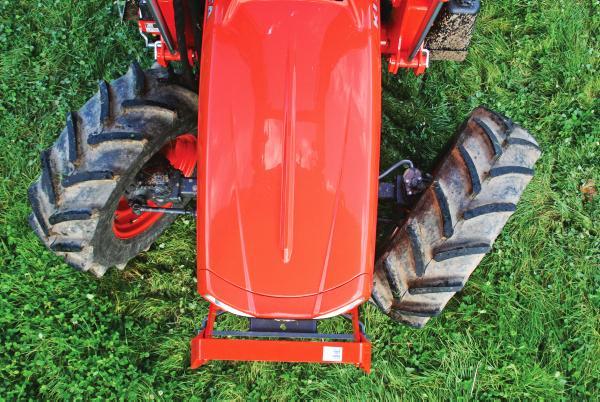
Manoeuvrability was excellent. Kubota uses a different front axle design with bevel gear drive at the hub pivots to give extra clearance under the front axle.
Another, yes another, interesting feature is Kubota’s Bi-turn steering facility.
With four-wheel-drive and the bi-speed function switched on, turning the steering to full lock changes the drive speed to the front wheels, increasing it by 1.6 times the normal speed.
So, the four-wheel-drive operates normally until the wheels are steered to almost full lock which kicks the over-drive facility to the front wheels.
This literally pulls the front of the tractor around drastically reducing the turning circle.
It doesn’t make the tractor and loader unstable unless done at unsafe speed to begin with. It does, however, cut up the ground if on grass, stubble or clay.
On concrete, it would be hard on tyres. In reality, the tractor has a wheelbase of just 2.435m and is very agile anyway without bi-speed switched on.
Performance
The 109.5hp Kubota engine is fully emissioned with cooled Exhaust Gas Recirculation (EGR) unit and a Diesel Particulate Filter (DPF) integrated into the exhaust system to catch and burn the soot particles.
Performance wise, I felt it was a bit disappointing and almost sluggish. Curiously, this was reflected across all the tasks we carried out from loader work to trailer work to ploughing.
What I mean by this is that it didn’t get any worse no matter how much it was loaded.
It almost performed well across every task but it still had the same sluggishness regardless of the task or load.
Are those the effects of emissionisation?
The DPF filter under the bonnet will re-generate when it reaches a pre-determined level of soot or when ‘blocked’ for the want of a better word. Then the engine management system injects fuel into the exhaust stroke flooding the DPF with fuel and setting it on fire internally to burn the soot gathered.
The tractor’s management system will tell the operator when this needs to be done. The frequency will depend on the type of driving/use of the tractor.
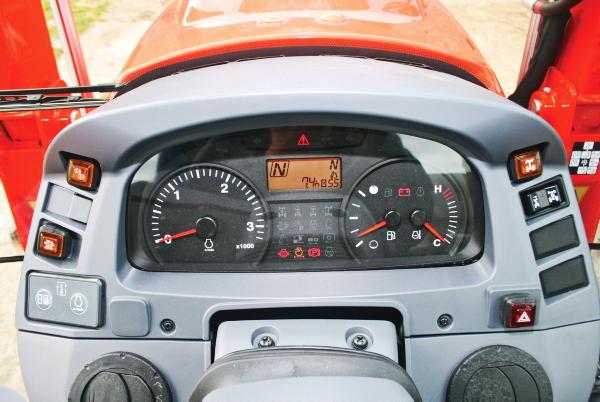
On the Kubota, the operator controls when the regeneration is done by two buttons on the left of the dash. The driver can monitor the status of soot gathering in the DPF to get an indication of when regeneration will need to be done.
Ultimately, a DPF unit is a service item and though it can be dismantled to be cleaned (by a dealer), it will eventually require replacement. And it’s not cheap.
I decided to see what would happen hooking up to the farms four-furrow Kverneland reversible plough. Now I didn’t expect much here, but to my surprise it lifted and handled the plough very well, so we had to give it a go in the field. To be fair, lift capacity is five tonnes but the Kubota weight is just four (without the loader).
In the field, it actually worked well; lift control was nice to set up and use. The mini-quadrant type depth control mirrors the old mechanical system and a rocker switch does the raining and lowering. This is simple for those who might struggle a bit with using electronic lift control.
There is no lift suspension feature on the Kubota and none available according to Kubota. Again, this is not the sort of task for a tractor of this size.
Out in the field, it pulled the plough at a very respectable speed. Ploughing performance was only let down by a lack of weight to maximise grip where the ground was compacted by field traffic.
Our Kubota was fitted with Continental tyres all round with 520/70R34s on the rear and 380/70R24s on the front.
The Kubota M110GX was nimble with a trailer and came with a Dromone telescopic pick-up hitch.
Despite being a small and ‘tidy’ tractor the telescopic function was definitely required for hooking to a trailer when using the pick-up hook.
One negative was the position of the hitch release lever. When the seat is at the rear most position and 16 stone sitting on it, a good solid yank of the release lever leads to a good solid connection with the multifunction arm rest. Lesson learned and it was not repeated again throughout the test.
To sum up
The Kubota M110GX meets nearly all the criteria I believe the majority of us demand from a modern loader tractor and excels way beyond those in other areas.
It brings to the table features that no other manufacturer has, such as its bi-turn steering facility and loader parallel function. This hi-vis tractor won’t be everyone’s cup of tea but will definitely broaden your tractor experience and open your mind to what Asia and Japan has to offer Irish farmers.
The price
The retail price is Stg£49,900, plus VAT, or Stg£55,800, plus VAT, with a loader.
The instructor’s (passenger) seat costs an additional Stg£380, plus VAT. Front fenders add £500 plus VAT, while rear fender extensions cost an extra £300. Prices are quoted in sterling, according to Kubota’s Sam Thompson, as he said with the euro changing from week to week they use the sterling as a base.
Key Points
Kubota M110GX
standard specifications:
Engine: Kubota 3.569L.
Bore x stroke: 104mm x 132mm
Rated hp: 109.5hp
Rated engine speed (rpm): 2600
Max torque: (Nm) 740 at 1500
Transmission: 24F/24R
Turning radius: 4m
Weight: 3990kg
Spool valves: Two
Rear linkage capacity: 3,700kg
Fuel capacity: 190 litres
Pto: 540/1000
Wheelbase: 2.435m
Height: 2.830m
Tyres: Front — Continental 380/70R24; rear — Continental 520/70R34.
Price: From £49,900, plus VAT.
Likes
√ Cab access
√ Visibility
√ Manoeuvrability
√ Everything about loader.
√ Auto-shift facility
√ Dromone hitch
√ Very stable with loader
considering light weight
Dislikes
X Engine performance a bit sluggish.
X The seat and lack of adjustability of the right hand arm rest.
X Position of hitch release lever.
X No eco-pto speed option or fender PTO switches.
X Noisy back end.
X Operator’s manual very hard to understand.
Our thanks to Sam Thompson and Kubota UK for organising and delivering a tractor to muck up.



SHARING OPTIONS