The area of farm buildings and planning permissions can be a minefield for farmers and we often get questions in to the Farmers Journal seeking answers on such. Below are some of the questions we have received of late, which I have done my best to answer.
I’m planning on building a slatted suckler shed with a creep area. Am I better to go it alone and forget about TAMS and planning permission or should I try and get the grant?
This is a question I’m asked a lot.
Firstly, one of the reasons people often don’t go for TAMS is that they don’t bother applying for planning permission, which is a huge mistake in my eyes.
With the level of investment currently required to construct any farm buildings, risking a demolition order for not having planning permission is a major risk.
The second part of that question primarily focuses on the timeline between applying for TAMS and receiving the green light to begin construction, which can be between six-12 months.
In this case, I would always advise farmers to apply for TAMS the winter before they really need the shed, eg applying now for a shed required for 2027.
Am I cheaper to build without the grant,
or is there really much difference between the two?
Again, another really common question, and one with a slightly controversial answer. In my opinion, there are very few instances in which you will get a shed completed cheaper without the grant than you will with it. If we think about it logically, the amount of concrete, slats, barriers and gates all stay the same. The only difference may be in the amount of steel used in tank walls and shed walls, or a lighter gauge RSJ used for stanchions and rafters.
Doing some back of a matchbox figures, if we look at a €100,000 shed (actual cost) that has a reference cost under TAMS of €85,000, with €25,000 of this attributed to the tank (at 60% grant aid) and the remaining €60,000 attributed to the structure above ground + slats (at 40% grant aid), we see a net grant amount of €39,000.
Take this from our actual cost of €100,000 and we are left with €61,000 of a cost to the farmer. Yes there will be some additional costs regarding application and drawings etc, but it would be very hard to shave off €30,000-€35,000 of a €100,000 shed without the integrity, longevity or usability of the shed being extremely compromised.
As a rule of thumb, when pricing a TAMS spec slatted shed, every bay of slats with a lie back area and covered canopy over the feed area will cost circa €24,000-€26,000.
I’m confused about the rules with the new planning exemptions. How far do I need to build off the public road and what size can I build?
There is some confusion surrounding the relaxation of planning laws, but it is fairly simple.
Firstly, you must locate the exempted development at least 10m away from a public road. What can affect more farmers will be the rule regarding the requirement to keep 100m or greater from any dwelling house (other than your own) with the exempted development. Written permission from a homeowner that is closer than 100m from the proposed development can allow for the exemption to still be valid. If the building will be higher than 8m at it’s highest point, then full planning permission will be required.
Size is another big thing. New farm buildings can be a maximum of 300m2 in size to qualify for the exemption. However, the total aggregate area (combined area) of all farm buildings within 100m of the new build can not be larger in size than 4502 , with this including the new development.
For example, a 250m2 calf house is being built within a yard that has a 150m² sheep house and a 200m2 slatted shed
Total area: 250+150+200= 600m2 not exempt
Even though the above proposed calf house is below 300m2 in size, the total area of the new development combined with the existing buildings is well over the 450m2 limit and is therefore not eligible for an exemption.
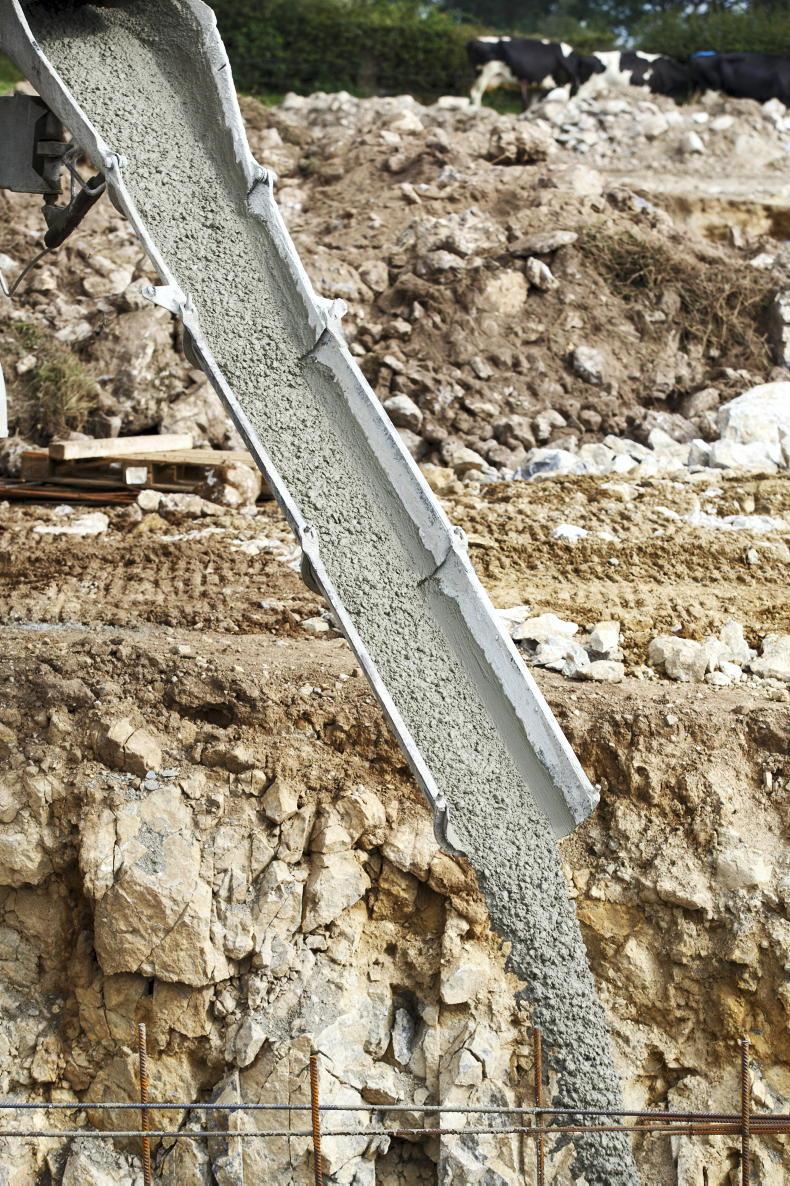
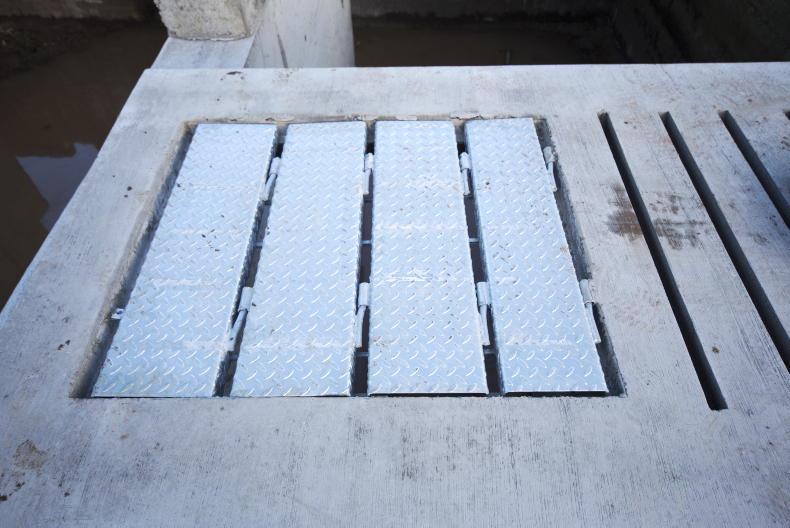
In non-grant spec sheds, the volume of concrete stays the same for the tank, walls, floors etc., with only a small saving on reinforcing steel being made in non-grant spec situations. /Donal O' Leary
The area of farm buildings and planning permissions can be a minefield for farmers and we often get questions in to the Farmers Journal seeking answers on such. Below are some of the questions we have received of late, which I have done my best to answer.
I’m planning on building a slatted suckler shed with a creep area. Am I better to go it alone and forget about TAMS and planning permission or should I try and get the grant?
This is a question I’m asked a lot.
Firstly, one of the reasons people often don’t go for TAMS is that they don’t bother applying for planning permission, which is a huge mistake in my eyes.
With the level of investment currently required to construct any farm buildings, risking a demolition order for not having planning permission is a major risk.
The second part of that question primarily focuses on the timeline between applying for TAMS and receiving the green light to begin construction, which can be between six-12 months.
In this case, I would always advise farmers to apply for TAMS the winter before they really need the shed, eg applying now for a shed required for 2027.
Am I cheaper to build without the grant,
or is there really much difference between the two?
Again, another really common question, and one with a slightly controversial answer. In my opinion, there are very few instances in which you will get a shed completed cheaper without the grant than you will with it. If we think about it logically, the amount of concrete, slats, barriers and gates all stay the same. The only difference may be in the amount of steel used in tank walls and shed walls, or a lighter gauge RSJ used for stanchions and rafters.
Doing some back of a matchbox figures, if we look at a €100,000 shed (actual cost) that has a reference cost under TAMS of €85,000, with €25,000 of this attributed to the tank (at 60% grant aid) and the remaining €60,000 attributed to the structure above ground + slats (at 40% grant aid), we see a net grant amount of €39,000.
Take this from our actual cost of €100,000 and we are left with €61,000 of a cost to the farmer. Yes there will be some additional costs regarding application and drawings etc, but it would be very hard to shave off €30,000-€35,000 of a €100,000 shed without the integrity, longevity or usability of the shed being extremely compromised.
As a rule of thumb, when pricing a TAMS spec slatted shed, every bay of slats with a lie back area and covered canopy over the feed area will cost circa €24,000-€26,000.
I’m confused about the rules with the new planning exemptions. How far do I need to build off the public road and what size can I build?
There is some confusion surrounding the relaxation of planning laws, but it is fairly simple.
Firstly, you must locate the exempted development at least 10m away from a public road. What can affect more farmers will be the rule regarding the requirement to keep 100m or greater from any dwelling house (other than your own) with the exempted development. Written permission from a homeowner that is closer than 100m from the proposed development can allow for the exemption to still be valid. If the building will be higher than 8m at it’s highest point, then full planning permission will be required.
Size is another big thing. New farm buildings can be a maximum of 300m2 in size to qualify for the exemption. However, the total aggregate area (combined area) of all farm buildings within 100m of the new build can not be larger in size than 4502 , with this including the new development.
For example, a 250m2 calf house is being built within a yard that has a 150m² sheep house and a 200m2 slatted shed
Total area: 250+150+200= 600m2 not exempt
Even though the above proposed calf house is below 300m2 in size, the total area of the new development combined with the existing buildings is well over the 450m2 limit and is therefore not eligible for an exemption.
In non-grant spec sheds, the volume of concrete stays the same for the tank, walls, floors etc., with only a small saving on reinforcing steel being made in non-grant spec situations. /Donal O' Leary






SHARING OPTIONS