The College of Agriculture, Food and Rural Enterprise (CAFRE) held two soil drainage events recently. In this, the first of two articles, Kieran Mailey covers some of the key points that were outlined
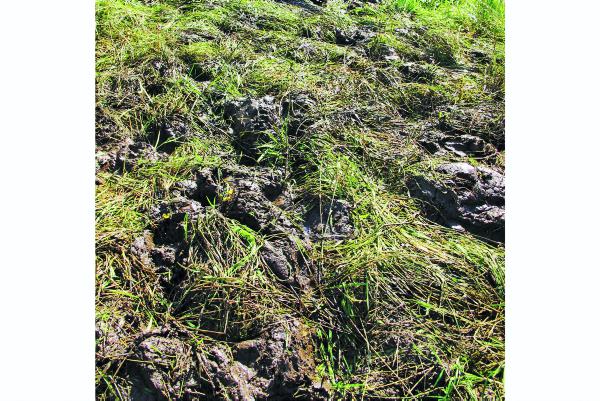
Picture one
The picture shows a wet spot that has developed in a particular part of the field. The initial impression is that the drains are blocked and new drains may need to be installed. Note the manhole cover at the top of the picture.
Picture two
With the manhole open, the drains are operating fine with plenty of free flowing water. Therefore, the problem is coming from a soil compaction problem preventing water from migrating down through the soil and accessing the drainage pipe.
Picture three
The photo shows a soil profile of the field. There is clearly a soil compaction problem with four distinct soil pans present in this soil profile. The top six inches are heavily compacted by machinery as the field is cut for silage. There is little prospect of surface water draining off the field. The lower compaction levels are created by machinery and the high clay content fusing together.
tent fusing together.
Photo four
With most main field drains running around field perimeters, there is a chance that drains may be blocked by the roots of trees and hedges. As soil water is high in nutrients, small roots can migrate through slits in the pipe and feed on the drainage water.
Photo five
Dig test holes to determine what the soil profile is like. Digging one hole will not tell you the extent of the problem as soil will vary within a field. The photo shows how the soil profile changes in such a short space of distance. On the far left of the trench, top soil went to a depth of 10 inches, increasing to 18 inches on the right hand side of the trench.
Photo six
The photo shows how livestock create surface compaction. The soil plug contains numerous horizontal layers. These will hold surface water rather than let it drain down through the soil. Grass roots are shallow rooting, which means they cannot fully access soil nutrients, therefore grass growth is lower.
Photo seven
Another soil profile, only this time it represents the ideal soil profile. The profile is a consistent colour and well drained.
Photo eight
This is a common soil profile found in Ireland. The top half of the profile has a high degree of silt, yet the sub-soil is clay. A lack of soil aeration and water logging causes the soil discolouration. Mole ploughs are often used to drain this type of ground, but are not carried out at the correct depth, which should be through the clay layer.
Photo nine
The photo shows the type of compaction that can be caused by a silage trailer carrying a full load on wet or soft ground. The trench created measured eight inches.
Photo 10
Tyre choice plays a part in reducing the level of soil compaction. The photo show the same trailer and load weight with low profile tyres (350 x 65). The trench created was halved to four inches.
Photo 11
This shows the leg of a sub-soiler — a shakerator. The machine is used to relieve surface compaction. The maximum depth that the sub-soiler should be used is four times the width of the leg wing. Any deeper and the machine is less effective as the soil heave is reduced.
Photo 12
A soil profile after a sub-soiler has been used. The cracking effect will instantly improve soil drainage and allow air to get in. As surface water can drain through, soil temperatures will be higher.
Draining and repairing land can be an expensive project. Before undertaking a drainage programme, it is important to assess the extent of the problem that exists. Soil types vary within every field, never mind across the farm.
The first thing that should be carried out is to dig test holes across individual fields to determine soil types and which type of action is most appropriate. On many farms, soil will only be compacted in the top four to five inches of the soil profile. As a result, using a sub-soiling machine will suffice. If the problems exist at a depth of 15 to 20 inches, ploughing and draining will be required as a combination course of action.
Soil texture
ADVERTISEMENT
The rate at which water moves through the soil is determined by soil type, structure and texture.
Soil is classified as sand, silt or clay with sand being the largest in particle size and clay being the smallest. Larger particles have greater air space between them allowing for greater natural drainage. Clay has fine particles and less natural drainage. Soil texture can be assessed by rubbing moist soil between your fingers and thumb. Sand feels gritty and will break apart. Silt feels smooth and will stick to your hands. Clay will feel sticky and hold its shape if rolled into a ball. Whereas silt sticks to your hand, clay will stick to itself.
Register for free to read this story and our free stories.
This content is available to digital subscribers and loyalty code users only. Sign in to your account, use the code or subscribe to get unlimited access.
However, if you would like to share the information in this article, you may use the headline, summary and link below:
Title: Improving soil and sward performance
The College of Agriculture, Food and Rural Enterprise (CAFRE) held two soil drainage events recently. In this, the first of two articles, Kieran Mailey covers some of the key points that were outlined
The reader loyalty code gives you full access to the site from when you enter it until the following Wednesday at 9pm. Find your unique code on the back page of Irish Country Living every week.
CODE ACCEPTED
You have full access to the site until next Wednesday at 9pm.
CODE NOT VALID
Please try again or contact support.
Draining and repairing land can be an expensive project. Before undertaking a drainage programme, it is important to assess the extent of the problem that exists. Soil types vary within every field, never mind across the farm.
The first thing that should be carried out is to dig test holes across individual fields to determine soil types and which type of action is most appropriate. On many farms, soil will only be compacted in the top four to five inches of the soil profile. As a result, using a sub-soiling machine will suffice. If the problems exist at a depth of 15 to 20 inches, ploughing and draining will be required as a combination course of action.
Soil texture
The rate at which water moves through the soil is determined by soil type, structure and texture.
Soil is classified as sand, silt or clay with sand being the largest in particle size and clay being the smallest. Larger particles have greater air space between them allowing for greater natural drainage. Clay has fine particles and less natural drainage. Soil texture can be assessed by rubbing moist soil between your fingers and thumb. Sand feels gritty and will break apart. Silt feels smooth and will stick to your hands. Clay will feel sticky and hold its shape if rolled into a ball. Whereas silt sticks to your hand, clay will stick to itself.
If you would like to speak to a member of our team, please call us on 01-4199525.
Link sent to your email address
We have sent an email to your address. Please click on the link in this email to reset your password. If you can't find it in your inbox, please check your spam folder. If you can't find the email, please call us on 01-4199525.
ENTER YOUR LOYALTY CODE:
The reader loyalty code gives you full access to the site from when you enter it until the following Wednesday at 9pm. Find your unique code on the back page of Irish Country Living every week.








SHARING OPTIONS