Barriers and dividing gates can sometimes be an afterthought on new builds, with the structure and layout taking more consideration and effort. Many farmers are also unaware of the effects that improperly set-up barriers or gates can have from both an animal welfare and ease of management/farmer safety point of view.
It’s important to note that barriers can be used right around animal housing, ie no exterior walls needed, with the exception being suckler houses and calf houses, with the Department noting that animals will often be healthier in such accommodation.
Types of barriers
For dairy or beef cows, various different types of feed barrier are available. These include diagonal feed barrier, straight bar, dove tail and head locking barriers, with head locking more common in suckler beef houses, while straight bar barriers are almost exclusively used in dairy houses. All barriers should be set at a height of 1,200mm from the floor for these adult animals.
I have seen some farmers of late that have created a bracket that keeps a straight bar barrier several inches out from the girder on which it is hung on, which prevents cows from rubbing the base of their neck along the rail. This is among a trend aptly named ‘cow signs’, whereby cows will indicate to the farmer what needs to be changed for them. Another example of this would be cows rear ends hanging out over a scraped passage due to too-short cubicles.
Spacing
As a general rule of thumb, each cow (suckler and dairy) requires 600mm of feed space where feed is restricted. Even where ad-lib feed is available, pushing up feed or adding fresh feed will result in animals going to the barrier, and where there is limited feed space, weaker animals will be bullied.
At 600mm of feed space, your standard 4.8m bay should feed eight cows, with larger 6m bays capable of accommodating 10. Where there are larger beef-bred cows on-farm, this scale may have to be adjusted. It’s important to note that most diagonal feed barriers have 10-11 spacings in them, but are incapable of feeding this number of adult cattle, however this should suffice for weanlings. Self-locking feed barriers are generally set at eight spacing per standard bay, so where adult cattle are involved, there is no compromise on the volume of cows capable of eating at the same time.
Self-locking feed barriers are becoming more common place in suckler sheds, particularly for autumn calving herds to facilitate AI without the cow having to be drafted to a crush, while the make up of the barrier has also anecdotally been said to prevent young calves exiting pens through the barrier, something that can be commonplace with straight or diagonal barriers.
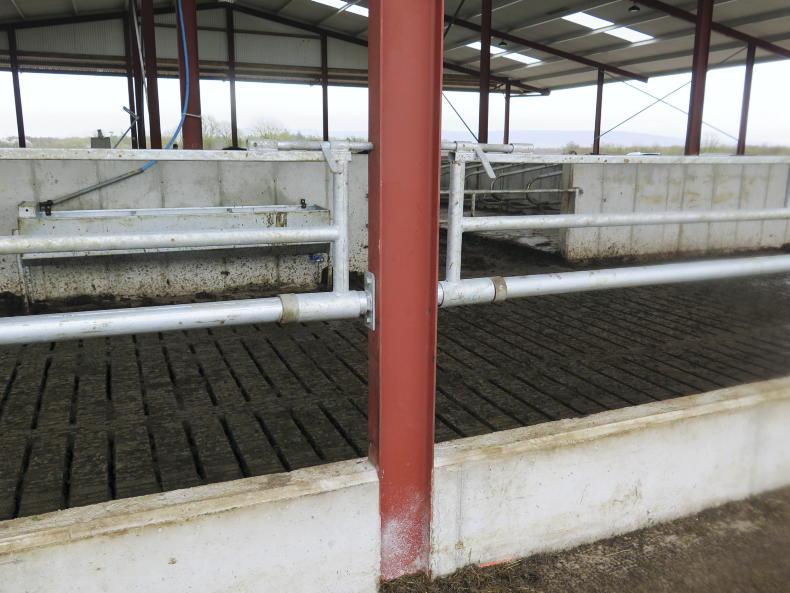
The feed barriers above can be turned over to lock the cows away from silage for on-off grazing, a useful feature for spring grazing.
Stub walls
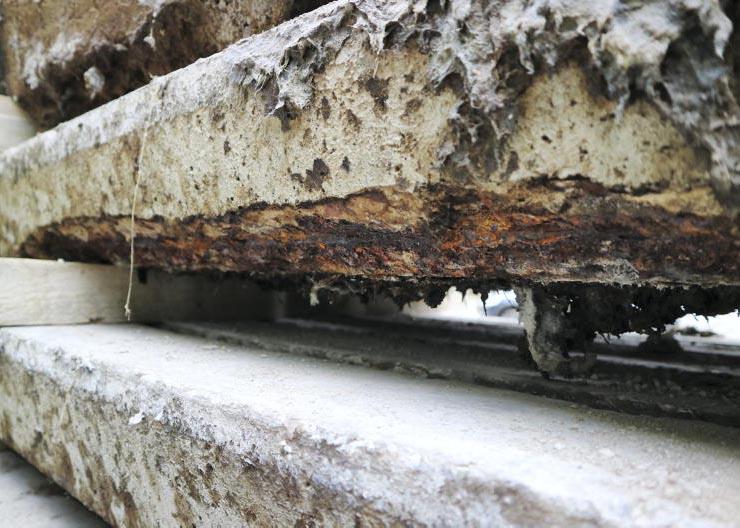
Swinging barriers with a timber at the bottom have fallen out of favour due to their weight as well as the accumulation of dung and urine tending to rot the bottom bar of the barrier. These types of barriers are usually restricted for access at the end bays to divert cows to and from a parlour/handling facilities.
A concrete stub wall or a timber board approximately 225mm (9’’) in height slotted between two girders works well, with the former more suited where shear grabs are used to feed out pit silage as a concrete stub wall will be better equipped to put up with the occasionally kiss from the shear grab.
When creating a stub wall under barriers, mass concrete is the preferred choice over blocks, with a thinner wall suitable reinforced with rebar the preferred choice. A stub wall measuring 100-150mm in width with several length of rebar encased will provide a long-lasting job. Increasing the stub wall thickness to 200-225mm can result in cows being pushed too far back from the barrier, limiting access to silage.
Dividing gates
Dividing gates are necessary in every animal housing to segregate animals for whatever reason eg calving date, BCS, age. In cubicle sheds, dividing gates can be incorporated in to crossover points but also between two lines of cubicles. The beauty of dividing via cubicles is that the segregate areas, eg dry cows and freshly calved cows, can be incrementally increased by as little as two cubicle spaces. It’s important that layout surrounding crossover points and availability of water allows this to happen.
For beef housing, an common issue is a singular, long gate dividing slatted pens which makes moving stock between pens a hazardous and difficult task. A split gate, with either two swinging gates or a fixed panel and one swinging gate, is a safer and better option for all.
Specifications
There are no official specifications regarding grant spec barriers or dividing gates, meaning farmers appear free to purchase from a buyer of their choosing or manufacture them themselves. I have reached out to the Department for clarification on the above.
Barriers and dividing gates can sometimes be an afterthought on new builds, with the structure and layout taking more consideration and effort. Many farmers are also unaware of the effects that improperly set-up barriers or gates can have from both an animal welfare and ease of management/farmer safety point of view.
It’s important to note that barriers can be used right around animal housing, ie no exterior walls needed, with the exception being suckler houses and calf houses, with the Department noting that animals will often be healthier in such accommodation.
Types of barriers
For dairy or beef cows, various different types of feed barrier are available. These include diagonal feed barrier, straight bar, dove tail and head locking barriers, with head locking more common in suckler beef houses, while straight bar barriers are almost exclusively used in dairy houses. All barriers should be set at a height of 1,200mm from the floor for these adult animals.
I have seen some farmers of late that have created a bracket that keeps a straight bar barrier several inches out from the girder on which it is hung on, which prevents cows from rubbing the base of their neck along the rail. This is among a trend aptly named ‘cow signs’, whereby cows will indicate to the farmer what needs to be changed for them. Another example of this would be cows rear ends hanging out over a scraped passage due to too-short cubicles.
Spacing
As a general rule of thumb, each cow (suckler and dairy) requires 600mm of feed space where feed is restricted. Even where ad-lib feed is available, pushing up feed or adding fresh feed will result in animals going to the barrier, and where there is limited feed space, weaker animals will be bullied.
At 600mm of feed space, your standard 4.8m bay should feed eight cows, with larger 6m bays capable of accommodating 10. Where there are larger beef-bred cows on-farm, this scale may have to be adjusted. It’s important to note that most diagonal feed barriers have 10-11 spacings in them, but are incapable of feeding this number of adult cattle, however this should suffice for weanlings. Self-locking feed barriers are generally set at eight spacing per standard bay, so where adult cattle are involved, there is no compromise on the volume of cows capable of eating at the same time.
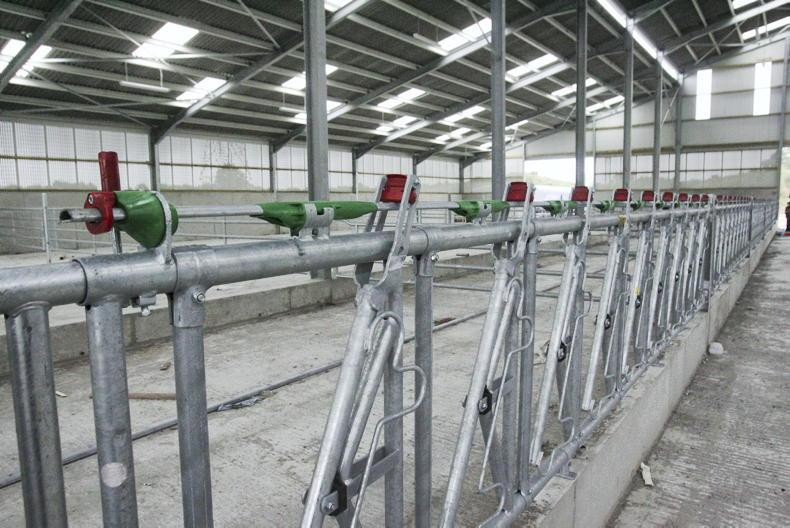
Self-locking feed barriers are becoming more common place in suckler sheds, particularly for autumn calving herds to facilitate AI without the cow having to be drafted to a crush, while the make up of the barrier has also anecdotally been said to prevent young calves exiting pens through the barrier, something that can be commonplace with straight or diagonal barriers.
The feed barriers above can be turned over to lock the cows away from silage for on-off grazing, a useful feature for spring grazing.
Stub walls
Swinging barriers with a timber at the bottom have fallen out of favour due to their weight as well as the accumulation of dung and urine tending to rot the bottom bar of the barrier. These types of barriers are usually restricted for access at the end bays to divert cows to and from a parlour/handling facilities.
A concrete stub wall or a timber board approximately 225mm (9’’) in height slotted between two girders works well, with the former more suited where shear grabs are used to feed out pit silage as a concrete stub wall will be better equipped to put up with the occasionally kiss from the shear grab.
When creating a stub wall under barriers, mass concrete is the preferred choice over blocks, with a thinner wall suitable reinforced with rebar the preferred choice. A stub wall measuring 100-150mm in width with several length of rebar encased will provide a long-lasting job. Increasing the stub wall thickness to 200-225mm can result in cows being pushed too far back from the barrier, limiting access to silage.
Dividing gates
Dividing gates are necessary in every animal housing to segregate animals for whatever reason eg calving date, BCS, age. In cubicle sheds, dividing gates can be incorporated in to crossover points but also between two lines of cubicles. The beauty of dividing via cubicles is that the segregate areas, eg dry cows and freshly calved cows, can be incrementally increased by as little as two cubicle spaces. It’s important that layout surrounding crossover points and availability of water allows this to happen.
For beef housing, an common issue is a singular, long gate dividing slatted pens which makes moving stock between pens a hazardous and difficult task. A split gate, with either two swinging gates or a fixed panel and one swinging gate, is a safer and better option for all.
Specifications
There are no official specifications regarding grant spec barriers or dividing gates, meaning farmers appear free to purchase from a buyer of their choosing or manufacture them themselves. I have reached out to the Department for clarification on the above.






SHARING OPTIONS