Northern Ireland is classified as a country with low incidence of TB in humans, but there has been an increase in recent years which can partly be explained by higher rates of bovine TB in cattle, a senior health professional has said.
Addressing a NI Agri-Rural Health Forum event in Ballynahinch last Thursday, Dr Jillian Johnston from the Public Health Agency (PHA) said in 2024 there were 86 TB cases notified to the PHA in NI, compared to 78, 69 and 54 people in the previous three years respectively.
Most of the human cases are caused by Mycobacterium tuberculosis, which is a bacteria passed in the air from one person to another.
It is also the most common cause of TB around the world, and while disease rates are low in Europe, best global estimates point to around 10m cases annually and over 1m deaths.
In total, eight countries have two-thirds of cases, with TB still prevalent in parts of sub-Saharan Africa, Asia and the south Americas, said Johnston.
Up to 10% of TB cases in humans are caused by Mycobacterium bovis, which is the bacterium that causes bovine TB in cattle and other animals. Where TB has passed from animals to humans it is known as zoonotic TB.
However, the figures are imprecise and likely to be an underestimate. “The counting of zoonotic TB is difficult as you have to grow the TB – you need a good lab system,” said Johnston.
In NI, she said “less than 10” of the 86 human TB cases in 2024 were confirmed in the lab as being due to bovine TB.
While that is a low number, our bovine TB rate is higher in NI than seen across the UK.
“There is a sense that because of the increase of TB in cattle, we are seeing some increases in our human TB cases as well,” she said.
Risk
As a result, people who regularly work with cattle and other animals are at higher risk than the general population.
However, the highest risk comes from eating products made from unpasteurised milk.
When someone is exposed to infection, it can lie dormant in your body for a number of years and is then reactivated later in life when you get older, said Johnston. She also maintained that young children or people who are immunosuppressed for any reason are most likely to develop the disease.
Symptoms
The symptoms of respiratory TB in humans include weight loss, night sweats, fever and a persistent cough. “The disease is serious. The treatment is long (9 to 12 months) and is likely to involve hospital admission, certainly at the start. It is not a nice disease to get,” said Johnston.
DAERA
She also revealed that a reporting system is now in place whereby DAERA warns the PHA about TB infected herds that “could pose a public health significance which we might want to risk assess.”
As part of that process a farm family could be contacted by the PHA to establish what exposure they may have had to the disease.

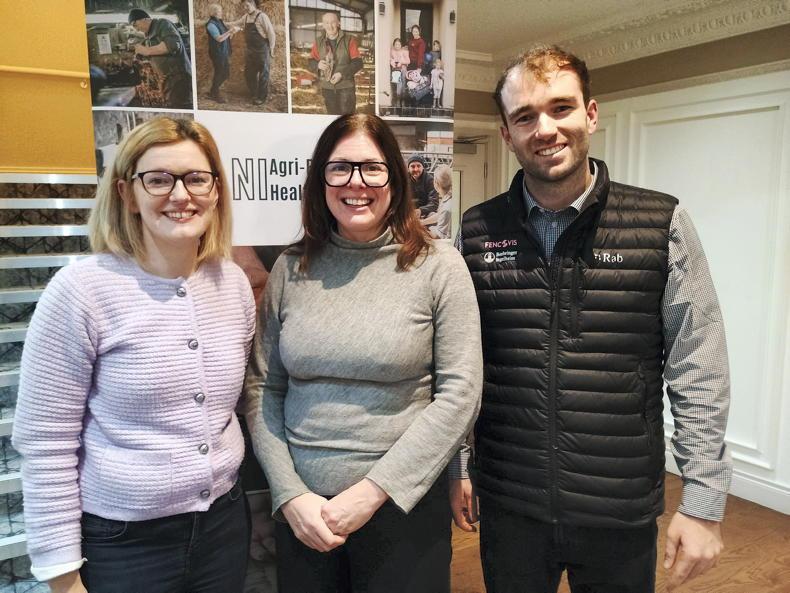
Jack Hall (left) and Gareth Deering from Co Down based Denroy Ltd. The company works across a number of sectors, including healthcare and during the COVID-19 pandemic in 2020 established its DenPro brand to offer a range of PPE products such as FFP3 face masks. According to Gareth Deering, the masks should be worn in dusty environments such as feed stores, poultry farms etc. The masks have a high fit-test pass rate and can be ordered direct from the DenPro website.
UFU deputy questions
TB strategy
The record rates of TB in cattle, reports of disease spread into dogs and cats, and a higher incidence of TB in humans, is against a context that government in NI is legally required to have a TB control programme in NI, said UFU deputy president, John McLenaghan.
“The question has to be put to those in authority why they are not doing more to stop these higher disease rates,” he said on Thursday night.
He also pointed out that farmers must test cattle and accept losing their animals, but the disease pressure coming from wildlife continues to remain untouched.
Focus of event
on lung health
The main focus of the Agri-Rural Health Forum event last Thursday night was around lung health in farming.
Attendees were told to take the safety of their lungs as importantly as any other safety issue around the farm. At present, around one in five people living in NI will be affected by a lung condition in their lifetime.
“We need our lungs and we are not going to get another set of them,” said the chair of the forum, Dr Rebecca Orr.
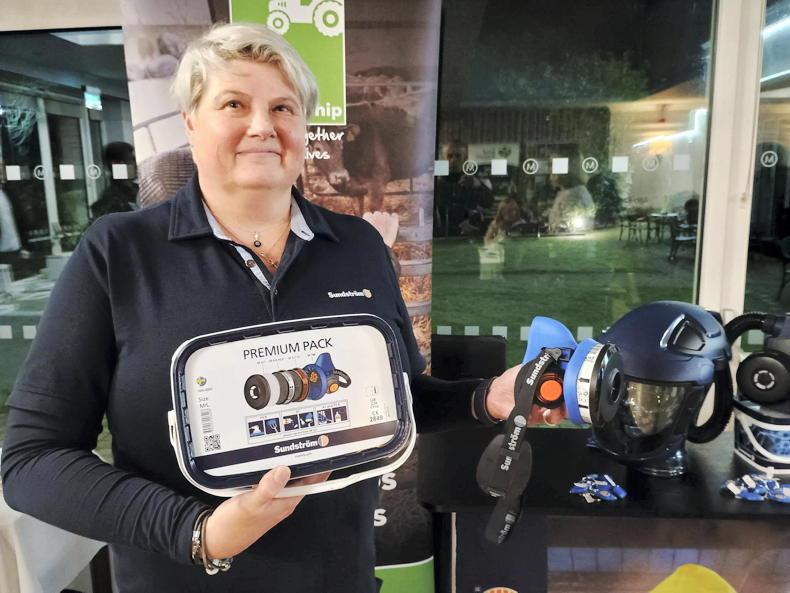
Anne Logan from Sundström Safety Services UK ltd. The company offers high-quality products designed to protect against polluted air, including a face shield which comes with a powered air-purifying respirator. Anne told the meeting last Thursday that the main issue with face masks can be to get the correct seal around the face. That seal can be negatively impacted by any facial hair, including stubble. She said her masks have been designed to ensure an excellent fit. The highest protection comes when a powered air supply is used as it effectively stops dirty air getting in around the neck or under the chin.
Ventilation is vital for young calves
As well as lung health in humans, the Agri-rural health forum event also included a presentation on lung health in calves by Peter Howard, a vet with Boehringer Ingelheim.
The company sells an intranasal vaccine (Bovalto Respi Intranasal) which gives 12 weeks of cover against RSV and PI3 and a 2-shot vaccine (Bovalto Respi 3) which offers six months of cover against RSV, PI3 and Mannheimia haemolytica.
While pneumonia vaccination is important, it is still vital to ensure calf houses are well ventilated. “You need a good source of clean, fresh air going in and an effective way to get stale air out. However, you don’t want a draughty shed,” said Howard.
He added that calves are unable to generate the energy necessary to achieve a stack effect whereby warm air is forced out the top of the roof and fresh air is sucked in from the side. As a result, some form of mechanical ventilation may be necessary.
It is also good practice to ensure calves are kept in a separate air space from older animals, especially adult cattle, given these animals continually shed virus. He said calves have relatively small lungs for their overall size, so any kind of negative impact on their lung health will hit production, including into adult life.
Northern Ireland is classified as a country with low incidence of TB in humans, but there has been an increase in recent years which can partly be explained by higher rates of bovine TB in cattle, a senior health professional has said.
Addressing a NI Agri-Rural Health Forum event in Ballynahinch last Thursday, Dr Jillian Johnston from the Public Health Agency (PHA) said in 2024 there were 86 TB cases notified to the PHA in NI, compared to 78, 69 and 54 people in the previous three years respectively.
Most of the human cases are caused by Mycobacterium tuberculosis, which is a bacteria passed in the air from one person to another.
It is also the most common cause of TB around the world, and while disease rates are low in Europe, best global estimates point to around 10m cases annually and over 1m deaths.
In total, eight countries have two-thirds of cases, with TB still prevalent in parts of sub-Saharan Africa, Asia and the south Americas, said Johnston.
Up to 10% of TB cases in humans are caused by Mycobacterium bovis, which is the bacterium that causes bovine TB in cattle and other animals. Where TB has passed from animals to humans it is known as zoonotic TB.
However, the figures are imprecise and likely to be an underestimate. “The counting of zoonotic TB is difficult as you have to grow the TB – you need a good lab system,” said Johnston.
In NI, she said “less than 10” of the 86 human TB cases in 2024 were confirmed in the lab as being due to bovine TB.
While that is a low number, our bovine TB rate is higher in NI than seen across the UK.
“There is a sense that because of the increase of TB in cattle, we are seeing some increases in our human TB cases as well,” she said.
Risk
As a result, people who regularly work with cattle and other animals are at higher risk than the general population.
However, the highest risk comes from eating products made from unpasteurised milk.
When someone is exposed to infection, it can lie dormant in your body for a number of years and is then reactivated later in life when you get older, said Johnston. She also maintained that young children or people who are immunosuppressed for any reason are most likely to develop the disease.
Symptoms
The symptoms of respiratory TB in humans include weight loss, night sweats, fever and a persistent cough. “The disease is serious. The treatment is long (9 to 12 months) and is likely to involve hospital admission, certainly at the start. It is not a nice disease to get,” said Johnston.
DAERA
She also revealed that a reporting system is now in place whereby DAERA warns the PHA about TB infected herds that “could pose a public health significance which we might want to risk assess.”
As part of that process a farm family could be contacted by the PHA to establish what exposure they may have had to the disease.
Jack Hall (left) and Gareth Deering from Co Down based Denroy Ltd. The company works across a number of sectors, including healthcare and during the COVID-19 pandemic in 2020 established its DenPro brand to offer a range of PPE products such as FFP3 face masks. According to Gareth Deering, the masks should be worn in dusty environments such as feed stores, poultry farms etc. The masks have a high fit-test pass rate and can be ordered direct from the DenPro website.
UFU deputy questions
TB strategy
The record rates of TB in cattle, reports of disease spread into dogs and cats, and a higher incidence of TB in humans, is against a context that government in NI is legally required to have a TB control programme in NI, said UFU deputy president, John McLenaghan.
“The question has to be put to those in authority why they are not doing more to stop these higher disease rates,” he said on Thursday night.
He also pointed out that farmers must test cattle and accept losing their animals, but the disease pressure coming from wildlife continues to remain untouched.
Focus of event
on lung health
The main focus of the Agri-Rural Health Forum event last Thursday night was around lung health in farming.
Attendees were told to take the safety of their lungs as importantly as any other safety issue around the farm. At present, around one in five people living in NI will be affected by a lung condition in their lifetime.
“We need our lungs and we are not going to get another set of them,” said the chair of the forum, Dr Rebecca Orr.
Anne Logan from Sundström Safety Services UK ltd. The company offers high-quality products designed to protect against polluted air, including a face shield which comes with a powered air-purifying respirator. Anne told the meeting last Thursday that the main issue with face masks can be to get the correct seal around the face. That seal can be negatively impacted by any facial hair, including stubble. She said her masks have been designed to ensure an excellent fit. The highest protection comes when a powered air supply is used as it effectively stops dirty air getting in around the neck or under the chin.
Ventilation is vital for young calves
As well as lung health in humans, the Agri-rural health forum event also included a presentation on lung health in calves by Peter Howard, a vet with Boehringer Ingelheim.
The company sells an intranasal vaccine (Bovalto Respi Intranasal) which gives 12 weeks of cover against RSV and PI3 and a 2-shot vaccine (Bovalto Respi 3) which offers six months of cover against RSV, PI3 and Mannheimia haemolytica.
While pneumonia vaccination is important, it is still vital to ensure calf houses are well ventilated. “You need a good source of clean, fresh air going in and an effective way to get stale air out. However, you don’t want a draughty shed,” said Howard.
He added that calves are unable to generate the energy necessary to achieve a stack effect whereby warm air is forced out the top of the roof and fresh air is sucked in from the side. As a result, some form of mechanical ventilation may be necessary.
It is also good practice to ensure calves are kept in a separate air space from older animals, especially adult cattle, given these animals continually shed virus. He said calves have relatively small lungs for their overall size, so any kind of negative impact on their lung health will hit production, including into adult life.






SHARING OPTIONS