A question we’re often asked in the Irish Farmers Journal is: why are the anaerobic digestion (AD) plants currently being developed so large?
The answer lies in the Government’s approach, which offers no ongoing subsidy and mandates consumers to pay full price for biomethane gas. This means larger plants are needed to avail of economies of scale.
That question is then usually followed up by: can it be done on my farm, at a much smaller scale? You would be forgiven for thinking it wasn’t possible as it’s currently not on the Government’s agenda. However, a new plant developed by Galwayman Brendan Gildea, along with the Irish Bioenergy Association (IrBEA), has turned this approach on its head, and he has shown that small-scale biogas isn’t just viable, it enhances the viability of his farm.
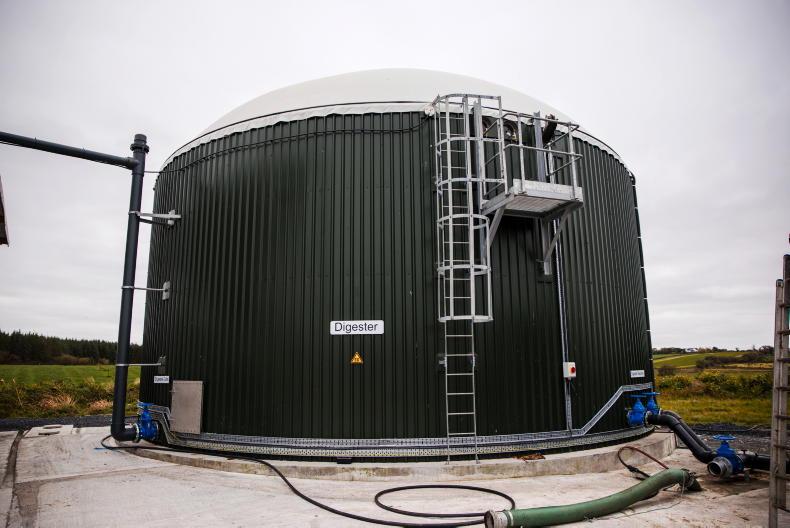
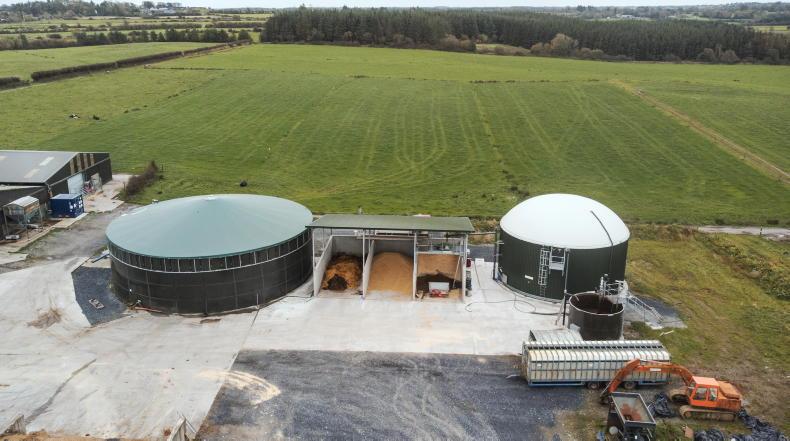
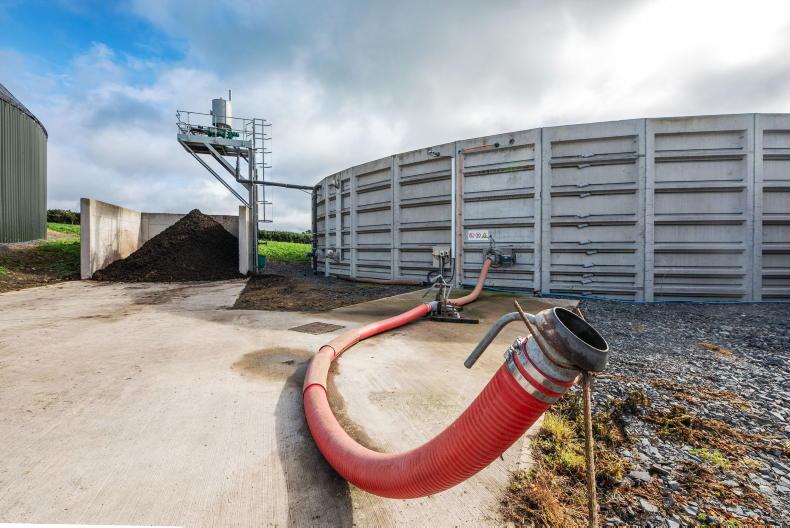
The AD tank.
The Irish Farmers Journal recently attended an open day on his farm, which drew farmers from all over the country.
Background
Brendan Gildea runs Riverview Farm, an organic dairy farm near Dunmore, Galway, supplying liquid milk from a herd of around 200 dairy cows.
The farm is fully self-sufficient in feed production, growing all its own peas, beans, cereals, red clover and silage across 500ac. Milking is carried out year-round through the use of four Lely robots. The cows are housed at night throughout the year and grazed by day during the grazing season.
Brendan built his organic-compliant yard in 2005 and is now Ireland’s longest-running robotic milking farmer.
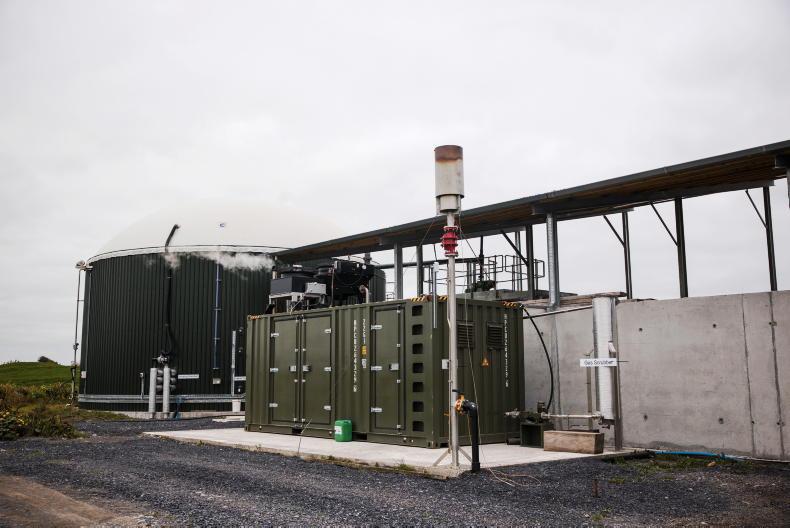
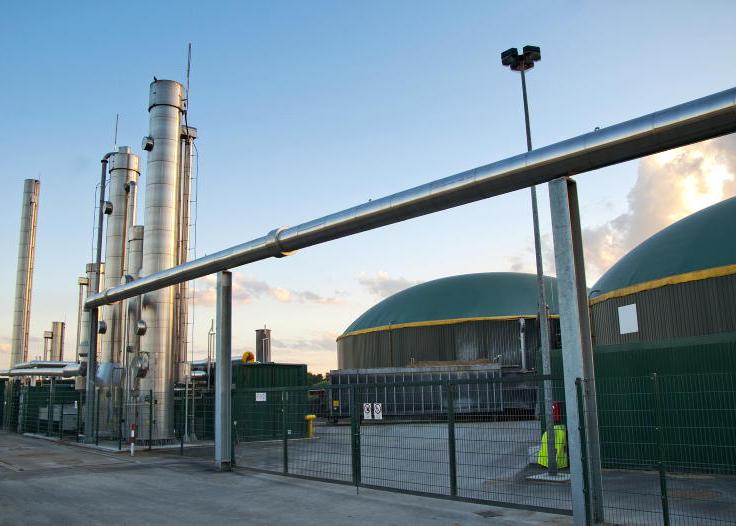
The CHP unit which generates heat and electricity.
What is farm-scale biogas?
A farm-scale biogas plant is wholly different to the large-scale plants currently in development. IrBEA describes the system as one that integrates with existing agricultural operations rather than replacing them. It relies on the same principle, using AD to make biogas.
But the system only uses materials already available on the farm, including slurry, manure, bedding and leftover feedstuffs, to produce the gas. Classified as an Animal By-Products (ABP) Regulation Type 9 biogas plant, it operates without the need for pasteurisation and requires no imported feedstocks.
Brendan’s plant
Brendan has always had an interest in renewables, biogas in particular. Given his early adoption of farm robotics, he is a forward thinker. He said when he saw the chance to work with IrBEA on this project, he jumped on it.
After securing planning permission, work began on building Brendan’s plant in 2024 and it is now fully operational. The system was built by Tank Storage Systems and designed by Ben Sage. It consists of a small sealed AD tank, a premixing tank and digestate storage tank. Slurry from the cow shed, manure and waste silage are mixed and macerated before entering the AD tank.
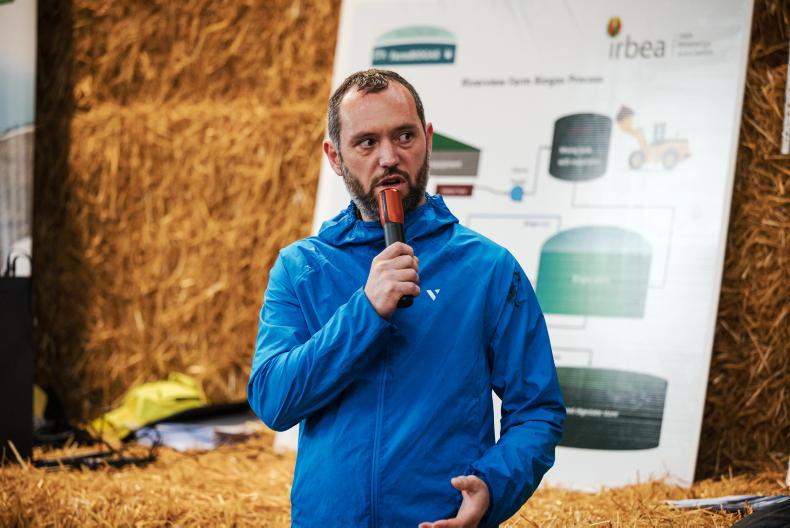
Ben Sage.
The plant operates continuously at 38-42°C. The feedstock, approximately 10.4 tonnes of slurry and one tonne of manure or silage per day (around 4,000 tonnes annually), remains in the 450m³ AD tank for around 40 days. The plant produces up to 450m³ of biogas per day, which is cleaned and used in the combined heat and power (CHP) generator.
When fully operational, the CHP unit will deliver 49kWh of electrical power and 55kWh of thermal energy. Electricity is used on the farm and exported to the grid, while the recovered heat maintains AD temperature and meets the farm needs.
The digestate is separated into solid and liquid fractions. The solid is stored for later spreading and the liquid is held in a covered store, both serving as nutrient-rich organic fertilisers.
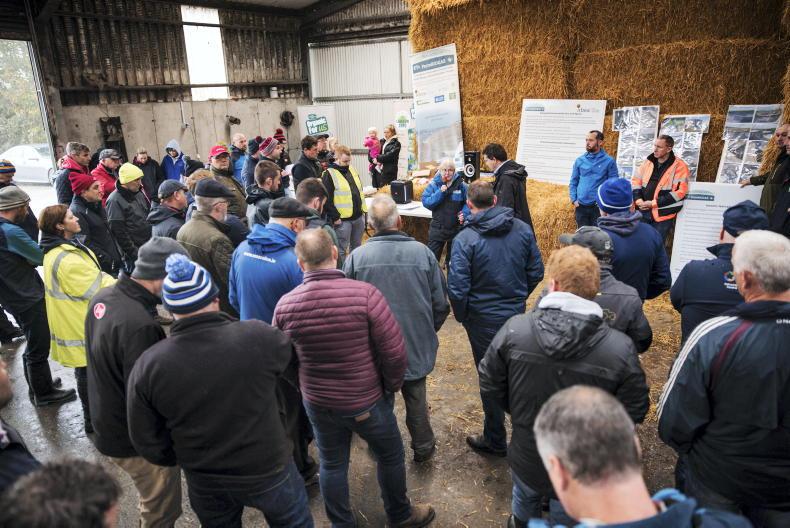
The Irish Farmers Journal recently attended a stormy open day in Galway, where farmers from all over the country attended.
IrBEA EIP project
The project was spearheaded by the team at IrBEA, under their Small Biogas Demonstration European Innovation Partnership (EIP) Project, supported by the Department of Agriculture. The project aimed to demonstrate how small, farm-scale biogas plants operate in practice, raise awareness of their potential, and assess their economic and environmental performance. When the project was launched, they envisaged building three small-scale plants around the country, but only one managed to progress to this stage.
As well as technical help, the EIP project provided a 50% capital grant towards the cost of building the plant, without which the project wouldn’t be viable.
Energy facts and figures
The business case for the biogas plant on Riverview farm was modelled on displacing imported electricity and oil, and securing the 50% grant. The electricity generated on-site replaces over €30,000 worth of purchased energy each year.
Since commissioning, the CHP unit has been producing between 24 and 28 kWh of electricity to meet the farm and plant’s needs. Brendan explained that, as ESB have not installed a three-phase smart meter on his farm yet, he won’t get paid for anything extra he exports to the grid. This is a widespread problem for small renewable electricity producers on three-phase connections.
The system’s recovered heat also replaces approximately 5,000 litres of heating oil annually.
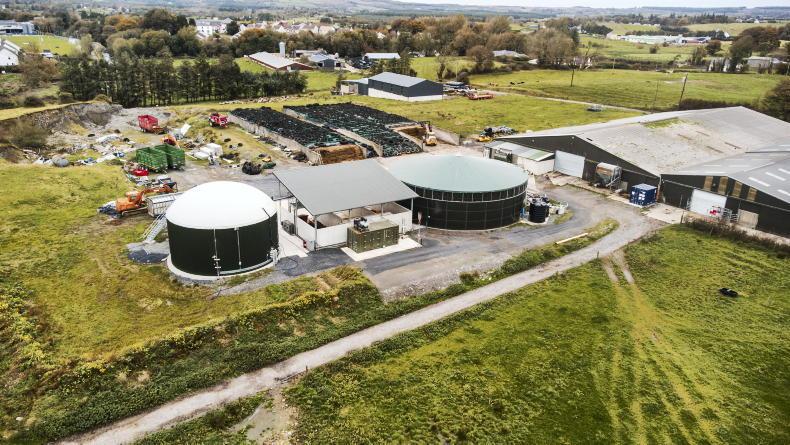
The biogas plant fits into his farm.
Each year, the plant will produce around 3,800 tonnes of digestate. Overall, the system is expected to deliver on-farm carbon savings of approximately 202 tonnes of CO2 equivalent per year through the displacement of fossil energy and reduced slurry emissions.
Economics
The total investment cost for the biogas plant itself was around €452,000 (excluding VAT). A 50% capital grant (€226,000) was secured under the EIP project.
This build cost includes the cover for the existing overground slurry store but excludes the cost of the digestate solid storage shed. Additional expenses were incurred for planning, grid connection and environmental assessments, however.
The expected payback period is between seven and seven-and-a-half years, with potential for a shorter timeframe when excess electricity can be sold to the grid.
Current on-farm feedstocks are capable of producing up to 70% more biogas than the farm’s own energy needs.
Lessons learned
The IrBEA Small Biogas Demonstration Project showed that farm-scale biogas production is both technically and economically viable in Ireland given the right support. Despite strong farmer interest, this model remains largely ignored by Government.
Thorough feedstock analysis is vital early on, as gas yields vary widely between and within materials like silage, manure and slurry.
Fresh slurry delivers the best results but requires suitable farm infrastructure and adequate digestate storage for timely nutrient spreading.
Future farm design should consider biogas potential, using efficient scraper systems and overground storage.
The project also identified issues with slow, inconsistent planning approvals and complex ESB grid and metering procedures that hinder small-scale generation.
However, a key conclusion of the project was that this scale of plant works well in Irish farms, but without a 50% capital grant, the payback would be too long.
A question we’re often asked in the Irish Farmers Journal is: why are the anaerobic digestion (AD) plants currently being developed so large?
The answer lies in the Government’s approach, which offers no ongoing subsidy and mandates consumers to pay full price for biomethane gas. This means larger plants are needed to avail of economies of scale.
That question is then usually followed up by: can it be done on my farm, at a much smaller scale? You would be forgiven for thinking it wasn’t possible as it’s currently not on the Government’s agenda. However, a new plant developed by Galwayman Brendan Gildea, along with the Irish Bioenergy Association (IrBEA), has turned this approach on its head, and he has shown that small-scale biogas isn’t just viable, it enhances the viability of his farm.
The AD tank.
The Irish Farmers Journal recently attended an open day on his farm, which drew farmers from all over the country.
Background
Brendan Gildea runs Riverview Farm, an organic dairy farm near Dunmore, Galway, supplying liquid milk from a herd of around 200 dairy cows.
The farm is fully self-sufficient in feed production, growing all its own peas, beans, cereals, red clover and silage across 500ac. Milking is carried out year-round through the use of four Lely robots. The cows are housed at night throughout the year and grazed by day during the grazing season.
Brendan built his organic-compliant yard in 2005 and is now Ireland’s longest-running robotic milking farmer.
The CHP unit which generates heat and electricity.
What is farm-scale biogas?
A farm-scale biogas plant is wholly different to the large-scale plants currently in development. IrBEA describes the system as one that integrates with existing agricultural operations rather than replacing them. It relies on the same principle, using AD to make biogas.
But the system only uses materials already available on the farm, including slurry, manure, bedding and leftover feedstuffs, to produce the gas. Classified as an Animal By-Products (ABP) Regulation Type 9 biogas plant, it operates without the need for pasteurisation and requires no imported feedstocks.
Brendan’s plant
Brendan has always had an interest in renewables, biogas in particular. Given his early adoption of farm robotics, he is a forward thinker. He said when he saw the chance to work with IrBEA on this project, he jumped on it.
After securing planning permission, work began on building Brendan’s plant in 2024 and it is now fully operational. The system was built by Tank Storage Systems and designed by Ben Sage. It consists of a small sealed AD tank, a premixing tank and digestate storage tank. Slurry from the cow shed, manure and waste silage are mixed and macerated before entering the AD tank.
Ben Sage.
The plant operates continuously at 38-42°C. The feedstock, approximately 10.4 tonnes of slurry and one tonne of manure or silage per day (around 4,000 tonnes annually), remains in the 450m³ AD tank for around 40 days. The plant produces up to 450m³ of biogas per day, which is cleaned and used in the combined heat and power (CHP) generator.
When fully operational, the CHP unit will deliver 49kWh of electrical power and 55kWh of thermal energy. Electricity is used on the farm and exported to the grid, while the recovered heat maintains AD temperature and meets the farm needs.
The digestate is separated into solid and liquid fractions. The solid is stored for later spreading and the liquid is held in a covered store, both serving as nutrient-rich organic fertilisers.
The Irish Farmers Journal recently attended a stormy open day in Galway, where farmers from all over the country attended.
IrBEA EIP project
The project was spearheaded by the team at IrBEA, under their Small Biogas Demonstration European Innovation Partnership (EIP) Project, supported by the Department of Agriculture. The project aimed to demonstrate how small, farm-scale biogas plants operate in practice, raise awareness of their potential, and assess their economic and environmental performance. When the project was launched, they envisaged building three small-scale plants around the country, but only one managed to progress to this stage.
As well as technical help, the EIP project provided a 50% capital grant towards the cost of building the plant, without which the project wouldn’t be viable.
Energy facts and figures
The business case for the biogas plant on Riverview farm was modelled on displacing imported electricity and oil, and securing the 50% grant. The electricity generated on-site replaces over €30,000 worth of purchased energy each year.
Since commissioning, the CHP unit has been producing between 24 and 28 kWh of electricity to meet the farm and plant’s needs. Brendan explained that, as ESB have not installed a three-phase smart meter on his farm yet, he won’t get paid for anything extra he exports to the grid. This is a widespread problem for small renewable electricity producers on three-phase connections.
The system’s recovered heat also replaces approximately 5,000 litres of heating oil annually.
The biogas plant fits into his farm.
Each year, the plant will produce around 3,800 tonnes of digestate. Overall, the system is expected to deliver on-farm carbon savings of approximately 202 tonnes of CO2 equivalent per year through the displacement of fossil energy and reduced slurry emissions.
Economics
The total investment cost for the biogas plant itself was around €452,000 (excluding VAT). A 50% capital grant (€226,000) was secured under the EIP project.
This build cost includes the cover for the existing overground slurry store but excludes the cost of the digestate solid storage shed. Additional expenses were incurred for planning, grid connection and environmental assessments, however.
The expected payback period is between seven and seven-and-a-half years, with potential for a shorter timeframe when excess electricity can be sold to the grid.
Current on-farm feedstocks are capable of producing up to 70% more biogas than the farm’s own energy needs.
Lessons learned
The IrBEA Small Biogas Demonstration Project showed that farm-scale biogas production is both technically and economically viable in Ireland given the right support. Despite strong farmer interest, this model remains largely ignored by Government.
Thorough feedstock analysis is vital early on, as gas yields vary widely between and within materials like silage, manure and slurry.
Fresh slurry delivers the best results but requires suitable farm infrastructure and adequate digestate storage for timely nutrient spreading.
Future farm design should consider biogas potential, using efficient scraper systems and overground storage.
The project also identified issues with slow, inconsistent planning approvals and complex ESB grid and metering procedures that hinder small-scale generation.
However, a key conclusion of the project was that this scale of plant works well in Irish farms, but without a 50% capital grant, the payback would be too long.





SHARING OPTIONS