


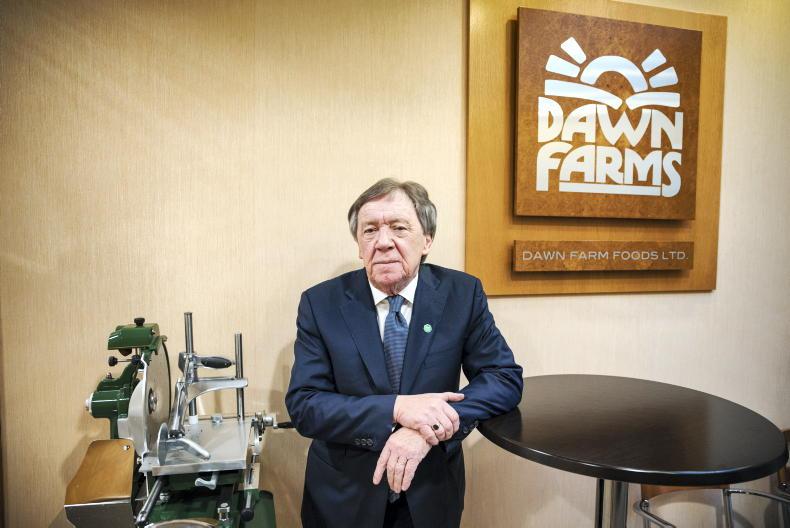
Monday evening saw the RTÉ News feature the resolution of the IFA/Bord Bia dispute, with Larry Murrin remaining in place but vacating the chair position for board meetings while an independent governance review takes place.
Immediately afterward, in an accident of timing that you couldn’t plan, came the documentary Goodman: Too Big To Fail.
Two Larrys, both of whom built up meat companies from the ground to international success. The commentary around the Larry Goodman documentary focused on how, when his Goodman International group was on the brink of financial ruin, emergency legislation passed by the Dáil, recalled from its summer recess, an unprecedented move in itself, bought enough time for Goodman to negotiate a pathway forward.
This was a key moment in Larry Goodman’s story, and the relationship between Irish politics and big business, so the interest is understandable.
Inevitably, farmers were asking if we had changed that much in the 35 years since. Did we not have another Irish Government protecting another so-called “beef baron” from accountability?
In this case, of course, it is Larry Murrin’s role as chair of Bord Bia that was being defended by Government, in the face of farmer fury at the revelation that Dawn Farm Foods was importing some Brazilian beef, and a lot of Brazilian chicken.
That whole issue has been well aired in these pages and elsewhere over the last six weeks. But one thing that is worth noting is how much the Irish beef sector has changed since the 1970s and 1980s in terms of where and how our beef is sold.
Intervention
As Larry Goodman built his business, a significant amount of Irish beef was sold into intervention, a system designed to cope with overproduction of food in Europe. This was a priority of a Europe that vividly remembered food shortages and hunger during and after World War II.
The MacSharry reforms in 1992 switched market supports from intervention payments and aid to private storage over to coupled subsidy payments to farmers. Bord Bia was established two years later, in part to help beef processors transform to fully market-led sales.
The war between Iran and Iraq had wrecked third-country exports, and the concentration was on developing EU markets in particular.
BSE then came along in 1996, a hammer blow to our beef exports. As farmers and processors had to eat from a smaller plate, tensions rose until the beef blockade of 2000. Relations were gradually restored, with the beef quality assurance scheme introduced in 2009.
Today, over 90% of Irish beef is exported to the UK or the EU. Notwithstanding the row over the suitability of Larry Murrin to chair Bord Bia, surely everyone can see that Irish beef processing, underpinned by the participation of 55,000 farmers in Bord Bia quality assurance schemes, has come a long way in 50 years.


SHARING OPTIONS