


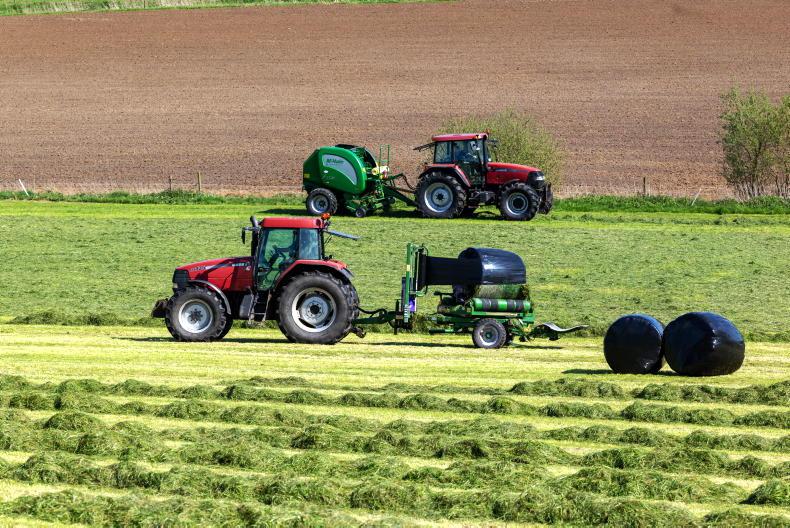
With the bulk of my silage crop being made in late May under ideal baling conditions, you might imagine that feeding it in the wintertime would be a straightforward procedure.
Simply send off a few representative samples for analysis, then match up each batch according to the nutritional requirements of sheep and cattle.
This, in theory, should see the highest energy material being kept for young growing cattle and heavily pregnant ewes.
But in practice, that is not how it works around here.
The first problem involves a cat (or perhaps cats) because I have discovered that the best silage this year (D-value 71) comes from a field where I suspect a feline wanderer has been sharpening its claws on my bales.
The bales are stacked individually in the corner, and I did notice a curled up pussy cat on top of a bale during the warm weeks of summer.
“How lovely”, I thought, “isn’t that just the picture of contentment.”
Despite being extremely fond of cats (our two, Winston and Ada, are better looked after than me), it is irritating to take the wrapping off a bale and find an area of waste silage.
The trouble is, there are no obvious ladders in the plastic; I can only assume that the cat’s claws just make pinholes in the wrap?
The upshot of this scenario is that these bales are not suitable for upending in a round feeder for sheep, since a spoiled area on one side is a real pain in the neck when it comes to getting it eaten clean and subsequently adding the next bale.
Therefore, these bales are being fed to cattle, where I can easily sweep away the waste material as the bale is finished.
Shower
A different problem has affected the bales at the rented farm.
They are all fed to sheep before they come home for lambing, and that particular field happened to hit a showery evening after mowing.
I reckoned it would be fine and confidently told the baler man that surface water on mown swards would have almost no visible effect on the ensiled grass. Wrong. Very wrong.
These bales have analysed D-value 69, but only 20% dry matter.
Believe me, trying to tip over a wet bale of silage, then slide below it with a bale lifter is nearly impossible.
In addition, when you slice the plastic with a knife, the water gushes out like a fountain.
I was a bit casual with the first of these bales and thought I would flip one over with the bale lifter, then transport it to some calves.
By the time I had turned it, lifted it, and driven across three fields, it was nearly football-shaped, and some of the bale was sagging onto the ground.
Trying to stand it up and remove the plastic was hard, but nothing compared to removing the netting.
Therefore, these bales are being carted home and fed to cattle by removing the wrap and netting whilst on the front-end loader.
And gloves are a vital part of this delicate operation due to the fragrancy of the voluminous effluent.
Second cut
While no-one deliberately sets out to make lower quality silage, my four acres of second cut (mown 30 June) didn’t analyse very well.
However, those high dry matter (DM), slightly stemmier bales are a joy to handle.
I am currently carting this very dry silage (42%DM, D-value 60) down the road and returning with the wet bales.
This must give my farming neighbours the impression that I have gone bonkers and am driving up and down the road with three bales on the tractor all the time.
And even though an ME of 9.7 is not high energy material, the combination of fibre and high dry matter makes mechanical handling a real pleasure.
These bales flip over like straw bales; they are dead easy to transport and don’t budge an inch when the netting is removed and the round feeder lifted over them.
Honestly, the ease of working with them almost outweighs the lower calorific value.
It’s just another case of that point where theoretical farming and real practical farming clash head on.
I’m supposed to celebrate my higher quality material and criticise those stemmier samples, but there are situations where it is so much easier to have bales that you might refer to as ‘traditional’.




SHARING OPTIONS