You could say cows and a bet both had a major part to play in Fiona McLoughlin opening her thriving pottery outlet in Co Leitrim.
The Aughavas native grew up on a dairy farm, spending her youth milking and doing farm jobs, so it’s not surprising that her signature ‘Old Cow’ range, or “big belly mugs”, take inspiration from the shape and markings of the bovine. Each individual piece also has a cow branding or stamp.
The theme continues in her shop name – Old Cow Clayworks in Drumshanbo – which she explains takes its cue from an incorrect translation of the Irish town name to the ‘Back of the Old Cow’ when it was anglicised. In reality, Droim Sean Boith or Droim Sean Bhó means ‘The Ridge of the Old Huts’.
But where does the bet fit in? Well, Fiona, who worked as a professional photographer for over 20 years, had always experimented with painting, drawing, sculpture and clay work in her spare time. “It was very natural to me to be always making something or playing with different creative outlets,” she comments.
When her partner Simon got her a pottery wheel for her birthday, she admits that it gave her the kick she needed. “He said if you make 500 pieces, we’ll open a shop, and I was like, ‘Challenge accepted,’” Fiona says of the bet, smiling as she talks about their competitive banter.
At the same time, she was looking for a slower pace of life, and being able to live and work hand-in-hand in the same place was very appealing.
“I started messing about on the pottery wheel, and I began to love it and then take it very seriously,” she recalls. With success over many months of trial and error, came belief.
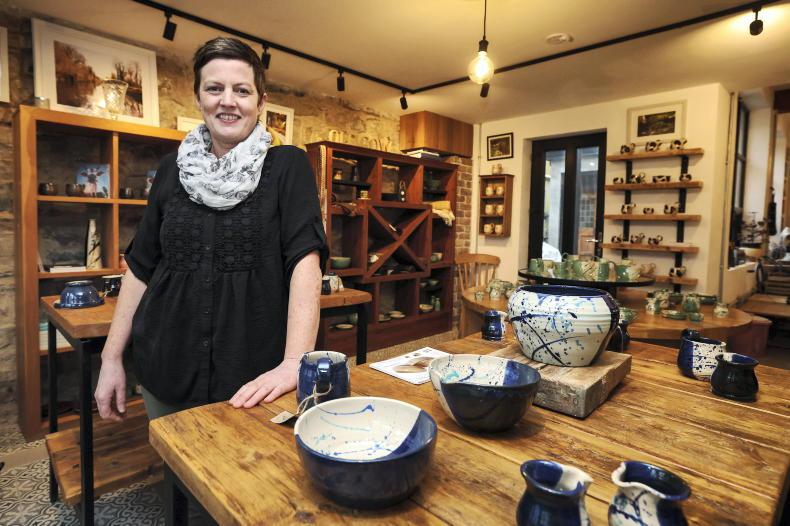
Surrounded by her pottery is Fiona McLoughlin, owner of Old Cow Clayworks, Drumshanbo. \ Lorraine O’Sullivan
Renovation journey
Next came testing the waters at local markets and an order from The Shed Distillery, which pushed her on another step to perfecting her craft. With lots of interest, she began to think a shop could be possible but couldn’t find a premises.
“Then this just happened for us,” Fiona recalls, her eyes darting around the former pub building in Drumshanbo she now calls home after a five-year renovation. “It wasn’t even for sale,” she adds, when her partner enquired about buying the large High Street premises. The pair had walked by it a few times and always thought it would make a great base.
“I love Drumshanbo; it is full of artists and craftspeople, music and poetry. It is just booming with creative people; if only we could get more shops to display that,” she suggests.
The couple actually ended up agreeing to buy the building without seeing it, which turned out to be lucky because the auctioneer was inundated with interest after the premises was used for a community event. Vacant for over 15 years, she jokes that they had a “what the hell have we done moment” when they saw it because it was an absolute mess.
In the middle of the mounds of bottles, a sagging studio roof and dark rooms, the couple could see immense potential for a home, shop and workspace. Then the pandemic happened, and “they really got stuck in” with all other work drying up and “ripped down every room one at a time”.
“That was the real turning point for us – the pandemic. It just gave me the time to be able to focus on the pottery to get it really up and running full-time and to get this place done as well.
“The way we decided to do it [the renovation] is whatever is old, let it be old, and whatever is new, show that it’s really new, like the steelwork or the tiles. A lot of people would not put that new tile with the old stone wall [retained in their kitchen/living room].”
While Fiona went back to work, her heart wasn’t in it, and she gave in her notice to focus on her dream. A fan of repurposing and salvage, the pair kept anything they could and managed the process themselves without an architect and using local tradespeople.
Using her graphic design and digital media background, Fiona used drawings of what she envisaged and availed of the Vacant Property Refurbishment Grant.
For anyone contemplating bringing an older building back to life, Fiona’s advice is simple and clear – “Just do it.”
“You do work for your €50,000, but at the same time, it’s a good chunk of money and well worth it. That €50,000 allowed us to up the standard of what we would have put in.
“It gave us free rein on certain things,” she comments. They also opted for natural products like hempcrete – hemp and lime on to the stone walls for insulation, which she says is “cosy as hell”.
While it was “a little bundle of madness” at times, it was all worth it as Fiona proudly shows Irish Country Living around the shop floor, previously the main bar, and the rest of her eclectic home.
Having seen an older man working in a small pottery studio and shop in Vinci, where Leonardo da Vinci is reputed to have grown up, many years before this was her template for her workspace.
“I just thought this was the best thing ever. Oh my God, he’s making pottery right in front of me. That was the idea of having the studio there [at the back of the shop].
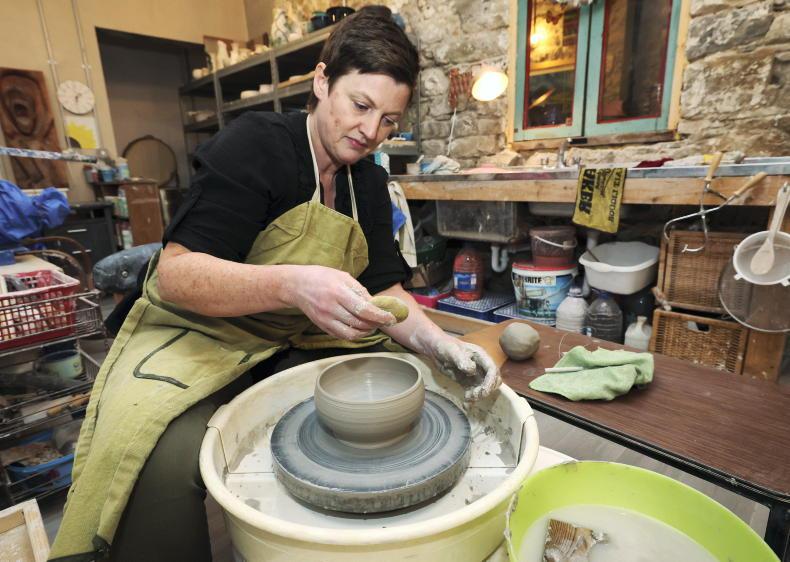
Fiona McLoughlin moulding pieces at the
pottery wheel. \ Lorraine O’Sullivan
The self-taught potter and mother of two enjoys the interaction with the public as she is making a vase or a butter dish.
“When you are making it there in front of them, they are asking questions, you’re educating them, and it’s not just a mug on the shelf,” she says, demonstrating how to make a vase on the electric pottery wheel, which whirrs in the background as we chat.
“I think there are definitely more people who are into Irish craft now and appreciate the work that goes into the pieces,” adds Fiona.
Small town optimism
While there are many naysayers on the future of small towns, she is full of optimism that they can rejuvenate themselves. One way would be to harness the power of artists, craftspeople and local farmers.
“My idea of High Street would be to have a weaver next door, someone blowing glass over there and a woodturner,” she says, adding that artists and craftspeople do need ongoing support on the business side because, often, that’s where they fall down.
After recently celebrating her first anniversary, Fiona’s big takeaway for anyone starting a new business is to get involved in their local community and they will support you.
“You can’t sit in a shop and wait for people to come to you. You have to throw marketing at it, you have to get into the community, and you have to go and find work,” she advises. This led her to doing a breakfast range for Kilronan Castle Hotel in Co Roscommon, mugs for a business in Carrick-on-Shannon and a local café.
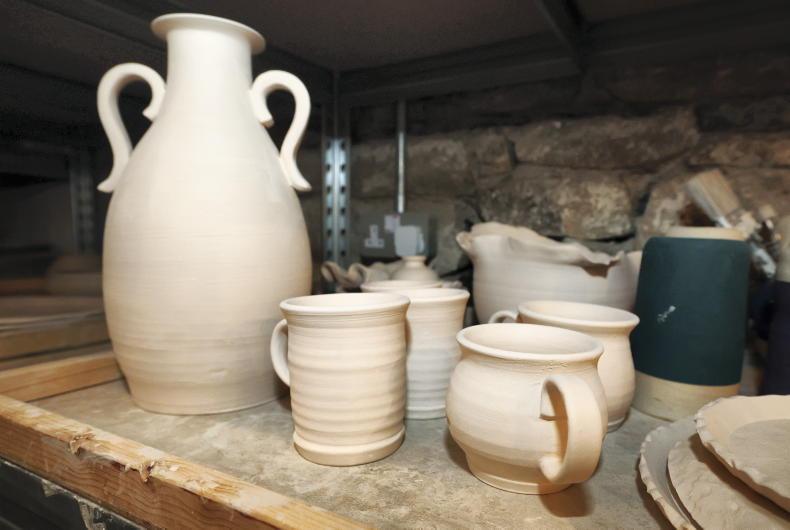
Some pieces ready for glazing.\ Lorraine O’Sullivan
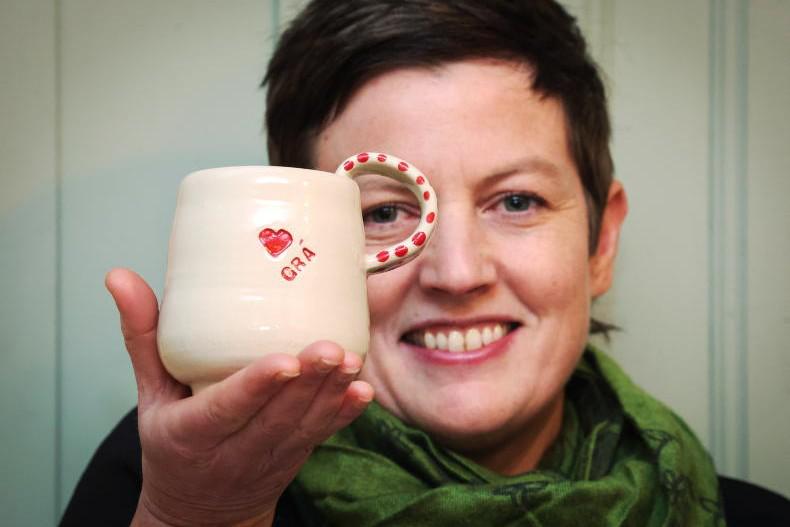
She also made commemorative pieces for the annual Joe Mooney Summer School, a festival that draws thousands of people to the town every year. Putting in that foundation has worked for her and drawn in a wide range of customers, from those coming from the mart to visitors or locals on the hunt for a handmade Leitrim gift like her popular Muga Grá range, bright green speckled collections or commissions.
Always looking to the local landscape for future inspiration, she is presently experimenting with glazes, using turf and gorse, and even the distinctive bottles of Drumshanbo Gin to make pieces that evoke the county in the future for sale and for an exhibition.
“Success for me is if I can make a living by working and making my own stuff and people continue to buy it, and I can live comfortably without any major stress; that to me is success. I’m happy with that.
See oldcowclayworks.com or
@oldcow_clayworks on Instagram.
You could say cows and a bet both had a major part to play in Fiona McLoughlin opening her thriving pottery outlet in Co Leitrim.
The Aughavas native grew up on a dairy farm, spending her youth milking and doing farm jobs, so it’s not surprising that her signature ‘Old Cow’ range, or “big belly mugs”, take inspiration from the shape and markings of the bovine. Each individual piece also has a cow branding or stamp.
The theme continues in her shop name – Old Cow Clayworks in Drumshanbo – which she explains takes its cue from an incorrect translation of the Irish town name to the ‘Back of the Old Cow’ when it was anglicised. In reality, Droim Sean Boith or Droim Sean Bhó means ‘The Ridge of the Old Huts’.
But where does the bet fit in? Well, Fiona, who worked as a professional photographer for over 20 years, had always experimented with painting, drawing, sculpture and clay work in her spare time. “It was very natural to me to be always making something or playing with different creative outlets,” she comments.
When her partner Simon got her a pottery wheel for her birthday, she admits that it gave her the kick she needed. “He said if you make 500 pieces, we’ll open a shop, and I was like, ‘Challenge accepted,’” Fiona says of the bet, smiling as she talks about their competitive banter.
At the same time, she was looking for a slower pace of life, and being able to live and work hand-in-hand in the same place was very appealing.
“I started messing about on the pottery wheel, and I began to love it and then take it very seriously,” she recalls. With success over many months of trial and error, came belief.
Surrounded by her pottery is Fiona McLoughlin, owner of Old Cow Clayworks, Drumshanbo. \ Lorraine O’Sullivan
Renovation journey
Next came testing the waters at local markets and an order from The Shed Distillery, which pushed her on another step to perfecting her craft. With lots of interest, she began to think a shop could be possible but couldn’t find a premises.
“Then this just happened for us,” Fiona recalls, her eyes darting around the former pub building in Drumshanbo she now calls home after a five-year renovation. “It wasn’t even for sale,” she adds, when her partner enquired about buying the large High Street premises. The pair had walked by it a few times and always thought it would make a great base.
“I love Drumshanbo; it is full of artists and craftspeople, music and poetry. It is just booming with creative people; if only we could get more shops to display that,” she suggests.
The couple actually ended up agreeing to buy the building without seeing it, which turned out to be lucky because the auctioneer was inundated with interest after the premises was used for a community event. Vacant for over 15 years, she jokes that they had a “what the hell have we done moment” when they saw it because it was an absolute mess.
In the middle of the mounds of bottles, a sagging studio roof and dark rooms, the couple could see immense potential for a home, shop and workspace. Then the pandemic happened, and “they really got stuck in” with all other work drying up and “ripped down every room one at a time”.
“That was the real turning point for us – the pandemic. It just gave me the time to be able to focus on the pottery to get it really up and running full-time and to get this place done as well.
“The way we decided to do it [the renovation] is whatever is old, let it be old, and whatever is new, show that it’s really new, like the steelwork or the tiles. A lot of people would not put that new tile with the old stone wall [retained in their kitchen/living room].”
While Fiona went back to work, her heart wasn’t in it, and she gave in her notice to focus on her dream. A fan of repurposing and salvage, the pair kept anything they could and managed the process themselves without an architect and using local tradespeople.
Using her graphic design and digital media background, Fiona used drawings of what she envisaged and availed of the Vacant Property Refurbishment Grant.
For anyone contemplating bringing an older building back to life, Fiona’s advice is simple and clear – “Just do it.”
“You do work for your €50,000, but at the same time, it’s a good chunk of money and well worth it. That €50,000 allowed us to up the standard of what we would have put in.
“It gave us free rein on certain things,” she comments. They also opted for natural products like hempcrete – hemp and lime on to the stone walls for insulation, which she says is “cosy as hell”.
While it was “a little bundle of madness” at times, it was all worth it as Fiona proudly shows Irish Country Living around the shop floor, previously the main bar, and the rest of her eclectic home.
Having seen an older man working in a small pottery studio and shop in Vinci, where Leonardo da Vinci is reputed to have grown up, many years before this was her template for her workspace.
“I just thought this was the best thing ever. Oh my God, he’s making pottery right in front of me. That was the idea of having the studio there [at the back of the shop].
Fiona McLoughlin moulding pieces at the
pottery wheel. \ Lorraine O’Sullivan
The self-taught potter and mother of two enjoys the interaction with the public as she is making a vase or a butter dish.
“When you are making it there in front of them, they are asking questions, you’re educating them, and it’s not just a mug on the shelf,” she says, demonstrating how to make a vase on the electric pottery wheel, which whirrs in the background as we chat.
“I think there are definitely more people who are into Irish craft now and appreciate the work that goes into the pieces,” adds Fiona.
Small town optimism
While there are many naysayers on the future of small towns, she is full of optimism that they can rejuvenate themselves. One way would be to harness the power of artists, craftspeople and local farmers.
“My idea of High Street would be to have a weaver next door, someone blowing glass over there and a woodturner,” she says, adding that artists and craftspeople do need ongoing support on the business side because, often, that’s where they fall down.
After recently celebrating her first anniversary, Fiona’s big takeaway for anyone starting a new business is to get involved in their local community and they will support you.
“You can’t sit in a shop and wait for people to come to you. You have to throw marketing at it, you have to get into the community, and you have to go and find work,” she advises. This led her to doing a breakfast range for Kilronan Castle Hotel in Co Roscommon, mugs for a business in Carrick-on-Shannon and a local café.
Some pieces ready for glazing.\ Lorraine O’Sullivan
She also made commemorative pieces for the annual Joe Mooney Summer School, a festival that draws thousands of people to the town every year. Putting in that foundation has worked for her and drawn in a wide range of customers, from those coming from the mart to visitors or locals on the hunt for a handmade Leitrim gift like her popular Muga Grá range, bright green speckled collections or commissions.
Always looking to the local landscape for future inspiration, she is presently experimenting with glazes, using turf and gorse, and even the distinctive bottles of Drumshanbo Gin to make pieces that evoke the county in the future for sale and for an exhibition.
“Success for me is if I can make a living by working and making my own stuff and people continue to buy it, and I can live comfortably without any major stress; that to me is success. I’m happy with that.
See oldcowclayworks.com or
@oldcow_clayworks on Instagram.





SHARING OPTIONS