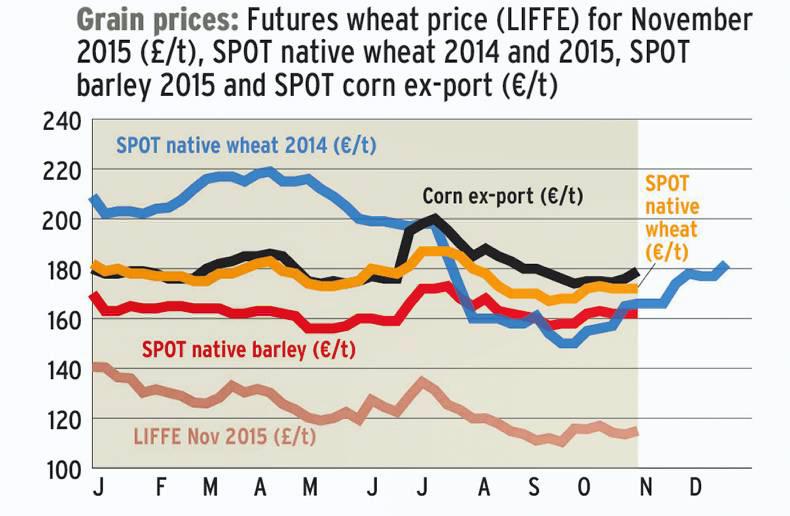
While futures wheat prices on MATIF showed slight but continuous improvement over the past six weeks, the nearby spot/cash/physical market prices have been largely static. Various things continue to influence world markets, but the situation remains flat for physical markets, except for currency.
Over the last while, the gap between physical (the price the seller can actually achieve for physical product) and futures prices has been increasing, with physical prices being lower.
Weather continues to impact on the market. The HGCA reports that dry weather in September reduced yield potential in Australia, but rain is now threatening to impact on its quality. This could cause part of the crop to be downgraded from milling to feed wheat.
ADVERTISEMENT
Dryness is reported to be causing problems for winter-planted wheat in some regions. HGCA reports that US wheat has had a difficult start due to drier than expected conditions in key growing regions. Problems are also suggested in Ukraine where reports suggest that harvest output could be down by onethird in 2016 due to autumn drought and poor crop conditions going into winter. And it is estimated that about 14% of the intended plantings did not occur.
The EU is not immune either, with eastern states like Poland reporting winter crop concerns due to dryness.
Native prices remain broadly similar, with spot wheat and barley still in the €170 to €173/t range and barley around €160 to €163/t. Forward prices for May are stronger at €178 to €180/t for wheat and €10 under for barley. Prices for November 2016 are up slightly with €183 to €185/t talked about for wheat and €173 to €175/t for barley.
Register for free to read this story and our free stories.
This content is available to digital subscribers and loyalty code users only. Sign in to your account, use the code or subscribe to get unlimited access.
The reader loyalty code gives you full access to the site from when you enter it until the following Wednesday at 9pm. Find your unique code on the back page of Irish Country Living every week.
CODE ACCEPTED
You have full access to the site until next Wednesday at 9pm.
CODE NOT VALID
Please try again or contact support.
While futures wheat prices on MATIF showed slight but continuous improvement over the past six weeks, the nearby spot/cash/physical market prices have been largely static. Various things continue to influence world markets, but the situation remains flat for physical markets, except for currency.
Over the last while, the gap between physical (the price the seller can actually achieve for physical product) and futures prices has been increasing, with physical prices being lower.
Weather continues to impact on the market. The HGCA reports that dry weather in September reduced yield potential in Australia, but rain is now threatening to impact on its quality. This could cause part of the crop to be downgraded from milling to feed wheat.
Dryness is reported to be causing problems for winter-planted wheat in some regions. HGCA reports that US wheat has had a difficult start due to drier than expected conditions in key growing regions. Problems are also suggested in Ukraine where reports suggest that harvest output could be down by onethird in 2016 due to autumn drought and poor crop conditions going into winter. And it is estimated that about 14% of the intended plantings did not occur.
The EU is not immune either, with eastern states like Poland reporting winter crop concerns due to dryness.
Native prices remain broadly similar, with spot wheat and barley still in the €170 to €173/t range and barley around €160 to €163/t. Forward prices for May are stronger at €178 to €180/t for wheat and €10 under for barley. Prices for November 2016 are up slightly with €183 to €185/t talked about for wheat and €173 to €175/t for barley.
If you would like to speak to a member of our team, please call us on 01-4199525.
Link sent to your email address
We have sent an email to your address. Please click on the link in this email to reset your password. If you can't find it in your inbox, please check your spam folder. If you can't find the email, please call us on 01-4199525.
ENTER YOUR LOYALTY CODE:
The reader loyalty code gives you full access to the site from when you enter it until the following Wednesday at 9pm. Find your unique code on the back page of Irish Country Living every week.








SHARING OPTIONS