


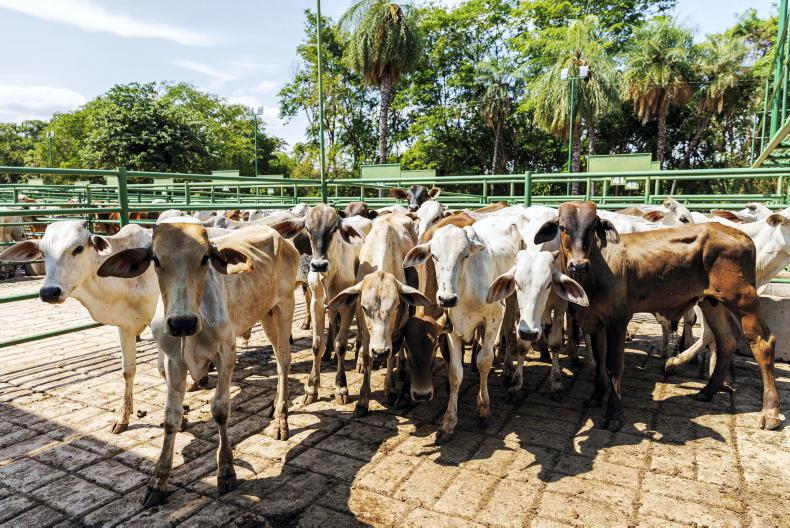
Brazil exported 3.1m tonnes of beef this year to the end of November, which is almost 243,000t more than was exported in all of 2024. This is according to ABIEC, the trade association that represents the companies that export 98% of Brazil’s beef. This is the latest landmark in an era of rapid growth in Brazilian beef exports.
As Table 1 shows, it is just five years since Brazil’s beef exports passed 2m tonnes for the first time, having exceeded 1m tonnes in 2004.
The growth in value of Brazil’s beef exports has been equally spectacular. As Table 2 shows, it first passed $1bn (€850m) in 2001, and while it fluctuated in value from year to year, the overall trend has been upwards, reaching $16.1bn (€13.6bn) this year.
Translating this to value per tonne, it has increased from $2,961 (€2,509) in 1998 to $5,171 (€4,382) per tonne this year. As Table 3 shows, this also reflects annual fluctuation, but as with overall export value, the trend has been upwards.
Last month, 352,565t of beef were exported, the second-highest monthly total on record and just behind the 353,156t exported in October.
In November 2024, Brazil’s beef exports were 258,743t, so the monthly total this year is almost 95,000t higher.
China
Brazil has moved from exporting twice as much beef as Ireland in 2004, to almost six times as much in 2025. To achieve this level of expansion, it was necessary to develop new export markets. This phase of export growth coincided with a period of rapid expansion in demand for beef in China. As Figure 1 shows, in 2012, China imported just over 70,000t of beef, but annual imports increased rapidly thereafter.
Its beef imports passed 1m tonnes in 2018 and this doubled to over 2.1m two years later in 2020. Since then, China’s annual beef imports have continued to grow, reaching 2.874m tonnes in 2024, but the rate of increase has slowed down.
Up to the end of October this year, China imported 2.406m tonnes, which is slightly ahead of the same period last year and it is doubtful if the 3m tonne beef import barrier will be passed by the end of the year.
United States
The US has had a volatile trading relationship with Brazil this year, with an additional 50% tariff added to beef imports for several weeks in the middle of the year. This caused beef imports to slow down from the record pace being set in the first half of the year. However when the 50% tariff was removed last month, the pace of Brazil’s beef exports to the US increased again.
USDA import data shows that despite the tariffs, overall the volume of beef imported from Brazil in 2025 to the end of the first week of December was 215,290t, 22% up on the 176,256t imported in the same period last year.
The US, like the EU, is a market that is both a major importer and exporter of beef. It is currently experiencing a reduction in cattle supply, with the national herd at its lowest level in over 70 years.
This is reflected in its trade patterns, with overall beef imports up 9% to 1.5m tonnes so far this year, compared to just under 1.4m tonnes imported in the same period last year. Up to the end of September 2025, US Meat Exporters Federation data shows beef exports were 856,023t, which is 11% lower than the same period last year.
European Union
Prior to the rapid expansion of the China and US markets for Brazilian beef, the European Union was its main export market. In 2006, ABIEC data shows that over 420,000t were exported to the EU, but this declined in subsequent years, as other markets developed.
However, looking at the latest EU data on beef imports from Brazil in Figure 2, we can see that there has been a sharp increase this year, with 53,853t imported in the nine months to the end of September. The EU and the UK, have been lucrative markets for all major beef exporting countries this year, as production has fallen significantly in most European countries.
Comment: Brazil’s expansion meets increased global demand
Brazil is now firmly established as the world’s largest beef exporter. In 2025 its volumes will be more than twice those of Australia and the United States – the second and third largest exporters. Brazil has a long tradition of trade with Europe, but it has been China and more recently the US that have been the main customers for Brazilian beef. The USDA is forecasting that Brazil will produce and export less beef in 2026. This suggests that the rapid expansion period may be coming to an end, but Brazil will remain the main beef exporting country in the world for the foreseeable future.





SHARING OPTIONS