While we are only in the very early stages of the conflict in the Middle East, the effects on global markets are already being felt. Following the attacks launched by Israel and US at the weekend against Iran, the first two trading days of March saw gas prices in Europe double, while the price of oil climbed above $80 (€69) a barrel (see Figure 1).
While higher fuel costs seem inevitable in the short-term, the biggest risk for farmers comes from fertiliser prices. Iran is one of the world’s largest urea exporters, while other countries in the region are both exporters of fertilisers and liquefied natural gas which is used in fertiliser production in other countries. Around a third of global seaborne urea trade passes through the Strait of Hormuz in the Persian Gulf, which has been effectively closed to shipping traffic (see 'Choke point').
As well as the disruption to fertiliser and gas exports through that shipping channel, there are other challenges to production which will become increasingly important, should the conflict become prolonged.
Egypt, another major exporter of urea, is reliant on gas imports from Israel for a significant proportion of its production. Israel has already temporarily halted production from the Leviathan natural gas reservoir which supplies both Egypt and Jordan, as well as helping to meet domestic needs. In Europe the mild winter, coupled with new rules around gas storage, has meant that the region’s gas-storage operators have allowed stockpiles to fall well below normal levels for this time of year. Currently EU storage is only 30% full, the lowest level since the Russian invasion of Ukraine.
In Germany, a major manufacturer of fertiliser, the level is close to 20%, the lowest since 2018. Ireland has neither a domestic gas stockpile nor any fertiliser manufacturing capacity.
If gas supplies in Europe are at risk, or if the price moves too high, then heavy users such as fertiliser manufacturers may be requested to halt production.
The longer the conflict drags on, the greater the risk of price increases becomes. Urea prices in the EU didn’t peak until two months after the Russian invasion of Ukraine
We are still some way from that scenario, with fertiliser stocks on the ground sufficient for the next one to two months. Large gas consumers will usually have price hedges in place – where they have bought gas for the coming months at prices which were available before the conflict broke out.
This means that we should not see an immediate significant rise in prices either at the pump for diesel, or in the merchant’s yard for fertiliser.
However, the longer the conflict drags on, the greater the risk of price increases becomes. Urea prices in the EU didn’t peak until two months after the Russian invasion of Ukraine.
Exports
As well as being hit by the closure of shipping from the region, Ireland may also face difficulties in getting exports into the region. Dairy exports to the Middle East have held between €300m and €400m per year for the last decade and Ornua has offices in Dubai and a manufacturing site in Saudi Arabia.
Conor Mulvihill, director of Dairy Industry Ireland, said: “As we navigate the current instability in the Middle East, our primary focus remains the safety and well-being of our teams working on the ground and thoughts with the people of the region.
“While our dairy and specialised nutrition exports are currently moving without significant disruption, we are not complacent and are monitoring the geopolitical situation hour-by-hour. The real challenge at present lies in the mounting pressure on global supply chains and the inevitable spike in shipping & energy costs.”
Prices
Away from the direct impacts of energy prices on fuel and fertiliser, there are risks from a wider increase in inflation, with those risks increasing the longer the conflict lasts.
Pressure
European Central Bank Chief Economist Philip Lane warned this week that the conflict puts pressure on inflation, especially in the near term, and would also be negative for economic growth in the euro-area.
“The scale of the impact and the implications for medium-term inflation depend on the breadth and duration of the conflict,” he said in an interview with the Financial Times.
Taoiseach Micheál Martin warned companies not to take advantage of the situation to immediately increase prices. “There is no excuse for prices going up at the pump [on Monday],” he said, adding that the Government met with the “competition and consumer authority” to ask them to examine the industry and sector in terms of unfair pricing practices.
On Tuesday 2 March Iranian armed forces announced that the Strait of Hormuz was closed and that any ship that entered the stretch of water would be set on fire. There were already reports of ships being fired on in the strait ahead of that announcement.
This announcement, coupled with the refusal of insurance companies to cover the risk of crossing the waterway effectively halted the passage of ships through the area.
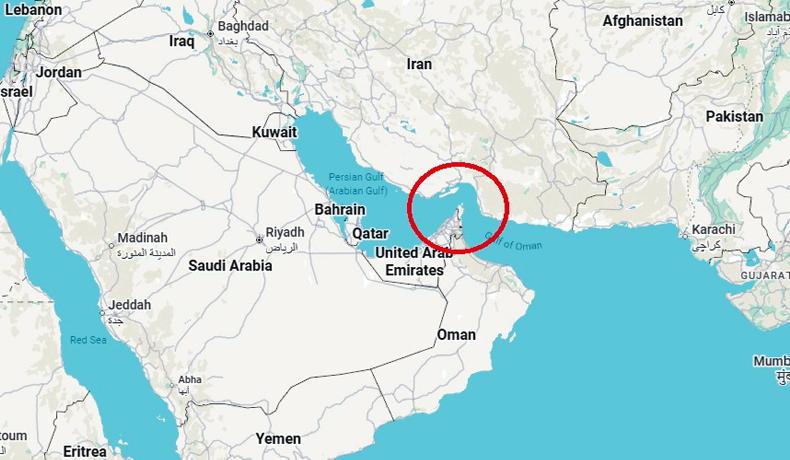
Strait of Hormuz, circled in red.
While a closure for a couple of days would not cause much damage to global growth, a prolonged closure of the strait will have serious consequences. Around 20% of the world’s daily oil needs pass along the route, oil that cannot easily be replaced from other sources. OPEC, the umbrella body for oil exporting nations, said that it would increase production to mitigate shortages, but much of OPEC’s production normally travels along the now-closed route.
The effect on fertiliser markets could be even more severe, as much of the product needed in the Indian market travels through the strait. India will have to source the product elsewhere ahead of its main growing season if it remains unavailable from its usual source, a move which would increase competition for European buyers.
It is also important to remember that the strait goes two ways. Australia is a significant exporter of sheepmeat and beef to the region.
Shipments of frozen meat will be halted, while the export of chilled meat in aircraft is also suspended as airports in the region remain closed. Once again, the longer the situation drags on, the wider the effects will be. If the Middle East market effectively closes to Australian beef, then that meat will have to find space in another market.
It is important to stress that we are only in the opening days of the conflict in the Middle East and there is no certainty about how things will develop from here.
If there is a rapid resolution, and a reopening of trade routes, then oil and gas prices will quickly return close to the levels which prevailed ahead of the outbreak of hostilities.
At the time of writing, however, a rapid resolution looks unlikely, and markets are currently pricing for an extended disruption to trade in the region. For many, this means pulling out the lessons that were learned in the wake of the Russian invasion of Ukraine.
The supply-chain effects from that hit every part of the economy, causing elevated global inflation for a couple of years and sluggish economic growth.
There were higher prices for some agricultural output, but any increase in prices was swallowed by surging input prices in feed, fuel and fertiliser.
Fertiliser
While farmers should all hope for a rapid resolution, they should also prepare as much as they can for longer disruptions. Right now, this means making sure they have as much of their fertiliser needs for the year in the yard as possible.
Many of the farmers we have talked to are already well ahead of the game on this, buying before of the introduction of CBAM charges.
While we are only in the very early stages of the conflict in the Middle East, the effects on global markets are already being felt. Following the attacks launched by Israel and US at the weekend against Iran, the first two trading days of March saw gas prices in Europe double, while the price of oil climbed above $80 (€69) a barrel (see Figure 1).
While higher fuel costs seem inevitable in the short-term, the biggest risk for farmers comes from fertiliser prices. Iran is one of the world’s largest urea exporters, while other countries in the region are both exporters of fertilisers and liquefied natural gas which is used in fertiliser production in other countries. Around a third of global seaborne urea trade passes through the Strait of Hormuz in the Persian Gulf, which has been effectively closed to shipping traffic (see 'Choke point').
As well as the disruption to fertiliser and gas exports through that shipping channel, there are other challenges to production which will become increasingly important, should the conflict become prolonged.
Egypt, another major exporter of urea, is reliant on gas imports from Israel for a significant proportion of its production. Israel has already temporarily halted production from the Leviathan natural gas reservoir which supplies both Egypt and Jordan, as well as helping to meet domestic needs. In Europe the mild winter, coupled with new rules around gas storage, has meant that the region’s gas-storage operators have allowed stockpiles to fall well below normal levels for this time of year. Currently EU storage is only 30% full, the lowest level since the Russian invasion of Ukraine.
In Germany, a major manufacturer of fertiliser, the level is close to 20%, the lowest since 2018. Ireland has neither a domestic gas stockpile nor any fertiliser manufacturing capacity.
If gas supplies in Europe are at risk, or if the price moves too high, then heavy users such as fertiliser manufacturers may be requested to halt production.
The longer the conflict drags on, the greater the risk of price increases becomes. Urea prices in the EU didn’t peak until two months after the Russian invasion of Ukraine
We are still some way from that scenario, with fertiliser stocks on the ground sufficient for the next one to two months. Large gas consumers will usually have price hedges in place – where they have bought gas for the coming months at prices which were available before the conflict broke out.
This means that we should not see an immediate significant rise in prices either at the pump for diesel, or in the merchant’s yard for fertiliser.
However, the longer the conflict drags on, the greater the risk of price increases becomes. Urea prices in the EU didn’t peak until two months after the Russian invasion of Ukraine.
Exports
As well as being hit by the closure of shipping from the region, Ireland may also face difficulties in getting exports into the region. Dairy exports to the Middle East have held between €300m and €400m per year for the last decade and Ornua has offices in Dubai and a manufacturing site in Saudi Arabia.
Conor Mulvihill, director of Dairy Industry Ireland, said: “As we navigate the current instability in the Middle East, our primary focus remains the safety and well-being of our teams working on the ground and thoughts with the people of the region.
“While our dairy and specialised nutrition exports are currently moving without significant disruption, we are not complacent and are monitoring the geopolitical situation hour-by-hour. The real challenge at present lies in the mounting pressure on global supply chains and the inevitable spike in shipping & energy costs.”
Prices
Away from the direct impacts of energy prices on fuel and fertiliser, there are risks from a wider increase in inflation, with those risks increasing the longer the conflict lasts.
Pressure
European Central Bank Chief Economist Philip Lane warned this week that the conflict puts pressure on inflation, especially in the near term, and would also be negative for economic growth in the euro-area.
“The scale of the impact and the implications for medium-term inflation depend on the breadth and duration of the conflict,” he said in an interview with the Financial Times.
Taoiseach Micheál Martin warned companies not to take advantage of the situation to immediately increase prices. “There is no excuse for prices going up at the pump [on Monday],” he said, adding that the Government met with the “competition and consumer authority” to ask them to examine the industry and sector in terms of unfair pricing practices.
On Tuesday 2 March Iranian armed forces announced that the Strait of Hormuz was closed and that any ship that entered the stretch of water would be set on fire. There were already reports of ships being fired on in the strait ahead of that announcement.
This announcement, coupled with the refusal of insurance companies to cover the risk of crossing the waterway effectively halted the passage of ships through the area.
Strait of Hormuz, circled in red.
While a closure for a couple of days would not cause much damage to global growth, a prolonged closure of the strait will have serious consequences. Around 20% of the world’s daily oil needs pass along the route, oil that cannot easily be replaced from other sources. OPEC, the umbrella body for oil exporting nations, said that it would increase production to mitigate shortages, but much of OPEC’s production normally travels along the now-closed route.
The effect on fertiliser markets could be even more severe, as much of the product needed in the Indian market travels through the strait. India will have to source the product elsewhere ahead of its main growing season if it remains unavailable from its usual source, a move which would increase competition for European buyers.
It is also important to remember that the strait goes two ways. Australia is a significant exporter of sheepmeat and beef to the region.
Shipments of frozen meat will be halted, while the export of chilled meat in aircraft is also suspended as airports in the region remain closed. Once again, the longer the situation drags on, the wider the effects will be. If the Middle East market effectively closes to Australian beef, then that meat will have to find space in another market.
It is important to stress that we are only in the opening days of the conflict in the Middle East and there is no certainty about how things will develop from here.
If there is a rapid resolution, and a reopening of trade routes, then oil and gas prices will quickly return close to the levels which prevailed ahead of the outbreak of hostilities.
At the time of writing, however, a rapid resolution looks unlikely, and markets are currently pricing for an extended disruption to trade in the region. For many, this means pulling out the lessons that were learned in the wake of the Russian invasion of Ukraine.
The supply-chain effects from that hit every part of the economy, causing elevated global inflation for a couple of years and sluggish economic growth.
There were higher prices for some agricultural output, but any increase in prices was swallowed by surging input prices in feed, fuel and fertiliser.
Fertiliser
While farmers should all hope for a rapid resolution, they should also prepare as much as they can for longer disruptions. Right now, this means making sure they have as much of their fertiliser needs for the year in the yard as possible.
Many of the farmers we have talked to are already well ahead of the game on this, buying before of the introduction of CBAM charges.







SHARING OPTIONS