The presentations to members of both Aurivo and Dale Farm co-ops in recent weeks were very good at laying out the business logic for the deal.
Looking at the numbers, it is clear that a Aurivo-Dale Farm co-op merger would have the benefit of scale, while also having a well-diversified portfolio.
The new co-op would have earned just under 40% of its revenue from consumer foods, a similar share from ingredients, with the balance of revenue from both co-ops’ agribusinesses and Aurivo’s mart enterprises (see Figure 1).
Measured by profitability, the co-op would have been the second-largest in the country on an earnings basis.
Why?
The presentations to members posed the questions “why merge, and why now?” and answered the first of those by pointing to the opportunities to reduce costs, increase profits, build resilience through scale and enhance the growth prospects for the combined operation. It was presented that a mixture of by-product utilisation, a review of overheads and increased efficiency in product procurement would be worth 1c/l to suppliers.
The co-ops also outlined details of the proposal which tried to address some of the concerns which had emerged since the potential merger was announced. Members were told: “The merged co-op confirms that any part of the business of the merged co-op that is profitable and does not require investment that would be commercially unjustifiable relative to the level of profit generated, shall not be subject to closure.”
Details were also provided on the make-up of the board of the new entity (10 from Dale Farm and five from Aurivo), and the identity of the CEO (Nick Whelan, current Dale Farm CEO) while also emphasising that the co-op would maintain a presence in Sligo and hold some board meetings there.
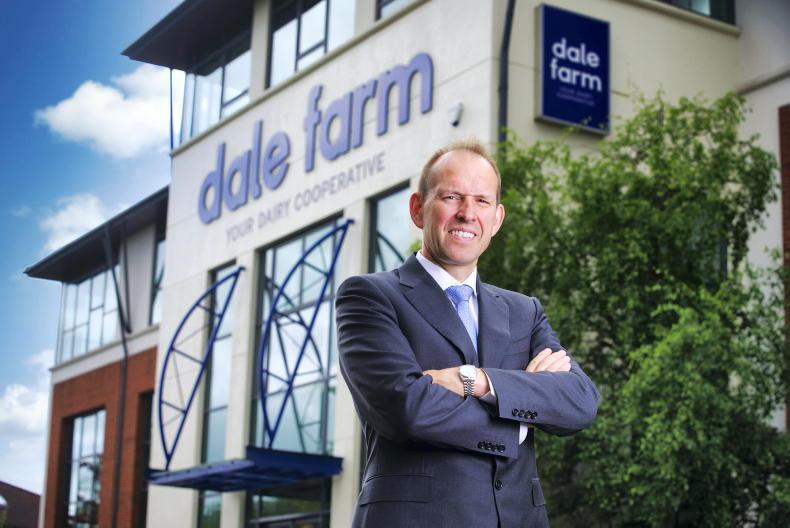
Nick Whelan, CEO of Dale Farm, would have been the CEO of the new entity.
Despite all the strong financial and business arguments in favour of the merger, the co-ops issued a joint statement last week which said: “Following detailed discussions and exploration over recent months, both co-operatives have decided that now is not the right time to proceed with a merger process.”
The boards of both operations had to make a judgement on where the prospects of getting the merger through membership votes were.
The Irish Farmers Journal understands that both co-ops were confident of getting the required 75% of the votes needed to get the deal over the line, but it was felt that a transformative move like this would have needed near-universal member support to establish the new co-op on the right footing.
Relationship not at an end
The decision not to go ahead with the merger does not mean an end to the relationship between both operations. The joint statement went on to say that the boards of both co-ops “have agreed to work together on projects including by-product utilisation and added-value protein”.
The statement added that by building on the close working relationship developed between the co-operatives over the past five years, “the partnership will enable both organisations to maximise synergies, optimise market opportunities and drive operational excellence”.
The proposed partnership is still in its early phase, with the co-ops setting up a steering group with representatives from both organisations to guide the strategic partnership.
Despite this, they said that work is set to begin immediately on the initial projects identified for the partnership.
The other task that will need to be completed now that the decision not to proceed with the merger has been made is for Aurivo to find a new CEO.
The merger would have negated the need to find a replacement for Donal Tierney who is set to retire from his leadership role at Aurivo.
Tierney told the Irish Farmers Journal that he intends to stay in the role until his replacement is appointed, a process that could take several months.
It was perhaps telling that the presentation to members of both co-ops was better at answering the “why merge” question than it was at answering the “why now” question it had posed.
Recent mergers in Irish dairy processing have been takeovers, or rescues, of struggling co-ops by their financially stronger neighbours. In the case of both Tipperary Co-op, now part of ArraTipp, and LacPatrick, now part of Lakeland, the writing was on the wall for the smaller, struggling operations. For the members, the choice was a stark one: either agree to the proposed “merger” as presented or risk not having your milk collected.
The proposal put on the table by Aurivo and Dale Farm is an entirely different beast. Both co-ops are financially strong, well-managed and growing. Both co-ops are profitable, with Dale Farm producing industry-leading margins in recent years.
This financial strength is perhaps the Achilles heel for the potential merger.
There is every chance that members of both operations feel quite comfortable with the co-operative that they have built up over generations. The lack of pressure to make a decision to join forces with another operation significantly raises the bar for persuading those members to both back the deal, and to see the new entity as ‘their’ co-op.
The boards of the co-ops are obviously aware of this difficulty. Perhaps that is some of the motivation behind the decision to proceed with a partnership arrangement, rather than walk away from each other entirely. They may feel that a longer courtship could improve the chances of a successful marriage in future.
There is a wider issue for this island’s dairy industry that does need to be addressed, and it was highlighted in the presentation given to the members of these co-ops when they were pitching the merger idea.
Total milk production on the island is approximately 11.6bn litres. That is equal to about half the milk pool of Lactalis or Fonterra, and well below half of Dairy Farmers of America. While scale certainly isn’t everything, there are plenty of benefits to having larger processors.
The decision on whether Ireland should have fewer larger co-ops is completely down to the members of those co-ops. But, if mergers are to happen, it is better for everyone that they are entered when both operations are coming from a position of strength, rather than the forced rescues which have been the hallmark of any sector consolidation in recent years.
The presentations to members of both Aurivo and Dale Farm co-ops in recent weeks were very good at laying out the business logic for the deal.
Looking at the numbers, it is clear that a Aurivo-Dale Farm co-op merger would have the benefit of scale, while also having a well-diversified portfolio.
The new co-op would have earned just under 40% of its revenue from consumer foods, a similar share from ingredients, with the balance of revenue from both co-ops’ agribusinesses and Aurivo’s mart enterprises (see Figure 1).
Measured by profitability, the co-op would have been the second-largest in the country on an earnings basis.
Why?
The presentations to members posed the questions “why merge, and why now?” and answered the first of those by pointing to the opportunities to reduce costs, increase profits, build resilience through scale and enhance the growth prospects for the combined operation. It was presented that a mixture of by-product utilisation, a review of overheads and increased efficiency in product procurement would be worth 1c/l to suppliers.
The co-ops also outlined details of the proposal which tried to address some of the concerns which had emerged since the potential merger was announced. Members were told: “The merged co-op confirms that any part of the business of the merged co-op that is profitable and does not require investment that would be commercially unjustifiable relative to the level of profit generated, shall not be subject to closure.”
Details were also provided on the make-up of the board of the new entity (10 from Dale Farm and five from Aurivo), and the identity of the CEO (Nick Whelan, current Dale Farm CEO) while also emphasising that the co-op would maintain a presence in Sligo and hold some board meetings there.
Nick Whelan, CEO of Dale Farm, would have been the CEO of the new entity.
Despite all the strong financial and business arguments in favour of the merger, the co-ops issued a joint statement last week which said: “Following detailed discussions and exploration over recent months, both co-operatives have decided that now is not the right time to proceed with a merger process.”
The boards of both operations had to make a judgement on where the prospects of getting the merger through membership votes were.
The Irish Farmers Journal understands that both co-ops were confident of getting the required 75% of the votes needed to get the deal over the line, but it was felt that a transformative move like this would have needed near-universal member support to establish the new co-op on the right footing.
Relationship not at an end
The decision not to go ahead with the merger does not mean an end to the relationship between both operations. The joint statement went on to say that the boards of both co-ops “have agreed to work together on projects including by-product utilisation and added-value protein”.
The statement added that by building on the close working relationship developed between the co-operatives over the past five years, “the partnership will enable both organisations to maximise synergies, optimise market opportunities and drive operational excellence”.
The proposed partnership is still in its early phase, with the co-ops setting up a steering group with representatives from both organisations to guide the strategic partnership.
Despite this, they said that work is set to begin immediately on the initial projects identified for the partnership.
The other task that will need to be completed now that the decision not to proceed with the merger has been made is for Aurivo to find a new CEO.
The merger would have negated the need to find a replacement for Donal Tierney who is set to retire from his leadership role at Aurivo.
Tierney told the Irish Farmers Journal that he intends to stay in the role until his replacement is appointed, a process that could take several months.
It was perhaps telling that the presentation to members of both co-ops was better at answering the “why merge” question than it was at answering the “why now” question it had posed.
Recent mergers in Irish dairy processing have been takeovers, or rescues, of struggling co-ops by their financially stronger neighbours. In the case of both Tipperary Co-op, now part of ArraTipp, and LacPatrick, now part of Lakeland, the writing was on the wall for the smaller, struggling operations. For the members, the choice was a stark one: either agree to the proposed “merger” as presented or risk not having your milk collected.
The proposal put on the table by Aurivo and Dale Farm is an entirely different beast. Both co-ops are financially strong, well-managed and growing. Both co-ops are profitable, with Dale Farm producing industry-leading margins in recent years.
This financial strength is perhaps the Achilles heel for the potential merger.
There is every chance that members of both operations feel quite comfortable with the co-operative that they have built up over generations. The lack of pressure to make a decision to join forces with another operation significantly raises the bar for persuading those members to both back the deal, and to see the new entity as ‘their’ co-op.
The boards of the co-ops are obviously aware of this difficulty. Perhaps that is some of the motivation behind the decision to proceed with a partnership arrangement, rather than walk away from each other entirely. They may feel that a longer courtship could improve the chances of a successful marriage in future.
There is a wider issue for this island’s dairy industry that does need to be addressed, and it was highlighted in the presentation given to the members of these co-ops when they were pitching the merger idea.
Total milk production on the island is approximately 11.6bn litres. That is equal to about half the milk pool of Lactalis or Fonterra, and well below half of Dairy Farmers of America. While scale certainly isn’t everything, there are plenty of benefits to having larger processors.
The decision on whether Ireland should have fewer larger co-ops is completely down to the members of those co-ops. But, if mergers are to happen, it is better for everyone that they are entered when both operations are coming from a position of strength, rather than the forced rescues which have been the hallmark of any sector consolidation in recent years.







SHARING OPTIONS