Tirlán reported a 10% increase in revenue to €2.94bn for 2025, with a slight decline in operating profit to €63.7m. Profit after tax rose 8% to €39m, aided by an adjustment to tax charges in respect of previous years.
Last year was a record milk supply year for the co-op, with volume up 7% to 3.2bn litres, which Tirlán said accounted for around a third of the Irish milk pool.
Significantly, milk solids were up 9% to 440kg per cow, also a record.
The average price paid during 2025 was 54.4 c/l.
Green grain intake reached 234,000t, with Tirlán saying it is the largest purchaser and user of Irish grain. The harvest price for green feed barley was €190/t and for green feed wheat was €200/t.
Over 41% of all green grain delivered during the 2025 harvest qualified for premium payments.
Tirlán’s sustainability action plan will include a new measure which will reward farmers who choose native grain through their use of the co-op’s dairy feeds.
Bond
On the financial side, the highlight of the year was the repayment of the €250m exchangeable bond which was raised in 2022 to enable the co-op to acquire the Irish processing assets of Glanbia.
The closing of the bond involved selling 17m of Tirlán’s Glanbia shares in October. Earlier in the year, the co-op had spun out 15m shares to members.
These two transactions reduced Tirlán’s shareholding in Glanbia from 29.5% to 17.9%, leaving it with 43.55m shares in the plc.
That stake was worth €630m at the end of 2025. Given the increase in the value of Glanbia shares in 2026, that stake was valued at €750m by mid-April.
It is notable that the value of Tirlán stake in Glanbia in mid-April 2025, ie before it has disposed of any of its shares in the plc, was also approximately €750m as Glanbia’s shares were trading below €10 each at the time.
This week, those shares were trading above €17 each.
Investments
2025 also saw the announcement of the €126m investment in a new whey processing facility at the Ballyragget site.
The project, which broke ground in 2026 and is expected to be in production by the middle of 2027, is Tirlán’s largest value-add investment to date.
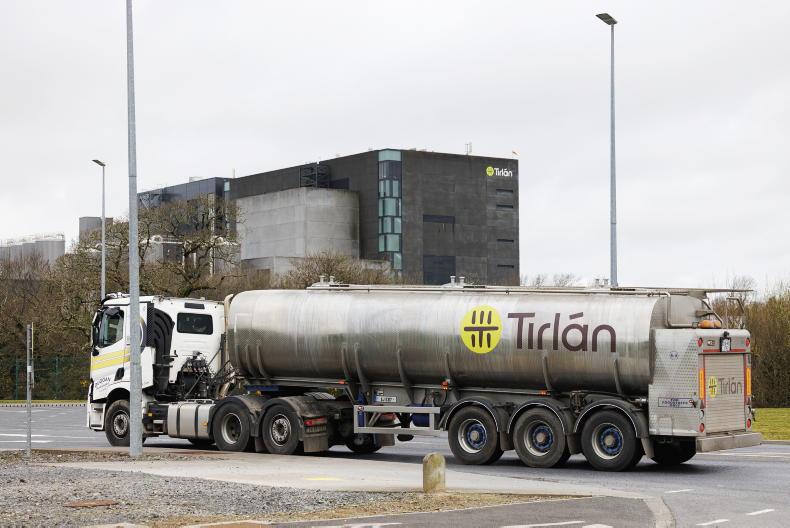
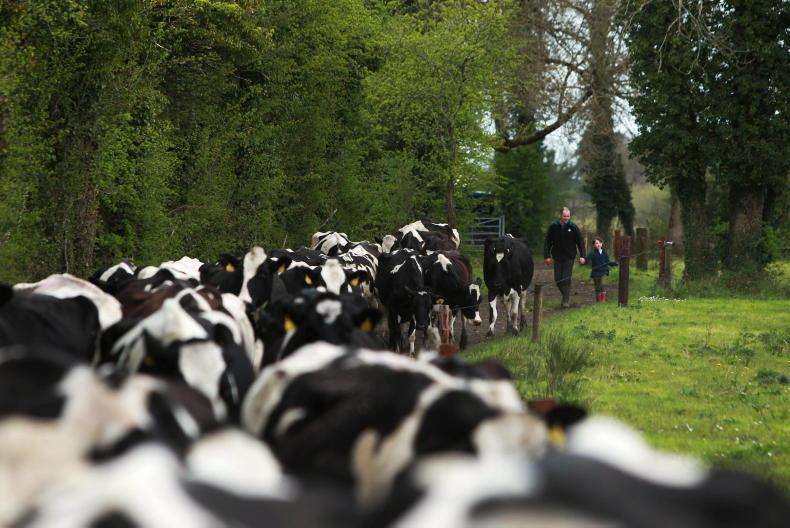
Tirlán processed 3.2bn litres of milk in 2025. \ Donal O'Leary
The facility will use the whey stream from the Kilkenny Cheese joint venture with Royal A-ware to produce high-value whey ingredients for lifestyle and performance nutrition.
Seán Molloy, CEO of Tirlán, described the co-op’s performance in 2025 to the Irish Farmers Journal as “strong, and consistent”.
“We had to manage exceptional volatility during the year,” Molloy said.
“Not just due to the dairy market price collapse from August onwards, but also due to the tariff environment.
“We had to navigate the difficulties around the US tariffs, which even now probably isn’t a complete story yet. Then in December the Chinese decided to place another tariff on top of us.
“China was and is a very important market to us, particularly for UHT cream, so we’ve had to navigate that milestone as well,” he said.
“Overall, 2025 was a very volatile and difficult year which has only got worse into the current year.”
On processing, Molloy said that the co-op had seen “huge growth” in milk supply in 2025 and that it was “fantastic that we could handle that from a processing perspective as it allowed our farmers to grow their businesses when prices were good”.
Milk supply
Molloy said the growth in milk supply has continued into the current year, even with a much more challenged market environment and less favourable weather.
“We are seeing milk supply up 3% in the first few months of 2026,” he said.
“I suspect by the time the year is out it will be roughly line ball with 2025, depending on how the weather goes. That means that all of our processing facilities are operating to near maximum capacity.
“Something like 96m litres of milk will be processed weekly across the supply peak.”
Molloy noted that it is probably a similar situation across the industry and that there is a lot of good work cooperation between the co-ops going on to ensure that the peak is managed in the right fashion.
Looking ahead, Molloy said he thinks that the growth in milk supply will be different over the coming years where it will be at the productivity rather than the volume level, where solids per cow rather than litres per cow are the driving factor.
“For us, then, the opportunity is there to think about adding value to the litre of milk, rather than just taking it in and processing it.
“In that context we over the years developed a very strong play in the whole whey arena. We invested in this space and it has gone very well for us. We have now put in this investment which will double our capacity by mid-2027,” Molloy added.
“Either through good fortune or good work, we’re in the right space at the right time with a product where there is huge appetite in the market for it.”
Costs
Molloy said that 2026 is “clearly going to be a much higher cost year and a much lower price year than 2025 for farmers”. However, he does say there are some positives.
“Fertiliser has gone up enormously as everyone is well aware,” he said.
“We have 70% of our fertiliser already forward sold to our farmers with 80% of the urea that will be used this year already purchased, and that has been purchased at around €300/t less than the current market price for that product.
“We were concerned about the CBAM (carbon border adjustment mechanism) legislation which we knew was coming in, so we went out in the autumn and recommended to our farmers that they buy then.
“It turned out to be a doubly good recommendation, which we also promoted by taking €20 off the price and giving interest-free credit. The combination of those, plus perhaps a bit of management of the end-of-year accounts on farm meant that we had very high [fertiliser] sales.
“Looking forward to the end of the year, we don’t envisage any shortages of volume. We either have in stock or have visibility of getting into stock the requirements for the rest of the year.”
On feed prices, Molloy suggested that they will probably rise over the summer, driven by energy and transport costs rather than by increased in the cost of grain.
Grain
Molloy said that Tirlán paid the leading price in country for a scale buyer of tillage. He said that farmers were generally pleased with the prices they got last year.
“That is not to say that they wouldn’t have wanted more, but when you combine the high yields they got last year with the ease with which they got the harvest in and the price we paid, it left them reasonably OK,” Molloy said.
I thought it would have been well back due to the price, the weather and the sentiment more generally
He said Tirlán do like to support the Irish grain sector, as shown by the inclusion of the usage of Irish grain in feed in Tirlán’s sustainability payment structure.
“The more difficult news for the grain sector is where we are going in 2026.
“I was surprised to find out that we have as much, if not more, seed sold to our grain growers this year.
“I thought it would have been well back due to the price, the weather and the sentiment more generally.
“It looks like we’ll end up in the same situation tonnage wise as we did last year. In terms of pricing, the news isn’t good. You would expect with the volatility in the world and oil prices going up that you’d have a higher grain price in the autumn, but there seems to be an awful lot of wheat in the world, so the outlook for the year is very challenged,” he said.
Molloy said that Tirlán had offered a future price of €183/t for green grain which is admitted is “not exciting at all considering where the cost of production might be” adding that “nobody has taken that up.”
“The establishment of KCL (Kilkenny Cheese Ltd) was driven by a number of considerations,” Molloy said, “number one was to give capacity at peak and KCL can do somewhere between 14 and 16 million litres at peak, so it absolutely has delivered in terms of giving us that capacity increase.
“The second motivation was to establish routes to market for product categories where we didn’t have a presence or even a capability in at that point in time,” he said.
“Last year something in the order of 40,000t and this year in the region of 50,000t will be produced and go to that market.
“The market last year was quite challenged for those products, but they are better this year.
“The third, more longer-term objective was to establish a whey pool that would support our future investment. That has now come to pass.”
Molloy said that in terms of contributing to milk price, KCL is neutral.
He said it gives capacity during peak, a route to market and whey, and that is where the facility finds itself.
There was a further €6m invested in the plant in 2025, divided evenly between Tirlán and Royal A-ware, the 50:50 partners in the processor.
Michael Horan, chief financial officer of Tirlán, said that investment was for additional packaging format equipment which would allow for some extra product flexibility.
Molloy described the relationship with Royal A-ware as “very good” adding that “they have been top class”.
The annual report for Tirlán shows a steady performance for the co-op during 2025. The growth in milk, as seen across the industry, would have come as a surprise to any co-op CEO in 2023 when all the talk was about the end to expansion of supply. Tirlán dealt well with that supply growth, helped in no small part by the capacity at Kilkenny Cheese.
The work done on the management of the exchangeable bond draws another line under the old ties between the co-op and Glanbia, and while the reduced shareholding in the plc will still pay some dividends for Tirlán, the co-op will rely more on its own processing profitability than on Glanbia’s in future.
The investment in whey is where the focus is for added value, and that will come on stream in 2027. Presuming that the demand for the product remains robust – and there is no sign of a slowdown of that on the horizon – then the value-add from that will secure the long-term profitability of the processor.
For 2026, however, it looks like there will be plenty of challenges to overcome. Global dairy (and grain) markets remain relatively weak, with over-supply being a significant factor in both. Rising input costs, plus the tariffs imposed by both the US and China, will all prove to be headwinds as the year progresses.
Tirlán’s recent move to confirm its milk price for March, April and May should, under these circumstances, be welcomed by suppliers as it does give some element of certainty during the current period of high volatility.
Tirlán reported a 10% increase in revenue to €2.94bn for 2025, with a slight decline in operating profit to €63.7m. Profit after tax rose 8% to €39m, aided by an adjustment to tax charges in respect of previous years.
Last year was a record milk supply year for the co-op, with volume up 7% to 3.2bn litres, which Tirlán said accounted for around a third of the Irish milk pool.
Significantly, milk solids were up 9% to 440kg per cow, also a record.
The average price paid during 2025 was 54.4 c/l.
Green grain intake reached 234,000t, with Tirlán saying it is the largest purchaser and user of Irish grain. The harvest price for green feed barley was €190/t and for green feed wheat was €200/t.
Over 41% of all green grain delivered during the 2025 harvest qualified for premium payments.
Tirlán’s sustainability action plan will include a new measure which will reward farmers who choose native grain through their use of the co-op’s dairy feeds.
Bond
On the financial side, the highlight of the year was the repayment of the €250m exchangeable bond which was raised in 2022 to enable the co-op to acquire the Irish processing assets of Glanbia.
The closing of the bond involved selling 17m of Tirlán’s Glanbia shares in October. Earlier in the year, the co-op had spun out 15m shares to members.
These two transactions reduced Tirlán’s shareholding in Glanbia from 29.5% to 17.9%, leaving it with 43.55m shares in the plc.
That stake was worth €630m at the end of 2025. Given the increase in the value of Glanbia shares in 2026, that stake was valued at €750m by mid-April.
It is notable that the value of Tirlán stake in Glanbia in mid-April 2025, ie before it has disposed of any of its shares in the plc, was also approximately €750m as Glanbia’s shares were trading below €10 each at the time.
This week, those shares were trading above €17 each.
Investments
2025 also saw the announcement of the €126m investment in a new whey processing facility at the Ballyragget site.
The project, which broke ground in 2026 and is expected to be in production by the middle of 2027, is Tirlán’s largest value-add investment to date.
Tirlán processed 3.2bn litres of milk in 2025. \ Donal O'Leary
The facility will use the whey stream from the Kilkenny Cheese joint venture with Royal A-ware to produce high-value whey ingredients for lifestyle and performance nutrition.
Seán Molloy, CEO of Tirlán, described the co-op’s performance in 2025 to the Irish Farmers Journal as “strong, and consistent”.
“We had to manage exceptional volatility during the year,” Molloy said.
“Not just due to the dairy market price collapse from August onwards, but also due to the tariff environment.
“We had to navigate the difficulties around the US tariffs, which even now probably isn’t a complete story yet. Then in December the Chinese decided to place another tariff on top of us.
“China was and is a very important market to us, particularly for UHT cream, so we’ve had to navigate that milestone as well,” he said.
“Overall, 2025 was a very volatile and difficult year which has only got worse into the current year.”
On processing, Molloy said that the co-op had seen “huge growth” in milk supply in 2025 and that it was “fantastic that we could handle that from a processing perspective as it allowed our farmers to grow their businesses when prices were good”.
Milk supply
Molloy said the growth in milk supply has continued into the current year, even with a much more challenged market environment and less favourable weather.
“We are seeing milk supply up 3% in the first few months of 2026,” he said.
“I suspect by the time the year is out it will be roughly line ball with 2025, depending on how the weather goes. That means that all of our processing facilities are operating to near maximum capacity.
“Something like 96m litres of milk will be processed weekly across the supply peak.”
Molloy noted that it is probably a similar situation across the industry and that there is a lot of good work cooperation between the co-ops going on to ensure that the peak is managed in the right fashion.
Looking ahead, Molloy said he thinks that the growth in milk supply will be different over the coming years where it will be at the productivity rather than the volume level, where solids per cow rather than litres per cow are the driving factor.
“For us, then, the opportunity is there to think about adding value to the litre of milk, rather than just taking it in and processing it.
“In that context we over the years developed a very strong play in the whole whey arena. We invested in this space and it has gone very well for us. We have now put in this investment which will double our capacity by mid-2027,” Molloy added.
“Either through good fortune or good work, we’re in the right space at the right time with a product where there is huge appetite in the market for it.”
Costs
Molloy said that 2026 is “clearly going to be a much higher cost year and a much lower price year than 2025 for farmers”. However, he does say there are some positives.
“Fertiliser has gone up enormously as everyone is well aware,” he said.
“We have 70% of our fertiliser already forward sold to our farmers with 80% of the urea that will be used this year already purchased, and that has been purchased at around €300/t less than the current market price for that product.
“We were concerned about the CBAM (carbon border adjustment mechanism) legislation which we knew was coming in, so we went out in the autumn and recommended to our farmers that they buy then.
“It turned out to be a doubly good recommendation, which we also promoted by taking €20 off the price and giving interest-free credit. The combination of those, plus perhaps a bit of management of the end-of-year accounts on farm meant that we had very high [fertiliser] sales.
“Looking forward to the end of the year, we don’t envisage any shortages of volume. We either have in stock or have visibility of getting into stock the requirements for the rest of the year.”
On feed prices, Molloy suggested that they will probably rise over the summer, driven by energy and transport costs rather than by increased in the cost of grain.
Grain
Molloy said that Tirlán paid the leading price in country for a scale buyer of tillage. He said that farmers were generally pleased with the prices they got last year.
“That is not to say that they wouldn’t have wanted more, but when you combine the high yields they got last year with the ease with which they got the harvest in and the price we paid, it left them reasonably OK,” Molloy said.
I thought it would have been well back due to the price, the weather and the sentiment more generally
He said Tirlán do like to support the Irish grain sector, as shown by the inclusion of the usage of Irish grain in feed in Tirlán’s sustainability payment structure.
“The more difficult news for the grain sector is where we are going in 2026.
“I was surprised to find out that we have as much, if not more, seed sold to our grain growers this year.
“I thought it would have been well back due to the price, the weather and the sentiment more generally.
“It looks like we’ll end up in the same situation tonnage wise as we did last year. In terms of pricing, the news isn’t good. You would expect with the volatility in the world and oil prices going up that you’d have a higher grain price in the autumn, but there seems to be an awful lot of wheat in the world, so the outlook for the year is very challenged,” he said.
Molloy said that Tirlán had offered a future price of €183/t for green grain which is admitted is “not exciting at all considering where the cost of production might be” adding that “nobody has taken that up.”
“The establishment of KCL (Kilkenny Cheese Ltd) was driven by a number of considerations,” Molloy said, “number one was to give capacity at peak and KCL can do somewhere between 14 and 16 million litres at peak, so it absolutely has delivered in terms of giving us that capacity increase.
“The second motivation was to establish routes to market for product categories where we didn’t have a presence or even a capability in at that point in time,” he said.
“Last year something in the order of 40,000t and this year in the region of 50,000t will be produced and go to that market.
“The market last year was quite challenged for those products, but they are better this year.
“The third, more longer-term objective was to establish a whey pool that would support our future investment. That has now come to pass.”
Molloy said that in terms of contributing to milk price, KCL is neutral.
He said it gives capacity during peak, a route to market and whey, and that is where the facility finds itself.
There was a further €6m invested in the plant in 2025, divided evenly between Tirlán and Royal A-ware, the 50:50 partners in the processor.
Michael Horan, chief financial officer of Tirlán, said that investment was for additional packaging format equipment which would allow for some extra product flexibility.
Molloy described the relationship with Royal A-ware as “very good” adding that “they have been top class”.
The annual report for Tirlán shows a steady performance for the co-op during 2025. The growth in milk, as seen across the industry, would have come as a surprise to any co-op CEO in 2023 when all the talk was about the end to expansion of supply. Tirlán dealt well with that supply growth, helped in no small part by the capacity at Kilkenny Cheese.
The work done on the management of the exchangeable bond draws another line under the old ties between the co-op and Glanbia, and while the reduced shareholding in the plc will still pay some dividends for Tirlán, the co-op will rely more on its own processing profitability than on Glanbia’s in future.
The investment in whey is where the focus is for added value, and that will come on stream in 2027. Presuming that the demand for the product remains robust – and there is no sign of a slowdown of that on the horizon – then the value-add from that will secure the long-term profitability of the processor.
For 2026, however, it looks like there will be plenty of challenges to overcome. Global dairy (and grain) markets remain relatively weak, with over-supply being a significant factor in both. Rising input costs, plus the tariffs imposed by both the US and China, will all prove to be headwinds as the year progresses.
Tirlán’s recent move to confirm its milk price for March, April and May should, under these circumstances, be welcomed by suppliers as it does give some element of certainty during the current period of high volatility.






SHARING OPTIONS