


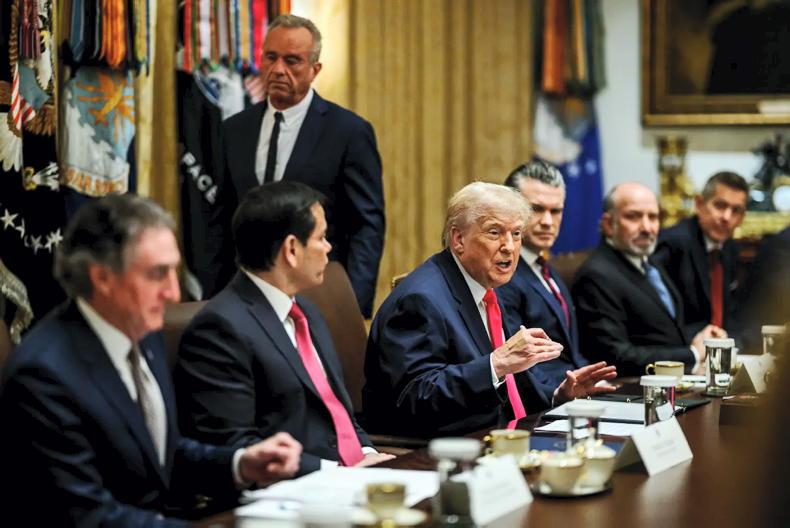
US President Donald Trump this week announced the latest support package for US farmers by way of a $12bn (€10.3bn) fund for “one time bridge payments to American farmers in response to temporary trade market disruptions and increased production costs”.
The Farmer Bridge Assistance (FBA), which supports what are referred to in the US as ‘row crop farmers’ will utilise $11bn (€9.5bn) of this, with $1bn (€860m) held for other commodities such as speciality crops and sugar with details and timelines still being developed.
According to the American Farm Bureau, who represent US farmers, growers of the main crops in the US lost a combined $17bn (€14.6bn) in the 2024/25 crop year. This was after including support payments and crop insurance, which were worth a total of $18bn (€15.5bn). The Farm Bureau are forecasting a loss in the sector of $35bn (€30.2bn) this year from production costs compared with sales, with $6bn (€5.2bn) of this offset by crop insurance.
That leaves a $28bn (€24.1bn) deficit before any other one off payments are added. If this $11bn (€9.5bn) fund is included, it means that according to Farm Bureau projections, the sector will also have a $17bn (€14.6bn) deficit in the 2025/26 crop year.
Trade policy impact
As Irish tillage farmers are too well aware, 2025 has been a poor year for prices which offset the benefit of relatively good growing and harvest conditions in most places.
Weak prices have been a feature around the world this year across the main crops, with strong global supplies being more than sufficient to meet demand. For US growers, the problem has been made worse by US trade policy, which saw the introduction of tariffs on trade partners.
Retaliation was sporadic but particularly strong by China, who matched US tariff increases and as result US exports collapsed. While this had an impact across all sectors of US agriculture including meat and dairy, the most dramatic impact has been on soyabean exports which have almost ground to a halt this year.
While this has made problems in the sector worse for US growers, the impact on China, the world’s biggest importer of soyabeans has been negligible. This is because the major South American countries have stepped in to fill the gap in supply, and it is generally recognised that Brazilian farmers have been the real winners in the latest US-China trade war.
Precedent
US crop producers have been here before. When president Trump commenced his first term in 2017, he adopted a similar policy with tariffs on China, which triggered the same retaliation in return. As a result, US soyabean exports to China collapsed in that year to just over $3bn (€2.6bn) from over $12bn (€10.3bn) the previous year as shown in Figure 1.
Following a partial trade deal in 2020, exports recovered quickly and sharply, but it is expected that 2025 will be an even worse year than 2017 for US soyabean exports to China.
While soyabeans are the most dramatic example of the impact from the US – China trade dispute, all US agricultural exports to China have been damaged.
For example, in 2024, China was the second-most valuable market for US beef exports, worth almost $2bn (€1.72bn). Up to the end of August this year, the value of beef sales to mainland China had fallen to just $2.8m (€2.4m) compared with $124.3m (€107.1m) in the same month last year. (US Meat Export Federation data).
Negligible impact on China
At the beginning of November this year, the US and China agreed on some relaxing of their trade dispute, and as a result China would import at least 12m tonnes of US soyabeans in the last two months of this year.
However, it seems that over the course of 2025, China has simply switched the supply of imports previously filled by the US to Brazil. USDA reports that in May, the first month after the announcement of the “Liberation Day” tariffs by president Trump, China imported a record 13.9m tonnes of soyabeans, of which 12.1m tonnes came from Brazil. In each of the subsequent three months to August 2025, Brazil supplied over 10m tonnes of China’s soyabeans imports.
Comment – US trade policy consequences
The announcement of a $12bn (€10.3bn) fund for US growers this week is a huge amount of money, but it looks like it won’t be enough to cover the losses being experienced in the sector.
Crop production has been difficult over the past two years as Irish farmers know, but the situation has been made worse in the US by trade policy. The support fund announced by the US administration would in a previous era have drawn the attention of the World Trade Organisation (WTO).
While what the WTO thinks of the support package is likely to be of little concern to the administration, it will be watching to see if it is enough to keep US farmers on board for the mid-term elections in 2026.





SHARING OPTIONS