


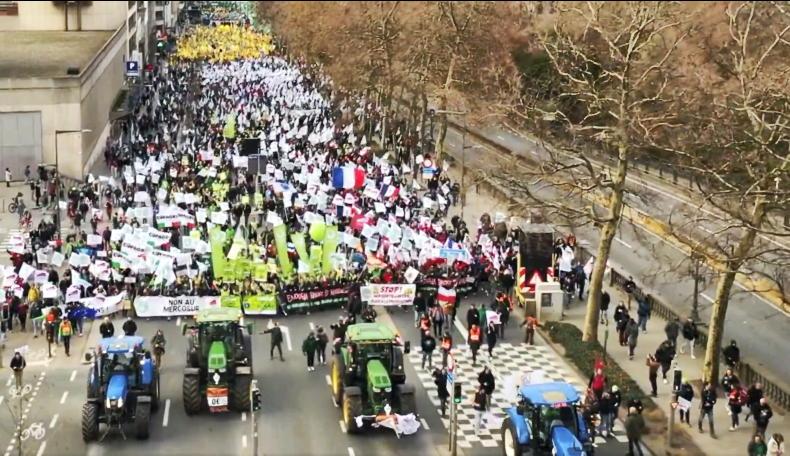
On Saturday, we'll see one of the larger protests by Irish farmers of this century. It hasn't been organised by farmers - it’s being organised by political party Independent Ireland.
More specifically by Ciaran Mullooly, its MEP for Midlands North West, and Michael Fitzmaurice, the Galway-Roscommon TD, who have called farmers to Athlone to protest the Mercosur deal.
Sinn Féin is attending, as are other opposition TDs, so it will be a pan-opposition event. Minister for State in the Department of Agriculture Michael Healy Rae is also attending, to register his opposition to the deal.
And practically every farming organisation in the country (and there are quite a few) will be present.
There’s only one problem. The Mercosur trade deal is now a reality. On Friday morning, the ambassadors of the member states to the European Union voted on Mercosur.
And 21 voted in favour, ensuring the deal’s ratification by the member states. The only hurdle left now is for the European Parliament to approve it.
Ireland voted against the deal
Ireland voted against the deal and the Government has indicated that its MEPs will vote against the deal too. It means that Ireland has maintained opposition to the deal right to the bitter end.
Bizarrely, Ireland's commissioner, European Commissioner for Democracy, Justice, the Rule of Law and Consumer Protection Micheal McGrath, welcomed the positive vote.
He seems to be good at welcoming things relating to agriculture, no matter what farmers think. He was last heard from gazumping the government (or being their temporary spokesperson, depending on your view of events) announcing the extension of the nitrates derogation.
Being a party and indeed constituency colleague of Micheál Martin, the commissioner’s intervention is particularly unhelpful on the eve of the Athlone protest.
It will be quoted on Saturday, I would imagine, as proof that the Government only opposed Mercosur knowing it would pass without Ireland’s support.
In one sense, it could be argued that this protest is for nothing. Instead of it being an effort to force the Government into maintaining its stance, the focus moves from Dublin to Brussels.
I am predicting that farmer buy-in to this protest will be practically unchanged by Friday’s events. The Government may have held firm to its pre-election promise, but the European Commission - and Ursula von der Leyen in particular - have got their deal and farmers feel betrayed.
Practical effects
What will the practical effects of the Mercosur deal be?
Well in brass tacks, as most people connected to agriculture know by now, it's 99,000t extra of beef coming from South America into Europe at low tariffs.
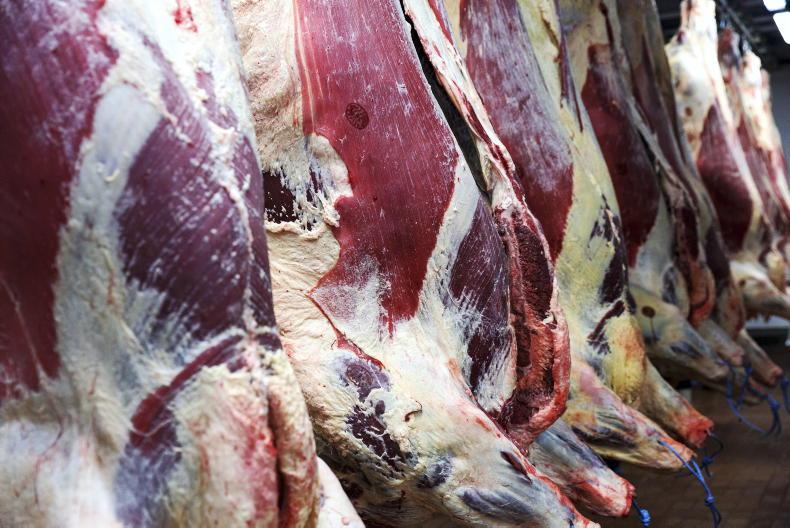
Many commentators have pointed out this is a very small proportion of the overall beef in Europe. Farmers have pointed out that it's likely it will all come in the form of prime cuts, which will have a disproportionate effect on the market, because if you swamp the market with prime cuts, that will deflate their price, which will in turn affect the price of all these products.
You’re not going to pay the same price as before for stewing beef if ribeye steaks are 30% cheaper. I’ve seen a number of speculative estimates and guesstimates of what the impact could be, but we don’t need to speculate any more. We're going to find out soon enough.
But it won't be good. It won't be positive.
We've recently seen the UK beef market affected by the increase in low- and zero-tariff Australian and New Zealand beef that's coming into the UK under post-Brexit trade agreements.
They had a very quick and very real impact on Irish beef volumes and prices. Fortunately, overall market trends are still generally good, if you're a producer.
Rabobank is predicting a 3% downturn in global production of beef this year. It may mean prices won’t be affected in the short-term, but then this is not a temporary little arrangement, it’s a permanent agreement.
The punitive 55% tariffs that have been imposed by China on beef imports last month will have an impact on global trade too.
But impact of the Mercosur deal is not just about financial losses to Irish beef farmers. It’s also - and perhaps mostly - about further damage to the very fragile relationship between Irish farmers, indeed European farmers, and the European Union itself.
Mercosur has become a totem, a symbol of a broken trust, where European farmers believe rightly or wrongly that the European Commission has not been serving their best interests.
CAP decline
Is there any evidence to support this point of view?
It starts with the Common Agricultural Policy (CAP). The CAP hasn't grown in real terms since 1990. That’s 35 years ago, when you could build a house for €30,000, whereas now it would cost 10 to 15 times that for the same house.
You could buy a tractor for €30,000 then too - it would cost at least five times that to buy the same tractor today. Higher spec, that's true, and, of course, the house would be higher specification too. That's the level of inflation we're talking about. Yet, the CAP budget has been static.
Remember, the production systems, animal welfare standards and environmental regulations that farmers are working to are higher spec too.
The asks of the Commission in relation to CAP have increased significantly. In 1990, in order to get your direct payments, basically all you had to do is produce food. How you produced it was almost your own business.
There were some environmental regulations, but they weren't very significant in terms of cost imposed. They didn't impact on your production costs in any real way.
In the intervening 35 years, farmers have lost pesticides and growth promoters, they've seen significant increases in costs due to environmental regulations. Their inputs have gone through the roof - whether that's fertiliser, feed, machinery or steel. Land prices have increased dramatically.
Farmers need more land to survive. I know that’s counterintuitive in one sense. But the reality is that when your margin is cut, the only way you can maintain your income is to increase your scale or your intensity.
The option to increase intensity has been removed by environmental regulation and by the lack of research and development that was taking place in European agriculture in terms of harnessing technology.
It has taken until last month for the European institutions to approve the use of plants using gene editing. So farmers needed more land to maintain income as margins were squeezed and supports were diluted by inflation.
There was a further diluting effect on supports - the expansion of the EU. In 1990, there were only a dozen member states, now it’s 27. There were nine million farmers being supported by the CAP fund, that expanded to over 20 million when counties such as Poland, Spain and Romania joined.
The land base the static CAP fund had to be spread over expanded even more than farmer numbers would imply.
Standards
And as the European Commission eagerly pursued trade deals that would disadvantage farming in the EU, they also raised production standards, animal welfare requirements, the environmental footprint and traceability of food produced within the EU.
But demands for parallel standards of food being imported into the EU were made politely and mostly ignored.
And now, even as the Mercosur trade deal is being approved, the European Commission is proposing a 20% cut in CAP funding for the next decade. With a straight face. In the full knowledge that livestock farmers in Ireland and across the continent depend almost entirely on those direct payments for an income.
Some might say why not just stop farming so? If rural pubs can be allowed to die, maybe farming has to go the same way.
But here’s the catch. Europe desperately needs the food our farmers produce. The world desperately needs the food Europe’s farmers produce.
But no one has worked out a way for paying enough for it to ensure food producers operating at family-farm scale make a living. Farming in Europe is slowly going broke.
And that’s why thousands of farmers will congregate in Athlone on Saturday. I’ll be there, as will a number of my Irish Farmers Journal colleagues. We’ll keep you posted on what seems certain to be a day where emotions will run high, but clarity could be hard to find.


SHARING OPTIONS