


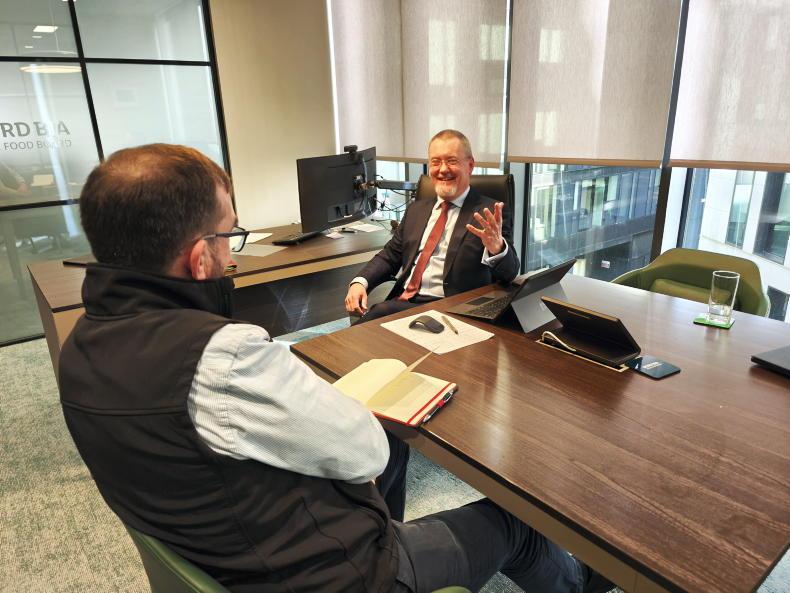
The Irish Farmers Journal sat down recently with Bord Bia CEO Jim O’Toole to discuss the performance of Irish food and drink exports in 2025 and the prospects for this year.
“Nineteen billion euro is a record achievement and that is something that the industry, right through the supply chain, should feel proud of,” he said “It is a significant achievement.”
O’Toole noted how the volatility which has existed in global markets in recent years increased further in 2025, and warned that there “is no sign of it abating”.
He highlighted some of the good results from the year, saying: “We’ve seen significant increases in beef prices and it’s great to see returns to beef farmers getting to where they should be, perhaps. We’ve seen one of the best seasons for grass growth in recent memory and that translated into increased dairy production. Given all that has gone on, in terms of geopolitical instability, I think the sector has demonstrated again its agility and innovation.”
While the overall report on the export performance for last year shows a strong result, O’Toole cautioned that there are very different stories depending on what sector of the Irish food and drinks industry is looked at.
Taking the dairy sector first, O’Toole noted that none of the forecasters predicted the rapid decline in global dairy prices which took place in the second half of 2025. He said that one of the things which can be learned from that drop in prices is that the global dairy market is very finely attuned to supply and demand.
“While the drop in prices has certainly been more severe than anybody anticipated, people are looking outward to see how long that is going to last. There is a possibility that should weather conditions and production change a little, wherever in the world that might happen, we could see an improvement sooner rather than later. But, certainly for the first half of 2026, we’re looking at disappointing returns.”
While Irish dairy exports in 2025 were dominated by the UK, EU and US which accounted for 72% of sector shipments by value, O’Toole noted that Irish companies have been active in developing markets.
There is a possibility that should weather conditions and production change a little, wherever in the world that might happen, we could see an improvement sooner rather than later. But, certainly for the first half of 2026, we’re looking at disappointing returns
“We have seen a lot of activity in South East Asia, and I think there is a lot more opportunity to be developed there.”
When asked if Bord Bia was working on developing markets in South America in anticipation of a ratification of the Mercosur trade deal, O’Toole diplomatically said that “wherever there are opportunities, it is our responsibility to develop those for the Irish food industry”.
Markets
Speaking of market access, the Irish Farmers Journal noted the announcement on 5 January that Irish beef had gained access to the Vietnamese market.
“There’s an enormous amount of effort and negotiation that goes into opening a new market, whether it is Vietnam or South Korea. To have those options provide opportunities, if they are required. However, given our price increases this year, we haven’t been competitive in these markets,” O’Toole said.
In fact, the Bord Bia report shows that of the €3.4bn of primary beef exports in 2025, only €135m went to markets outside the UK and EU. There was also a notable drop in beef exports overall, by volume, from Ireland last year with the total falling 40,000t below the 10-year average.
Across Europe, the supply of cattle is expected to remain constrained in 2026, which is likely to lead to a continuation of the concentration of Irish exports to our nearest neighbours. O’Toole said that Bord Bia is not at all complacent about these key markets.
“A huge amount of work goes into servicing that business in terms of our standards and sustainability. While our work in frontier markets and making new trade deals is, by necessity, very visible, much of the work that is done in the UK and EU goes under the radar. However, that is the engine that drives the export performance.”
A big part of what drove the success of Irish beef in the UK in 2025 was scarcity of supply. The Irish Farmers Journal asked if this success is likely to come under threat from increased imports of southern hemisphere product into that key market, where data already shows an expansion of Australia’s and New Zealand’s market share – even if it is from a very low base.
“Bord Bia has put a huge amount of work into getting Irish beef viewed as being an equivalent to UK-produced beef in that market,” O’Toole said, “however, the increase is something which needs to be watched very closely. The big threat in the UK market would be if one of the big retailers was to open up their offering to include something which isn’t UK or Irish produce.
“It’s something they talk about a lot, and it is something that is on their mind from a business perspective. However, all our research says that the trust [from consumers] for other imported beef is not the same as it is for Irish beef.
O’Toole is clearly awake to the risks to the UK from the availability of Southern Hemisphere. While pointing to the consumer trends and tastes which have existed until now, he cautions that “nothing lasts forever”.
Overall, on the beef sector he said that lack of supply will continue to drive beef prices into 2026. But an eye will have to kept on affordability.
“Consumer preference will ultimately dictate this. What Bord Bia really wants, is something that can be sustained over the longer term.”
Comment
When we sat down with Jim O’Toole a year ago to discuss the prospects for Irish food and drink exports for 2025, there were two messages.
First, there was the uncertainty over the outlook, mostly due to the election of President Trump in the US, and second that Irish food and drink exporters had shown their resilience and agility in overcoming challenges in the past and these talents would be needed again.
Twelve months later, it’s clear that both of those messages were correct. 2025 was hugely volatile for every sector, with threats and opportunities abundant. But the resilience and agility of exporters also once again came to the fore. The increase in the overall value of exports is certainly welcome, but it goes no way towards telling the story of a year, which had more than its fair share of ups and downs.
The messages from this year’s meeting are the same as 12 months ago. The future, as ever, is uncertain. There are plenty of potential risks on the horizon, whether it be global production, changing trade flows or the continued drop in sheep and cattle numbers in Ireland.
However, experience has shown that those changes will also lead to opportunities, and we have learned over many years that the Irish agri-food sector has always been skilful about taking advantage of those.


SHARING OPTIONS