


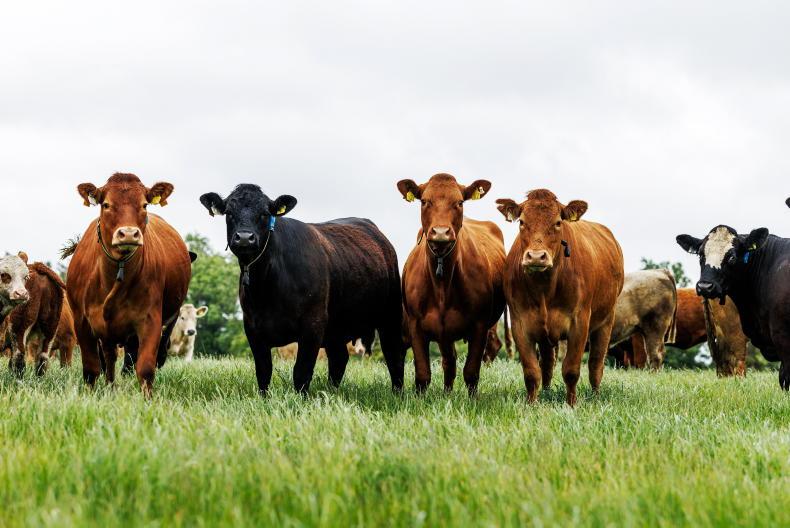
A total of 17 cull cows were finished on Tullamore Farm this year. Ten of these cows were selected for culling based on age, performance or undesirable traits, with the remaining seven cows added to the list that scanned empty after being put forward for breeding this summer.
The farm has seen two years of heavy culling rejuvenate the herd with the introduction of more homebred heifers.
The average lactation of the herd due to calf this spring is now sitting at 3.5 lactations; this figure includes 15 in-calf heifers, meaning the herd is relatively young.
The young profile of the herd and the added use of sexed female semen means the farm can afford to reduce its replacement rate to between 10 and 15% in the coming years, allowing for the sale of more in-calf heifers, which have demanded a premium price at recent sales.
The high value of cull cows in the past 12 months also makes the decision to cull under-performers and older cows much easier. The 17 cull cows finished off-farm were weaned in early October and finished on a high concentrate diet.
The cows were slaughtered on 4 December; the decision to move these cows off-farm has proved to be a good one, with price coming under increasing pressure from processors in the last 10 days.
These cows were fed a 15% protein ration during the finishing period and have consumed 550kg/head. This ration is costing €330/tonne delivered, so an associated meal cost of €181.50/head was observed to get cows fit for slaughter.
The 17 cows slaughtered had an average liveweight of 725kg. The average kill out percentage across the group was 54%, delivering an average carcase weight of 368kg achieving an average price/head of €2,823.
Calving preparations for spring of 2026 are currently underway, with sheds being cleaned and power-washed and pre-calving mineral introduced to the diet.
Breeding came to a close in the sheep flock on 29 November.
The breeding season ran over a six-week period with low activity recorded in the final two weeks. Ewes were introduced to rams on the 16 October and mated in a number of groups using single-sire mating. A total of 205 ewes were joined with eight different rams leaving an average of 26 ewes per ram.
Groups
However, some fitter or more-active rams were put with larger groups and older rams were placed in smaller groups for first service. This allowed them to reserve energy should they be needed to be subbed in for a lame or sick ram in another bunch later in the season.
Of the eight rams used, there were four Texels, one Suffolk, Two Charollais and one Easycare.
The farm has practised single-sire mating for a number of years now to good success, but it does require careful management to ensure all rams are working and a number of grazing groups which may make it unfeasible on some farms.
The farm does a lot of data recording around lambing and during the rearing period of lambs in spring and summer. By using single-sire mating, it gives us invaluable data around sire performance.
Since the start of the project, we have been committed to buying four- and five-star rams and by single-sire mating and recording breeding activity we have a clear picture on how rams are performing when we record lambing difficulty, birthweight, six-week weights, weaning performance and slaughter data.
This allows us to make more informed breeding decisions in future based on ram performance. Sixty-two ewe lambs were also bred to Charollais rams this autumn over a three-week breeding season. The shorter breeding season will most likely mean a higher barren rate in this bunch but will keep lambing compact.
Empty ewe lambs will be run over to breed as year-and-a-half old hoggets the following season.


SHARING OPTIONS