Scanning took place this week in Tullamore Farm in the 206 ewes and two-tooth hoggets joined to the ram along with 63 ewe lambs joined.
The scanning rate per ewe joined was recorded at 1.88 lambs with a breakdown in litter size detailed in Table 1.
Scanning operator John Guinan also marked three or four ewes scanned with triplet litters as potentially carrying quads which would push the scanning rate closer to the 1.9 lambs per ewe joined mark.
The scan of ewes includes 12 barren ewes which gives an in-lamb rate of two lambs per ewe in lamb.
There are 68 replacement ewe lambs on the farm with 63 of these joined to rams.
The five lambs not joined were five lighter Easycare ewe lambs which did not reach the breeding weight or were not deemed suitable for breeding in their first year by farm manager Shaun Diver.
Breeding performance for the ewe lambs is also summarised in Table 1 and includes 37 lambs scanned with a single lamb, 16 twin litters and 15 empty ewe lambs giving an average scanning rate of just over one lamb per ewe joined.

John Guinan scanning ewes with farm manager Shaun Diver.
The number of barren ewes at 12 empty ewes or 5.8% of ewes joined to the ram is higher than desired with the target to maintain this figure at 3% to 4% or less, ideally. This is an area that has been challenging in recent years with a spike in the barren rate in the 2020-2021 and the 2021-2022 seasons. Last year’s rate of 3.45% was back on target.
The 12 empty ewes include seven Mule ewes, five of which can be forgiven for not going in lamb. The culling policy in the flock in recent years has focused on identifying any problem ewes or poor performers with age overlooked to a point in Mule ewes performing positively with the aim of maximising the number of Texel and Suffolk replacements produced.
Four of the five ewes highlighted above have produced six crops of lambs totalling an average of 13 lambs in their lifetime while the other ewe produced 16 lambs over seven seasons.
There is a handful of ewes in-lamb born in 2018/2019 and a dozen born in 2020. The youngest Mule ewes in the flock are 2022-born with the breeding policy changing thereafter.
A decision will likely be made at weaning in 2026 on possibly culling any aged Mule ewes with such ewes having their job done.
Scanning results were recorded at the time of scanning on the Sheep Ireland app which is free to use for commercial flocks. This allows performance per breed or ewe age to be quickly analysed.
Easycare ewes now make up the largest percentage of the ewe flock and these recorded the highest litter size per ewe joined. There was no barren ewe recorded with 72.1% of ewes scanned with a twin litter, 16.4% with triplets and 11.5% with a single lamb. This gives an overall scanning rate of 2.05 lambs per ewe joined. Almost 45% of these are two-tooth hoggets.
The number of Mule ewes is just slightly ahead of Texel-cross ewes.
Despite a barren rate of 14.58% in these ewes, the batch still recorded an average litter size of 1.81 lambs per ewe joined with 45% of ewes joined carrying a twin litter, 25% triplets and 14.6% singles. If barren ewes are excluded the in-lamb rate in the Mule ewes is upwards of 2.1 lambs.
The scanning rate in the Texel-cross ewes is slightly below recent years and is in the region of 1.75 lambs per ewe joined. There is about 59% twin litters, 25% single litters, over 11% triplet litters and about 5% barren. Reproductive performance is similar in Suffolk-cross ewes which comprise Suffolk X Mule-crosses and Suffolk X Easycare-crosses.

Bulls will be transferred on to an intensive finishing diet with the aim of finishing at less than 16 months of age.
As touched on above the scanning rate in the ewe lambs was recorded at just over one lamb per ewe joined to the ram. There were 37 single litters, 16 ewe lambs carrying a twin litter and 10 ewe lambs scanned empty. The breeding season in the ewe lambs is short at just three and a half weeks.
Rams are joined to rams after the first breeding cycle in mature ewes. Extending the breeding season would reduce the barren rate from 16% but keeping a tight breeding season suits the workload and programme of activities on the farm.
Calving commences in the last week of January with a high percentage of cows calved in February and March. Lambing commences around 12 March and is winding down at the end of the month with attention in April turning to field tasks / grassland management and getting the suckler herd ready for breeding.
The ten empty ewe lambs will be assessed along with the five ewe lambs not bred and a decision will be taken on whether to run these dry or sell in the coming weeks. Given the cost of replacements in 2025 and the fact that these sheep have undergone an extensive health regime it is likely that at least the Easycare ewe lambs may be retained and run dry.
Management in ewe lambs will continue to focus on ensuring performance is not compromised and limit any loss in body condition. Concentrates will be introduced at a low level of about 0.4kg to 0.5kg to lambs over the next 10 days and remain at this level until ewe lambs enter late pregnancy feeding.
This feeding regime has worked well in recent years and the overall cost on concentrate input is low given the benefit in ensuring ewe lambs are in the best possible position at lambing.
In recent years, ewe lambs have been retained outdoors on grass until late January but it is likely that housing will take place earlier this year given grass supplies were depleted quicker or, if ground conditions are favourable, a decision may be taken to retain ewe lambs outdoors and supplement with silage.

Cow condition is good ahead of calving with minerals fed at a rate of 100g daily.
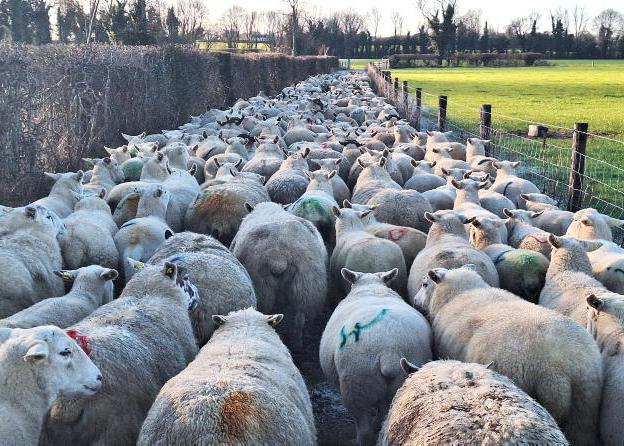
Ewes have been supplemented with silage in recent weeks and this will continue until housing takes place in the coming week. The next task on the agenda is shearing of ewes.
There is some time pressure on to complete this task with the aim of having at least eight weeks wool regrowth on ewes before turning outdoors post-lambing. Shaun explains that a cover comb suitable for winter shearing will be used which will not shear ewes as tight. Ewes are in good body condition with no concerns as they head in to late pregnancy.
At present ewes are being supplemented with lower-quality silage which tested in the mid-60s for dry matter digestibility (DMD) and is being fed to the suckler herd.
They will be transferred on to higher quality silage which tested in the low 70s for DMD once housed.
There is no significant issues with liver fluke on the farm but a faecal egg count will be taken and analysed with the farm’s vet Donal Lynch and a decision will then be taken on dosing.
The health status of cull ewes will also be followed up on when slaughtered to check for the presence of active liver fluke.
The batch of 2025 spring-born bulls will be stepped up on to an intensive finishing diet this week. Bulls were up to now receiving wholecrop silage along with 3kg concentrates daily. There is some refusal in consuming the straw and any uneaten forage is being offered to suckler cows which are housed across from the bulls.
The change in diet will also tie in with a move in housing. Bulls are currently housed in the slatted shed with straw lie-back but will be switched with in-calf heifers who will be moved to this area in advance of calving. Bulls will be offered good-quality silage and stepped up to 5kg concentrates and from here built up in stages to ad-lib concentrates.

Heifers are on target to achieve target weight at breeding.
Late-pregnancy management
Suckler cows and heifers are being fed silage of 65DMD with body condition monitored to ensure it does not slip.
Heifers will be offered about 0.5kg concentrates in the coming week along with 160g of a pre-calving mineral daily. Shaun finds that the low level of concentrates helps to ensure minerals are consumed and the boost in energy helps milk yield pre-calving.
Cows are also being offered 160g daily of a pre-calving mineral sprinkled on top of silage, with a higher mineral allocation fed due to some cases of subclinical milk fever/slow calvings in the past.
The first cows will be moved to the slatted shed with access to a straw lie-back in the coming weeks with calving set to commence in the last week of January.
Yearling heifers are all housed and are receiving 2kg concentrates along with wholecrop silage.
The aim is to gain at least 0.6kg to 0.7kg liveweight daily over the winter period with the majority of heifers well on target to reach at least 60% of mature weight at breeding.
Scanning took place this week with ewes recording an average litter size of 1.88 lambs per ewe joined.Ewe lambs achieved an average litter size of just over one lamb per ewe lamb joined to rams. Ewes will be housed and shorn over the next week with concentrates introduced to ewe lambs at a low rate.2025-born bulls are being stepped up to 5kg concentrates and will be built up to ad-lib feeding.In-calf heifers will receive 0.5kg concentrates along with 160g of a pre-calving powered mineral daily in advance of calving. 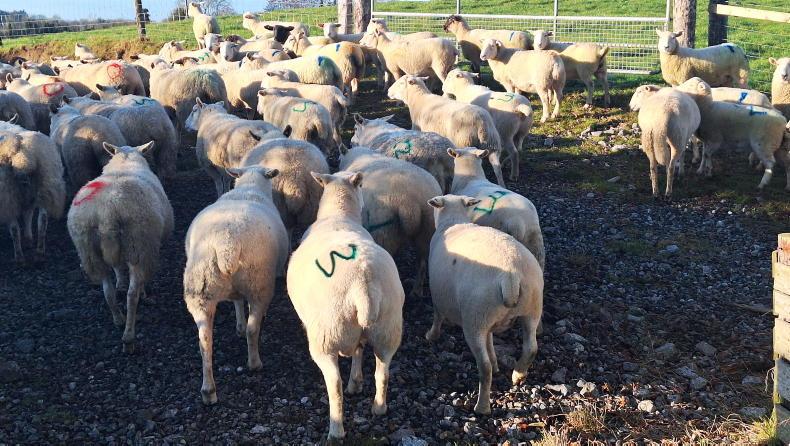
There are 34 ewes scanned with a triplet litter.

Ewes will be supplemented with silage at grass and housed over the next week.
Scanning took place this week in Tullamore Farm in the 206 ewes and two-tooth hoggets joined to the ram along with 63 ewe lambs joined.
The scanning rate per ewe joined was recorded at 1.88 lambs with a breakdown in litter size detailed in Table 1.
Scanning operator John Guinan also marked three or four ewes scanned with triplet litters as potentially carrying quads which would push the scanning rate closer to the 1.9 lambs per ewe joined mark.
The scan of ewes includes 12 barren ewes which gives an in-lamb rate of two lambs per ewe in lamb.
There are 68 replacement ewe lambs on the farm with 63 of these joined to rams.
The five lambs not joined were five lighter Easycare ewe lambs which did not reach the breeding weight or were not deemed suitable for breeding in their first year by farm manager Shaun Diver.
Breeding performance for the ewe lambs is also summarised in Table 1 and includes 37 lambs scanned with a single lamb, 16 twin litters and 15 empty ewe lambs giving an average scanning rate of just over one lamb per ewe joined.
John Guinan scanning ewes with farm manager Shaun Diver.
The number of barren ewes at 12 empty ewes or 5.8% of ewes joined to the ram is higher than desired with the target to maintain this figure at 3% to 4% or less, ideally. This is an area that has been challenging in recent years with a spike in the barren rate in the 2020-2021 and the 2021-2022 seasons. Last year’s rate of 3.45% was back on target.
The 12 empty ewes include seven Mule ewes, five of which can be forgiven for not going in lamb. The culling policy in the flock in recent years has focused on identifying any problem ewes or poor performers with age overlooked to a point in Mule ewes performing positively with the aim of maximising the number of Texel and Suffolk replacements produced.
Four of the five ewes highlighted above have produced six crops of lambs totalling an average of 13 lambs in their lifetime while the other ewe produced 16 lambs over seven seasons.
There is a handful of ewes in-lamb born in 2018/2019 and a dozen born in 2020. The youngest Mule ewes in the flock are 2022-born with the breeding policy changing thereafter.
A decision will likely be made at weaning in 2026 on possibly culling any aged Mule ewes with such ewes having their job done.
Scanning results were recorded at the time of scanning on the Sheep Ireland app which is free to use for commercial flocks. This allows performance per breed or ewe age to be quickly analysed.
Easycare ewes now make up the largest percentage of the ewe flock and these recorded the highest litter size per ewe joined. There was no barren ewe recorded with 72.1% of ewes scanned with a twin litter, 16.4% with triplets and 11.5% with a single lamb. This gives an overall scanning rate of 2.05 lambs per ewe joined. Almost 45% of these are two-tooth hoggets.
The number of Mule ewes is just slightly ahead of Texel-cross ewes.
Despite a barren rate of 14.58% in these ewes, the batch still recorded an average litter size of 1.81 lambs per ewe joined with 45% of ewes joined carrying a twin litter, 25% triplets and 14.6% singles. If barren ewes are excluded the in-lamb rate in the Mule ewes is upwards of 2.1 lambs.
The scanning rate in the Texel-cross ewes is slightly below recent years and is in the region of 1.75 lambs per ewe joined. There is about 59% twin litters, 25% single litters, over 11% triplet litters and about 5% barren. Reproductive performance is similar in Suffolk-cross ewes which comprise Suffolk X Mule-crosses and Suffolk X Easycare-crosses.
Bulls will be transferred on to an intensive finishing diet with the aim of finishing at less than 16 months of age.
As touched on above the scanning rate in the ewe lambs was recorded at just over one lamb per ewe joined to the ram. There were 37 single litters, 16 ewe lambs carrying a twin litter and 10 ewe lambs scanned empty. The breeding season in the ewe lambs is short at just three and a half weeks.
Rams are joined to rams after the first breeding cycle in mature ewes. Extending the breeding season would reduce the barren rate from 16% but keeping a tight breeding season suits the workload and programme of activities on the farm.
Calving commences in the last week of January with a high percentage of cows calved in February and March. Lambing commences around 12 March and is winding down at the end of the month with attention in April turning to field tasks / grassland management and getting the suckler herd ready for breeding.
The ten empty ewe lambs will be assessed along with the five ewe lambs not bred and a decision will be taken on whether to run these dry or sell in the coming weeks. Given the cost of replacements in 2025 and the fact that these sheep have undergone an extensive health regime it is likely that at least the Easycare ewe lambs may be retained and run dry.
Management in ewe lambs will continue to focus on ensuring performance is not compromised and limit any loss in body condition. Concentrates will be introduced at a low level of about 0.4kg to 0.5kg to lambs over the next 10 days and remain at this level until ewe lambs enter late pregnancy feeding.
This feeding regime has worked well in recent years and the overall cost on concentrate input is low given the benefit in ensuring ewe lambs are in the best possible position at lambing.
In recent years, ewe lambs have been retained outdoors on grass until late January but it is likely that housing will take place earlier this year given grass supplies were depleted quicker or, if ground conditions are favourable, a decision may be taken to retain ewe lambs outdoors and supplement with silage.
Cow condition is good ahead of calving with minerals fed at a rate of 100g daily.
Ewes have been supplemented with silage in recent weeks and this will continue until housing takes place in the coming week. The next task on the agenda is shearing of ewes.
There is some time pressure on to complete this task with the aim of having at least eight weeks wool regrowth on ewes before turning outdoors post-lambing. Shaun explains that a cover comb suitable for winter shearing will be used which will not shear ewes as tight. Ewes are in good body condition with no concerns as they head in to late pregnancy.
At present ewes are being supplemented with lower-quality silage which tested in the mid-60s for dry matter digestibility (DMD) and is being fed to the suckler herd.
They will be transferred on to higher quality silage which tested in the low 70s for DMD once housed.
There is no significant issues with liver fluke on the farm but a faecal egg count will be taken and analysed with the farm’s vet Donal Lynch and a decision will then be taken on dosing.
The health status of cull ewes will also be followed up on when slaughtered to check for the presence of active liver fluke.
The batch of 2025 spring-born bulls will be stepped up on to an intensive finishing diet this week. Bulls were up to now receiving wholecrop silage along with 3kg concentrates daily. There is some refusal in consuming the straw and any uneaten forage is being offered to suckler cows which are housed across from the bulls.
The change in diet will also tie in with a move in housing. Bulls are currently housed in the slatted shed with straw lie-back but will be switched with in-calf heifers who will be moved to this area in advance of calving. Bulls will be offered good-quality silage and stepped up to 5kg concentrates and from here built up in stages to ad-lib concentrates.
Heifers are on target to achieve target weight at breeding.
Late-pregnancy management
Suckler cows and heifers are being fed silage of 65DMD with body condition monitored to ensure it does not slip.
Heifers will be offered about 0.5kg concentrates in the coming week along with 160g of a pre-calving mineral daily. Shaun finds that the low level of concentrates helps to ensure minerals are consumed and the boost in energy helps milk yield pre-calving.
Cows are also being offered 160g daily of a pre-calving mineral sprinkled on top of silage, with a higher mineral allocation fed due to some cases of subclinical milk fever/slow calvings in the past.
The first cows will be moved to the slatted shed with access to a straw lie-back in the coming weeks with calving set to commence in the last week of January.
Yearling heifers are all housed and are receiving 2kg concentrates along with wholecrop silage.
The aim is to gain at least 0.6kg to 0.7kg liveweight daily over the winter period with the majority of heifers well on target to reach at least 60% of mature weight at breeding.
Scanning took place this week with ewes recording an average litter size of 1.88 lambs per ewe joined.Ewe lambs achieved an average litter size of just over one lamb per ewe lamb joined to rams. Ewes will be housed and shorn over the next week with concentrates introduced to ewe lambs at a low rate.2025-born bulls are being stepped up to 5kg concentrates and will be built up to ad-lib feeding.In-calf heifers will receive 0.5kg concentrates along with 160g of a pre-calving powered mineral daily in advance of calving.
There are 34 ewes scanned with a triplet litter.
Ewes will be supplemented with silage at grass and housed over the next week.





SHARING OPTIONS