


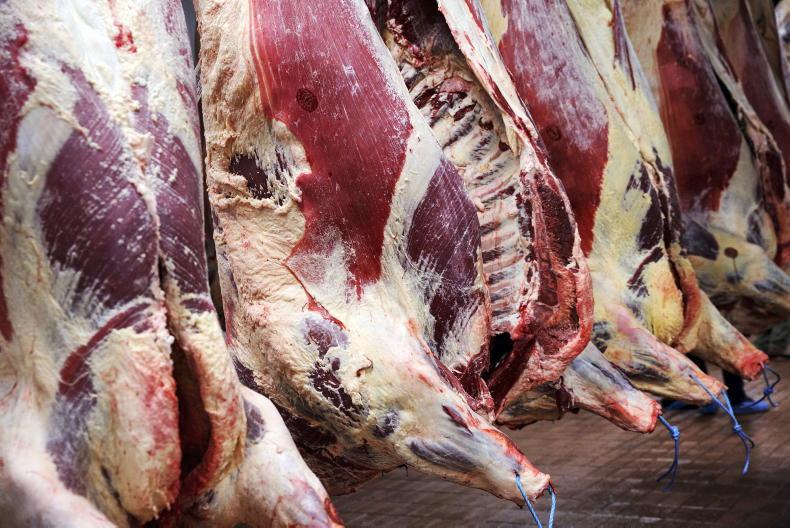
The beef trade remains in a steady position this week, with factory agents looking for cattle.
Bullocks are working off a base price of €6.60/kg to €6.70/kg, while heifers are moving at €6.70/kg to €6.80/kg, with some factories having to pay more for bigger loads.
Higher quotes are being reserved for those with numbers at the moment, but it’s a sign that the trade is starting to turn on the back of tighter numbers coming forward for slaughter over the next few weeks.
Flat prices of €7.10/kg are also on the table for in-spec Aberdeen Angus bullocks and heifers.
There are less delays in getting cattle killed, with agents generally active looking for stock this week in both farmyards and mart rings.
There is also some activity for forward booking cattle for the end of May and June, where agents appear to be particularly anxious for stock.
There are still issues getting breed bonuses in some factories, with bonuses for both Hereford and Aberdeen Angus cattle harder to come by in some locations in the last few weeks.
Cows
R grading cows are being priced at €6.40/kg to €6.50/kg. U grading cows are being bought at €6.70/kg.
O grading cows are being bought for €6.15/kg to €6.25/kg. P+3 cows are coming in at €6.00/kg to €6.20/kg, depending on flesh and weight, with some factories quoting lower for very light cows.
There a number of factories quoting higher quotes for bigger numbers of cows
Bulls
R grading bulls are coming in at €6.70/kg to €6.80/kg and U grading bulls are being quoted at €6.80/kg to €6.90/kg.
There are a number of operators still able to squeeze €7/kg for mixtures of R and U grading bulls.
O grading bulls are working off an all-in price of €6.50/kg to €6.60/kg, while P grading bulls are being quoted at €6.40/kg to €6.50/kg, depending on weight and flesh cover.
Under-16-month bulls are working off a €6.70/kg base price on the grid. There are still a few customers for overage bulls, with prices ranging from €6.70/kg to €6.85/kg for overage heavy bulls.
Last week’s kill came in at 30,512 head, with the four-day week having very little impact on numbers. Most factories are only killing three or four days in a normal week.
Last week’s kill continues to run just over 5,000 head behind the same week in 2025, with the annual kill to date running almost 80,000 behind the same period in 2025, with the three main stock categories of bullocks, heifers and cows all back to the tune of 25,000 head each.
Export restrictions to both South Korea and China as a result of an atypical case of BSE will not affect the trade in any way, given the very small volumes that were being exported to these countries.
Across the water, the British trade remains steady, with supplies continuing to be tight in most regions.
The 2026 kill is running almost 4,500 head behind the same period in 2025. There has been no real change on price, with in-spec bullocks and heifers trading for £6.30/kg to £6.40/kg (€7.58/kg to €7.71/kg incl VAT).
Global beef production is projected to decline by 1% in 2026 according to figures released by the United States Department of Agriculture (USDA) last week.
Following a record year of Brazilian beef production in 2025, production looks set to drop by 2% in 2026.
Australia will also see a decline of 1%, while EU beef production is also expected to drop by 1% in 2026.
The USA will see beef production fall by 100,000 tonnes in 2026 and just over 1m tonnes less than where production was four years ago.
The USDA has also predicted that China will reduce its beef imports by 13% in 2026 due to tariffs and increased domestic production.



SHARING OPTIONS