


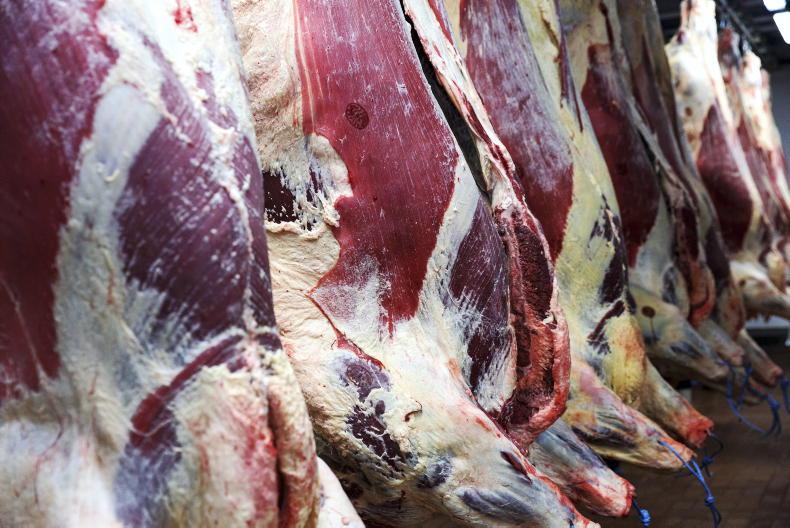
It’s been another very steady week for the beef trade, with no big movers or shakers in the last seven days.
Supplies seem to be balanced well with demand, with factory agents still anxious for cattle.
Bullocks continue to work off a base price of €7.00/kg to €7.10/kg, with the higher end of quotes being reserved for regular customers and those with numbers.
Heifers are also unchanged this week, with a range of base quotes from €7.10/kg to €7.20/kg available.
Breed bonuses are accessible on top of these base prices for in-spec cattle, with 20c/kg available at the moment for both Aberdeen Angus cattle and Hereford cattle at most processors. Other factory loyalty bonuses are also available.
Cow trade
The cow trade is also steady, with R grading cows being priced at €6.80/kg to €6.90/kg. U grading cows are still trading at €7.00/kg to €7.10/kg, while O grading cows are being bought for €6.60/kg to €6.70/kg.
P+3 cows are back a little further, with some factories trying to purchase P+3 cows at €6.20/kg to €6.30/kg.
Factory agents have been back paying some exceptional prices for well-fleshed, heavy cows, with up to €4.60/kg liveweight being paid for some cows in marts this week.
Mince sales continue to dominate the retail market and with that comes an increased appetite for cow beef.
Bulls
Bulls have probably held the best out of all categories of stock, with R grading bulls still coming in at €7.25/kg and U grading bulls at €7.40/kg.
Specialised bull finishers have been able to squeeze a little more out of some processors.
Under-16-month bulls are working off a €7.00/kg to €7.10/kg base price to go on the grid.
Some of the larger operators have started to kill autumn-born bulls in recent weeks, with margins reported to be very tight.
Some of the smaller finishers I spoke to this week are putting their losses close to €200/head on October-purchased cattle at the moment.
Last week’s kill came in at just under 31,000, a 400-head increase on the previous week.
Most stock categories remained at a similar level, but, interestingly, the bull kill continues to grow, with 3,518 young bulls slaughtered last week, up over 100 head on the previous week.
Last week’s kill was back just over 8,000 head on the same week in 2025, with the total kill now running 4,000 head above the same period in 2025.
While agents are reporting ample supplies coming on stream, there is no big surge anticipated, with numbers expected to remain tight for much of the first half of 2026.
Prices across the water continue to hover around £6.40/kg to £6.45/kg (€7.69/kg to €7.74/kg including VAT).
The AHDB is reporting that food service channels remain under a little pressure across the UK.
Beef volumes in food service were back 3.5% in 2025, driven by a decline in take-away purchases to the tune of 8.6%.
Burgers, which represent 48% of total beef food service volumes, were seen to decline in volumes by 3.4% year on year, driven by the move to lower-priced, smaller-volume burgers such as cheeseburgers.
Further afield, the number of cattle slaughtered in the USA has hit a 10-year low. US cattle slaughter fell 6.4% in 2025 to 29.3 million head, the lowest level since 2015 and the third consecutive annual decline since 2022.
Slaughter volumes are down 13%, reflecting a herd destocking process that has been under way since 2019 due to drought weather conditions.
Supply is set to remain tight in the short term, with herd rebuilding and a higher retention of heifers under way.
Factories appear to be particularly anxious about supplies in the April/May supply period.



SHARING OPTIONS