


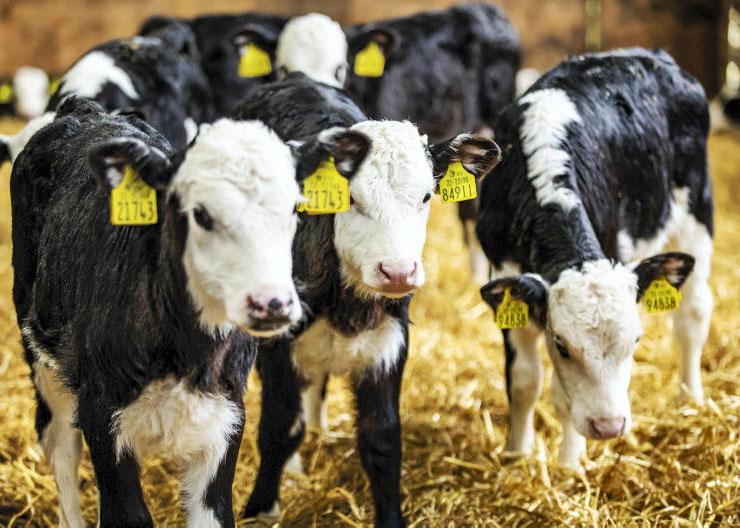
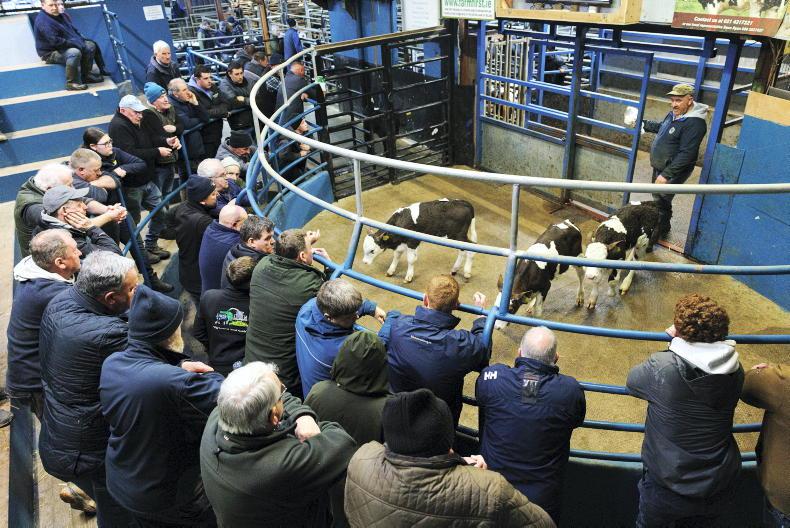
Headline prices for dairy-bred beef calves at three to four weeks of age range anywhere from €400/head to €900/head. In last week’s Irish Farmers Journal, the mart report from Ballyjamesduff in Cavan had a Belgian Blue heifer calf at three weeks old make €910. Another Charolais-cross calf at two weeks of age made €720.
Both animals looked like they were no more than two or three weeks of age. In other words, they weren’t half reared.
While the dairy farmer likely went home smiling, what of the calf buyer?
What will they need to do to ensure that they make money from these animals, so that they don’t die in debt.
Budget
There are two schools of thought when it comes to rearing dairy-beef animals.
The first approach is to maximise efficiency, output and margin per hectare by ensuring animals are finished off grass in their second autumn.
This is the policy adopted by Teagasc in its demonstration farms and it was also the policy adopted by the Irish Farmers Journal when it organised the Thrive demo farm in Tipperary.
By getting animals away before the second winter at 19 to 21 months, the costs of keeping animals for that full second winter are not incurred.
The downside is that maximum carcase weight is usually not met, particularly for bullocks.
Traditionally, dairy-beef bullocks were kept for the full second winter and finished out of the shed in spring, or stored over the winter and finished off grass the following year before 30 months of age.
This system may maximise carcase weight, but it also carries more cost and it limits the number of animals that can be carried per hectare – because there are extra mouths to be fed.
Looking at the example budget in Table 1, the costs of keeping an animal for the second winter are greater to the tune of €409/head.
At a beef price of €7/kg, that means an additional 58kg in carcase weight is required to just break even at €7/kg.
This should be easily achievable based on the additional lifetime age and expected liveweight gains and kill-out.
However, that is not to say it’s more profitable per hectare, because there will be less animals slaughtered per hectare if keeping animals until they are 24 months of age or older.
Essentially, the budget shows that getting animals to the autumn of their second summer costs €848/head.
This includes all the direct costs associated with feeding them as calves, grazing them in their first summer, feeding them meal and silage in their first winter and grazing them until the end of August in their second summer.
The costs of grass and silage are based on the Teagasc costs for each and include all associated costs including an opportunity cost for land, fertiliser, contractor, etc.
No additional land costs are included in this budget.
What is not included are fixed costs and labour, whether hired or not. Fixed costs include things like insurance, electricity, water charges, repairs and maintenance of buildings and land, interest repayments on any loans, consultancy fees, accountancy and so on.
Some may be offset by other enterprises. Teagasc estimates a fixed cost of €350/head.
To get the same margin from a calf costing say €800, an extra 56kg in carcase weight is required.
Other uses of funds such as tax, drawings and principle repayments on loans are not included either.
In terms of profitability, if we take it that the calves are being slaughtered at 19 to 21 months of age, after the second summer of grass, the total variable and fixed costs incurred in rearing the animals are €1,398/head.
If we add a calf cost of say €400/head, the total cost excluding labour comes to €1,798/head. Based on an expected carcase weight of say 315kg for Angus or Hereford bullocks at 20 months of age, the breakeven beef price is €5.70/kg.
This leaves a margin of €1.30/kg carcase to pay own labour, tax and principle repayments if beef price is €7/kg. On a 315kg carcase weight animal, that’s €410/head.
To get the same margin from a calf costing say €800, an extra 56kg in carcase weight is required.
While more continental breed animals like the aforementioned Belgian Blue and Charolais are definitely capable of putting on more weight, can they do it in the same timeframe as the cheaper, traditional beef calves?
If it takes longer to put on that weight, then those costs need to be factored in.
By my reckoning, there is an extra €519 in costs per head by keeping and finishing animals over a second winter. This requires an additional 74kg carcase weight just to break even.
Between the more expensive purchase price and the more expensive rearing costs, an extra 204kg in carcase weight at a beef price of €7/kg is required to make the same margin as a traditional breed animal slaughtered at 20 months of age with a carcase weight of 315kg.
In other words, the continental breed animal would need to kill out at greater than 519kg carcase weight at €7/kg to justify the extra purchase price – a tall ask.
Watch this week's video below:


SHARING OPTIONS