With sheer determination and a drive to follow his interests, Damien O’Reilly became one of the most recognised voices in Irish agricultural radio, spending 24 years at RTÉ as a broadcaster and well-known radio host.
It was Damien who started the popular Saturday morning show Countrywide on RTÉ Radio One, in which the show’s listenership reached a peak of 275,000 listeners across his 15 years. Along with that, he regularly presented Liveline, covered three Olympic games, and covered several radio shows.
Damien is also a familiar face to many readers as for over 10 years, he was a columnist on the back page of Irish Country Living.
Three years ago though, Damien made the hard decision to leave a career and job he was comfortable in, to take on new challenges and opportunities in Brussels. He started a new role in EU affairs with the Irish Co-operative Organisation Society (ICOS).
“It all happened very quickly. It was a very sliding doors moment,” says Damien. “In November 2022, I arrived in Brussels with my suitcase. It was like jumping out of an aeroplane and hoping the parachute opens.”
One part of the job he is passionate about is hosting groups, explaining to members and visitors how the EU works.
“I think when you’re in agriculture, you need to know how the EU works. We interact with the European Commission, and we work with our colleagues in Copa-Cogeca. It’s all for the betterment of making sure that the policies the Commission comes up with and that which the parliament debates on are workable for our members,” says Damien.
“As a young fella, I was born and bred in Castleknock in Dublin and went to school on the North Circular Road. And then I end up working for the Irish co-ops in Brussels, you never know where life might bring you,” he quips.
Castleknock to countryside
Damien spent a lot of summers on his uncle’s and granny’s small suckler and sheep farm in Ballyjamesduff, Co Cavan.
“I had this kind of connection with the countryside. I spent a lot of time down there,” he says.
Having a passion for sport, one summer when Damien was 15, he wrote to Eugene McGee, the editor of the Longford Leader, who had just set up a sister title, the Cavan Leader, in search of work experience.
“He was very well-known and managed the Offaly team to win the famous 1982 All-Ireland that stopped Kerry getting the five-in-a-row. I wrote him a letter, and I couldn’t believe it when he rang my granny’s house because I told him that’s where I’ll be in the summer,” Damien recalls.
At the time, there was only one journalism college in Ireland which was impossible to get into. Damien ended up going to Ballyfermot Senior College and spent two years on its [then] new journalism and broadcasting course.

Former EU commissioner Mairead McGuinness speaking with Damien O'Reilly during a panel discussion at the ASA conference in Kilkenny 2024.
He had planned to go on and do a degree after the course, but Damien was offered a job working for the Hogan Stand GAA magazine. As a sporting enthusiast, it was too good an offer to turn down.
With a love for radio that was developed in Ballyfermot, he was later offered a role with Shannonside’s Northern Sound just when local radio was kicking off.
“Of course I wanted to do sport, but in local radio you have to do everything from the death notices, to sports and news. I was also doing a current affairs midday show, and I was told I had to do a farmers’ bulletin,” he says. That was the start of his agricultural broadcasting and his stepping stone into RTÉ.
Jumping through hoops
At the time, RTÉ had an agricultural department – with four people working in radio led by PJ Nolan, who was leaving to work for the Irish Farmers Journal.
“I had gone on the panel. So then my file was pulled out as I knew about farming. So I said I’ll stick with this for a while, but I really want to go into sports.
In 1998, getting a break in RTÉ at the age of just 25, “was a pinch-me moment” for Damien. “It took a bit of time to get in there, and I had to jump through a lot of hoops and build up my experience but it was exciting.”
Damien started reading the farm news bulletin on Drivetime, which led him to become more immersed in the agri world.
“The idea of going out and interviewing farmers was great. And then Joe Murray retired, and there was a programme on Saturday morning called Farm Week that was pre-recorded. I loved putting that together and making packages. I would go out to interview farmers, and I changed the style of it from hard news,” he explains.
As the show started gaining traction, Damien went to the head of radio, Tom McGuire, and asked him if they could do a live show.
“I came up with Countrywide and even picked the signature tune, which exists to this day,” he says.
The name was chosen not to take farming out, but to make it appeal to a broader audience, rather than just a farming programme.
“I knew who the audience was; it was a big audience, but I needed to soften the farming message, which was very technical for a general audience,” he explains.
The first episode of the RTÉ Radio One programme Countrywide aired on Saturday 14 July 2012.
“It continued to develop. At the same time, I was a jack-of-all-trades and a master of none. I was being asked to present other programmes. I went to three Olympics as a producer, presenter and reporter. There was very little I didn’t do in RTÉ radio, which was great,” he says.
Making the move to Brussels
During COVID-19, Damien felt life needed to change; his children were getting older, and he wanted to do other things.
“I was about to turn 50, and I could have stayed there. RTÉ has gone through a tough time, but I got on well there. I have nothing bad to say.
“But personally, I wanted to do something different, something a bit mad, not just move to another radio. So I utilised my agri experience,” he says.
Damien had plenty of experience in the agriculture sector, interviewing ministers and covering farming news stories. While chair of the Guild of Agricultural Journalists, Damien was one of the founders who set up the European Network of Agricultural Journalists (ENAJ). This took him over and back to Brussels, where he fell in love with the buzz and fast-paced atmosphere.
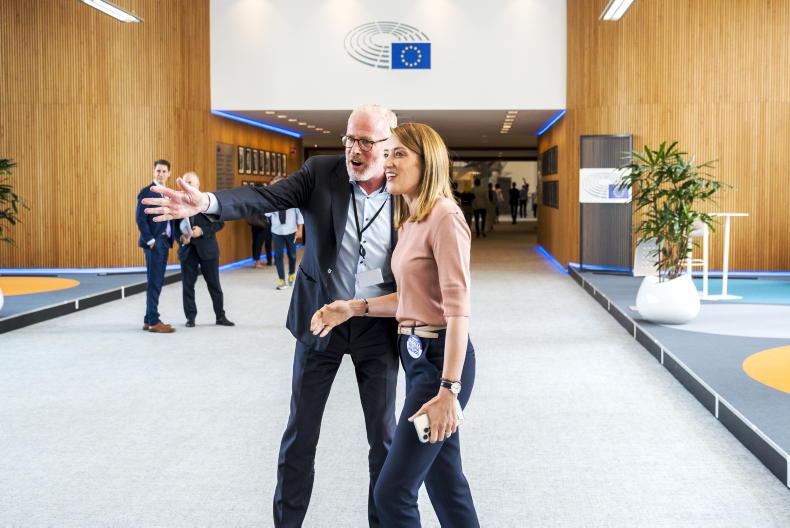
Damien with the president of the European Parliament, Roberta Metsola in the Parliament when she met a group of visiting farmers from Tirlán, © European Union 2025 - Source: EP
An opportunity came up with ICOS which currently represents 130 co-operative enterprises in Ireland.
“Every citizen in Europe has a representation in every sector and industry in Brussels, where all the decisions are being made. So being on the ground there, literally 10 minutes away from a face-to-face meeting, is priceless,” he says.
Damien always had a strong interest in politics, which made the move easier.
“It was somewhat daunting, getting used to how the EU works and finding out what I should be focusing on, and getting to know people. The key is building personal relationships and gaining trust with people over there.”
The biggest learning curve for Damien was figuring out how the system works, the technical language and the acronyms.
“For example, learning the timeframe for how a piece of legislation is first crafted until it comes into law. And learning about the Green Deal, which is a huge ambition for the commission to decarbonise to net zero by 2050 and the more immediate target in 2040,” he explains.
Now his days are filled with meetings and conferences, soaking up the avalanche of legislation, and then feeding that information back to Ireland.
“Not a lot has changed in terms of my day-to-day, I am still mixing with the same people and organisations, and still reading the Irish Farmers Journal,” he says.
Career highlights
For Damien, along with the Olympics and interviewing some of Ireland’s past presidents, one of the highlights of his career happened on foot of a programme he did on rural isolation.
“Martin McAleese called me and said Mary and I were listening to your programme on rural isolation, and it just struck us. He invited me up to the Áras, and we had a chat about what we can do about this,” Damien recalls.
He advised them that the best way of reaching every corner of the country is through two organisations, the IFA and the GAA.
“A steering group was developed and we set up what was then called The GAA Social Initiative. That’s something I am proud of, and it all began with a broadcast I did down in Kerry, interviewing people who told their stories of isolation and farming,” says Damien.

Former Carlow IFA chairman John Kehoe says farewell to John Murphy at Tullow Mart during his interview with Damien O'Reilly ;photo Karl McDonough
“Never underestimate the power of what you can do and your ability, sometimes it happens by accident,” he adds.
“Did I ever think I’d end up presenting Liveline – or interviewing presidents. Not really. And now I have interviewed Mary McAleese, Michael D Higgins, and Mary Robinson, so if you believe you can do it, you can. Everybody is human at the end of the day. If you want something, go for it,” he says.
Damien isn’t sure what the future holds or where his career will take him, but he
is really happy at the moment – and it shows.
With sheer determination and a drive to follow his interests, Damien O’Reilly became one of the most recognised voices in Irish agricultural radio, spending 24 years at RTÉ as a broadcaster and well-known radio host.
It was Damien who started the popular Saturday morning show Countrywide on RTÉ Radio One, in which the show’s listenership reached a peak of 275,000 listeners across his 15 years. Along with that, he regularly presented Liveline, covered three Olympic games, and covered several radio shows.
Damien is also a familiar face to many readers as for over 10 years, he was a columnist on the back page of Irish Country Living.
Three years ago though, Damien made the hard decision to leave a career and job he was comfortable in, to take on new challenges and opportunities in Brussels. He started a new role in EU affairs with the Irish Co-operative Organisation Society (ICOS).
“It all happened very quickly. It was a very sliding doors moment,” says Damien. “In November 2022, I arrived in Brussels with my suitcase. It was like jumping out of an aeroplane and hoping the parachute opens.”
One part of the job he is passionate about is hosting groups, explaining to members and visitors how the EU works.
“I think when you’re in agriculture, you need to know how the EU works. We interact with the European Commission, and we work with our colleagues in Copa-Cogeca. It’s all for the betterment of making sure that the policies the Commission comes up with and that which the parliament debates on are workable for our members,” says Damien.
“As a young fella, I was born and bred in Castleknock in Dublin and went to school on the North Circular Road. And then I end up working for the Irish co-ops in Brussels, you never know where life might bring you,” he quips.
Castleknock to countryside
Damien spent a lot of summers on his uncle’s and granny’s small suckler and sheep farm in Ballyjamesduff, Co Cavan.
“I had this kind of connection with the countryside. I spent a lot of time down there,” he says.
Having a passion for sport, one summer when Damien was 15, he wrote to Eugene McGee, the editor of the Longford Leader, who had just set up a sister title, the Cavan Leader, in search of work experience.
“He was very well-known and managed the Offaly team to win the famous 1982 All-Ireland that stopped Kerry getting the five-in-a-row. I wrote him a letter, and I couldn’t believe it when he rang my granny’s house because I told him that’s where I’ll be in the summer,” Damien recalls.
At the time, there was only one journalism college in Ireland which was impossible to get into. Damien ended up going to Ballyfermot Senior College and spent two years on its [then] new journalism and broadcasting course.
Former EU commissioner Mairead McGuinness speaking with Damien O'Reilly during a panel discussion at the ASA conference in Kilkenny 2024.
He had planned to go on and do a degree after the course, but Damien was offered a job working for the Hogan Stand GAA magazine. As a sporting enthusiast, it was too good an offer to turn down.
With a love for radio that was developed in Ballyfermot, he was later offered a role with Shannonside’s Northern Sound just when local radio was kicking off.
“Of course I wanted to do sport, but in local radio you have to do everything from the death notices, to sports and news. I was also doing a current affairs midday show, and I was told I had to do a farmers’ bulletin,” he says. That was the start of his agricultural broadcasting and his stepping stone into RTÉ.
Jumping through hoops
At the time, RTÉ had an agricultural department – with four people working in radio led by PJ Nolan, who was leaving to work for the Irish Farmers Journal.
“I had gone on the panel. So then my file was pulled out as I knew about farming. So I said I’ll stick with this for a while, but I really want to go into sports.
In 1998, getting a break in RTÉ at the age of just 25, “was a pinch-me moment” for Damien. “It took a bit of time to get in there, and I had to jump through a lot of hoops and build up my experience but it was exciting.”
Damien started reading the farm news bulletin on Drivetime, which led him to become more immersed in the agri world.
“The idea of going out and interviewing farmers was great. And then Joe Murray retired, and there was a programme on Saturday morning called Farm Week that was pre-recorded. I loved putting that together and making packages. I would go out to interview farmers, and I changed the style of it from hard news,” he explains.
As the show started gaining traction, Damien went to the head of radio, Tom McGuire, and asked him if they could do a live show.
“I came up with Countrywide and even picked the signature tune, which exists to this day,” he says.
The name was chosen not to take farming out, but to make it appeal to a broader audience, rather than just a farming programme.
“I knew who the audience was; it was a big audience, but I needed to soften the farming message, which was very technical for a general audience,” he explains.
The first episode of the RTÉ Radio One programme Countrywide aired on Saturday 14 July 2012.
“It continued to develop. At the same time, I was a jack-of-all-trades and a master of none. I was being asked to present other programmes. I went to three Olympics as a producer, presenter and reporter. There was very little I didn’t do in RTÉ radio, which was great,” he says.
Making the move to Brussels
During COVID-19, Damien felt life needed to change; his children were getting older, and he wanted to do other things.
“I was about to turn 50, and I could have stayed there. RTÉ has gone through a tough time, but I got on well there. I have nothing bad to say.
“But personally, I wanted to do something different, something a bit mad, not just move to another radio. So I utilised my agri experience,” he says.
Damien had plenty of experience in the agriculture sector, interviewing ministers and covering farming news stories. While chair of the Guild of Agricultural Journalists, Damien was one of the founders who set up the European Network of Agricultural Journalists (ENAJ). This took him over and back to Brussels, where he fell in love with the buzz and fast-paced atmosphere.
Damien with the president of the European Parliament, Roberta Metsola in the Parliament when she met a group of visiting farmers from Tirlán, © European Union 2025 - Source: EP
An opportunity came up with ICOS which currently represents 130 co-operative enterprises in Ireland.
“Every citizen in Europe has a representation in every sector and industry in Brussels, where all the decisions are being made. So being on the ground there, literally 10 minutes away from a face-to-face meeting, is priceless,” he says.
Damien always had a strong interest in politics, which made the move easier.
“It was somewhat daunting, getting used to how the EU works and finding out what I should be focusing on, and getting to know people. The key is building personal relationships and gaining trust with people over there.”
The biggest learning curve for Damien was figuring out how the system works, the technical language and the acronyms.
“For example, learning the timeframe for how a piece of legislation is first crafted until it comes into law. And learning about the Green Deal, which is a huge ambition for the commission to decarbonise to net zero by 2050 and the more immediate target in 2040,” he explains.
Now his days are filled with meetings and conferences, soaking up the avalanche of legislation, and then feeding that information back to Ireland.
“Not a lot has changed in terms of my day-to-day, I am still mixing with the same people and organisations, and still reading the Irish Farmers Journal,” he says.
Career highlights
For Damien, along with the Olympics and interviewing some of Ireland’s past presidents, one of the highlights of his career happened on foot of a programme he did on rural isolation.
“Martin McAleese called me and said Mary and I were listening to your programme on rural isolation, and it just struck us. He invited me up to the Áras, and we had a chat about what we can do about this,” Damien recalls.
He advised them that the best way of reaching every corner of the country is through two organisations, the IFA and the GAA.
“A steering group was developed and we set up what was then called The GAA Social Initiative. That’s something I am proud of, and it all began with a broadcast I did down in Kerry, interviewing people who told their stories of isolation and farming,” says Damien.
Former Carlow IFA chairman John Kehoe says farewell to John Murphy at Tullow Mart during his interview with Damien O'Reilly ;photo Karl McDonough
“Never underestimate the power of what you can do and your ability, sometimes it happens by accident,” he adds.
“Did I ever think I’d end up presenting Liveline – or interviewing presidents. Not really. And now I have interviewed Mary McAleese, Michael D Higgins, and Mary Robinson, so if you believe you can do it, you can. Everybody is human at the end of the day. If you want something, go for it,” he says.
Damien isn’t sure what the future holds or where his career will take him, but he
is really happy at the moment – and it shows.





SHARING OPTIONS