In two weeks, the normal deadline for this year’s Central Applications Office (CAO) will close. And it really isn’t something you want to put off until the last minute – or miss the deadline and have to pay a late fee.
We get it – at this time of year, students are focused on studying for their mock exams with practical subjects demanding attention for projects, and language orals around the corner.
Often students don’t have the headspace or motivation to look at college options, career pathways or further education routes. But it is important to take some time for your future self and think about what your next steps might be.
It doesn’t necessarily have to be a degree, there are lots of education options out there, and you shouldn’t feel pressured just because your friends are going in a certain direction. You need to think about what’s the right decision and pathway for you, to ensure you are ready for what the future holds.
The important thing though is not to get bogged down in the detail right now. Just get the application in – that keeps your options open as the change-of-mind facility means you have plenty of time to make your final selection.
Let’s take a look at how to make informed decisions about your CAO application and important things to keep an eye out for. This year, we have split our education focus into two parts. In CAO guide part two next week, we will be looking at the different pathways into further education outside of the points race.
Get expert advice
It is important that students avail of the guidance counsellor services in their secondary schools. These are qualified teachers who have been helping young people make decisions year after year.
They support students in practical, academic and emotional ways to help them understand how the CAO system works, explain how to research courses and guide them on how to check the entry requirements and eligibility of courses to ensure they meet the criteria.
It is important that students who need help managing stress and pressure around points also talk to their guidance teacher, as they might be able to put extra provisions in place during their exams.
Supports available
The HEAR and DARE schemes are admission programmes that offer reduced points and extra support for school leavers from disadvantaged backgrounds (HEAR) or with disabilities (DARE). It is about promoting fairness by considering individual circumstances alongside a student’s Leaving Certificate results.
Eligible students apply via the CAO, meet specific financial/social (HEAR) or disability criteria (DARE), and compete for reserved places based on the points they achieve.
Students who think they might be eligible for the schemes should talk to their parents and teachers. Once a student is in the scheme, they will receive extra support at third-level. Supports vary depending on each college’s learning support centre, but it normally leads to assistive technology, support during exams, and extra resources.
New courses
For the 2026 CAO cycle, new courses focus on high-demand areas like digital transformation in Technological University Dublin, law and cybersecurity in University of Limerick, alongside expanded offerings in arts, engineering, and healthcare.
In the agriculture and food sector, the biggest change this year is the introduction of the long-awaited and highly anticipated veterinary courses. You apply through the CAO, and there will be 80 new spaces in September.
The two new colleges offering a Bachelor of Veterinary are Atlantic Technological University (ATU) with the course code AU375, and South East Technological University (SETU) Waterford with the course code SE526.
Look into the course structure
A lot of students decide on their course based on the college, but they often overlook the structure of the course.
Each college website will outline the modules and topics students will cover over the duration of the course, along with whether or not it has professional work experience or study abroad opportunities.
It is important to look at the smaller details to ensure the subjects are of interest and to research if it offers Erasmus or a placement, if it is important to you. Colleges also outline prospective career opportunities upon completing the degree.
It is important to look beyond the course and college and to consider what career or job you see yourself working in.
Remember that one offer doesn’t define your future. There are options beyond the CAO and Leaving Certificate points system, which we will cover in Irish Country Living next week.
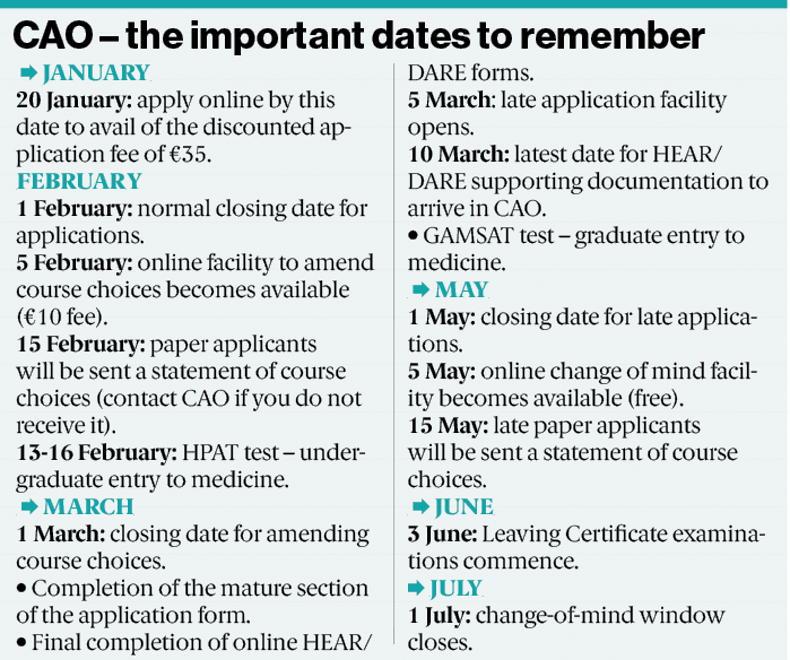
Important dates.
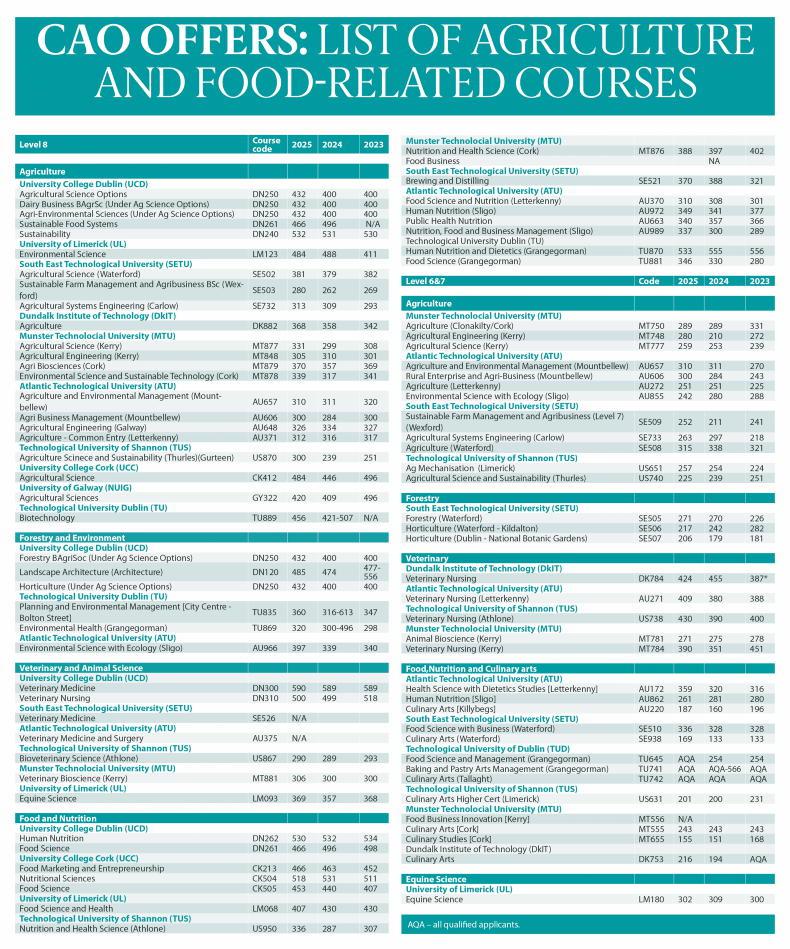
CAO 2026 list.
In two weeks, the normal deadline for this year’s Central Applications Office (CAO) will close. And it really isn’t something you want to put off until the last minute – or miss the deadline and have to pay a late fee.
We get it – at this time of year, students are focused on studying for their mock exams with practical subjects demanding attention for projects, and language orals around the corner.
Often students don’t have the headspace or motivation to look at college options, career pathways or further education routes. But it is important to take some time for your future self and think about what your next steps might be.
It doesn’t necessarily have to be a degree, there are lots of education options out there, and you shouldn’t feel pressured just because your friends are going in a certain direction. You need to think about what’s the right decision and pathway for you, to ensure you are ready for what the future holds.
The important thing though is not to get bogged down in the detail right now. Just get the application in – that keeps your options open as the change-of-mind facility means you have plenty of time to make your final selection.
Let’s take a look at how to make informed decisions about your CAO application and important things to keep an eye out for. This year, we have split our education focus into two parts. In CAO guide part two next week, we will be looking at the different pathways into further education outside of the points race.
Get expert advice
It is important that students avail of the guidance counsellor services in their secondary schools. These are qualified teachers who have been helping young people make decisions year after year.
They support students in practical, academic and emotional ways to help them understand how the CAO system works, explain how to research courses and guide them on how to check the entry requirements and eligibility of courses to ensure they meet the criteria.
It is important that students who need help managing stress and pressure around points also talk to their guidance teacher, as they might be able to put extra provisions in place during their exams.
Supports available
The HEAR and DARE schemes are admission programmes that offer reduced points and extra support for school leavers from disadvantaged backgrounds (HEAR) or with disabilities (DARE). It is about promoting fairness by considering individual circumstances alongside a student’s Leaving Certificate results.
Eligible students apply via the CAO, meet specific financial/social (HEAR) or disability criteria (DARE), and compete for reserved places based on the points they achieve.
Students who think they might be eligible for the schemes should talk to their parents and teachers. Once a student is in the scheme, they will receive extra support at third-level. Supports vary depending on each college’s learning support centre, but it normally leads to assistive technology, support during exams, and extra resources.
New courses
For the 2026 CAO cycle, new courses focus on high-demand areas like digital transformation in Technological University Dublin, law and cybersecurity in University of Limerick, alongside expanded offerings in arts, engineering, and healthcare.
In the agriculture and food sector, the biggest change this year is the introduction of the long-awaited and highly anticipated veterinary courses. You apply through the CAO, and there will be 80 new spaces in September.
The two new colleges offering a Bachelor of Veterinary are Atlantic Technological University (ATU) with the course code AU375, and South East Technological University (SETU) Waterford with the course code SE526.
Look into the course structure
A lot of students decide on their course based on the college, but they often overlook the structure of the course.
Each college website will outline the modules and topics students will cover over the duration of the course, along with whether or not it has professional work experience or study abroad opportunities.
It is important to look at the smaller details to ensure the subjects are of interest and to research if it offers Erasmus or a placement, if it is important to you. Colleges also outline prospective career opportunities upon completing the degree.
It is important to look beyond the course and college and to consider what career or job you see yourself working in.
Remember that one offer doesn’t define your future. There are options beyond the CAO and Leaving Certificate points system, which we will cover in Irish Country Living next week.
Important dates.
CAO 2026 list.











SHARING OPTIONS