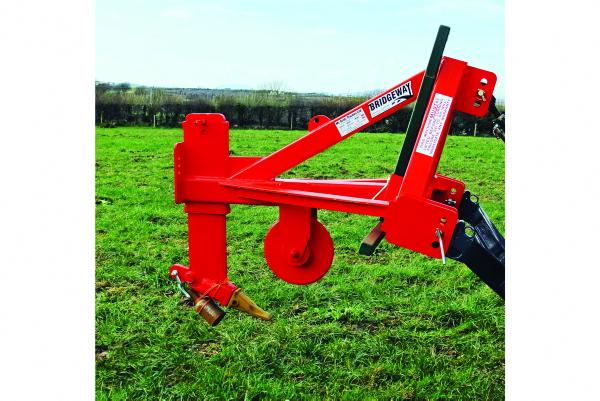
Photo 1
The mole plough is a common machine used to create small tunnels, allowing water to pass through soil. The plough operates by pulling a “bullet” through the sub soil forming a channel for water to flow through. The plough should be set so that it is level when pulling through the ground. Shortening the top link so that the bullet is pointed for better soil penetration should be avoided as the mole channel will be weaker and quickly collapse. The plough should only be used in dry con
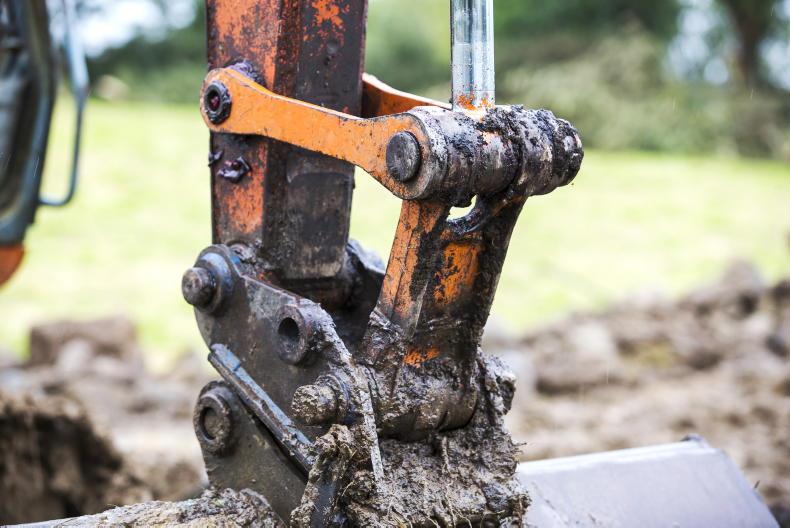
Photo 2
This machine is a gravel tunnel drainage system. It basically acts like a mole plough by creating a channel in the sub soil, but the attached hopper is filled with gravel which then fills the channel, preventing it from collapsing. The inclusion of stone makes the gravel tunnel drain more expensive than the mole plough at approximately €600 to €700/acre, compared with €300 for a straight mole drain. The gravel tunnel is recommended for use on lighter soils as it is less prone to c
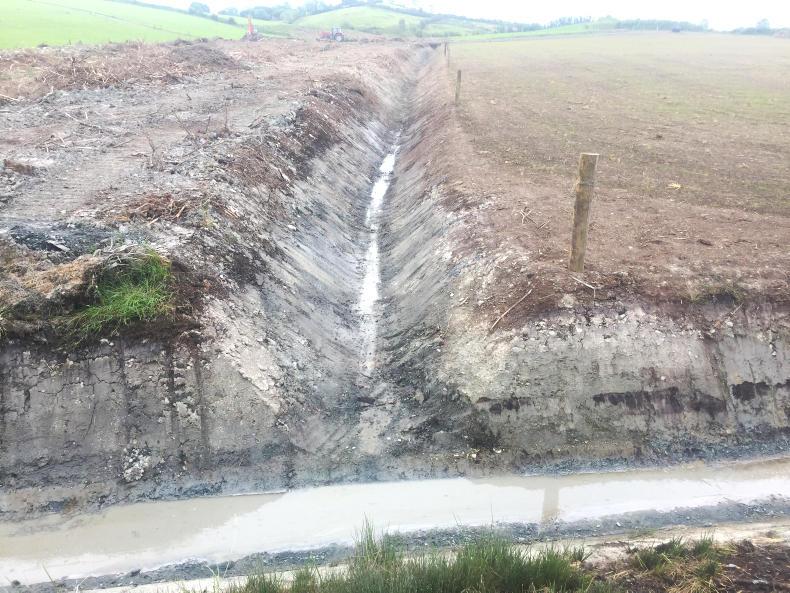
Photo 3
The trench drainage machine is a rare sight in modern drainage and is the equivalent of a one pass system. The drainage channel has uniform width which means there is less stone required compared with the channel created using a “V-shape” drainage bucket on a track digger. The pipe and stone are laid at the same time.
Photo 4
Two very different soil profiles that have different drainage requirements. The profile on the right is a peaty soil, while the profile on the left has a clay sub soil. Mole drains only work in clay, so there is no point in trying to drain the peaty soil using a mole plough or gravel tunnel as they will collapse. The only drain that suits this type of soil is drainage pipe and stone. For the clay profile, the mole drain will work provided the plough is pulled through the clay layer.
Photo 5
Collecting drains are vital for mole drains and gravel tunnels to function properly. They will not work without them. Collecting drains should be set at 20m to 30m on more permeable soils. On heavy soils, collecting drains should be closer at 10m to 15m apart. The mole plough and gravel tunnel should be pulled through the collecting drain so as water can escape. The photo shows a collecting drain, marked by the two white posts, with a series of mole drains passing through it.
Photo 6
Two soil profiles that have been mole ploughed. The profile on the left shows a mole drain that has recently been installed. The soil profile on the right shows a mole drain from 1984. Mole channels have a general lifespan of approximately five years, but if correctly installed and the collecting drains are maintained, the mole drain will remain effective.
Photo 7
Filling drains with stones is where the job becomes very expensive. The advice given on the day was to fill drains up to ploughing depth with stones. Filling to the surface creates unnecessary expense and the surface stones will only be spread once the field is ploughed and cultivated.
Photo 8
The photo shows how far one tonne of gravel will cover with varying size of drainage channel. The white line represents the distance each drain size will go and represents the size of drainage bucket on the digger.
Photo 9
At a drainage depth of 2ft 6 inches and a surface width of 18 inches, then one tonne of stone will cover five metres. To drain one acre of land, 130 tonnes of stone will be required.
Photo 10
At a drainage depth of 2ft 6 inches and a surface width of 13 inches, then one tonne of stone will cover six metres. To drain one acre of land, 110 tonnes of stone will be required.
Photo 11
Using machinery like the trench drainage machine will leave a uniform channel of width and depth at the soil surface and drain surface. At a drainage depth of 2ft 6 inches and a surface width of six inches, then one tonne of stone will cover eight metres. To drain one acre of land, 82 tonnes of stone will be required, reducing costs significantly.
In part two of the feature, Kieran Mailey describes some of the recommendations for draining ground presented at the CAFRE open event in early July.
The recent heatwave that has engulfed the country has led to ground drying out and becoming suitable for some form of drainage work, or aeration, to be carried out. Undertaking drainage work can be expensive and in many ways, its success is dependent on the soil type.
At the CAFRE open day, advice was presented on improving soil drainage through soil aeration, which was featured last week, mole ploughing, gravel tunnelling and traditional pipe and stone drains which are featured in this series of photographs.
ADVERTISEMENT
The objective of field drainage is to lower the level of ground water so that it does not inhibit crop production or the field’s ability to carry livestock. With heavy soils, this can be difficult to do as water can be slow to move through the soil layers. Therefore drains must be placed closer together and a series of secondary drains, such as moles or gravel tunnels, will be required.
Register for free to read this story and our free stories.
This content is available to digital subscribers and loyalty code users only. Sign in to your account, use the code or subscribe to get unlimited access.
The reader loyalty code gives you full access to the site from when you enter it until the following Wednesday at 9pm. Find your unique code on the back page of Irish Country Living every week.
CODE ACCEPTED
You have full access to the site until next Wednesday at 9pm.
CODE NOT VALID
Please try again or contact support.
In part two of the feature, Kieran Mailey describes some of the recommendations for draining ground presented at the CAFRE open event in early July.
The recent heatwave that has engulfed the country has led to ground drying out and becoming suitable for some form of drainage work, or aeration, to be carried out. Undertaking drainage work can be expensive and in many ways, its success is dependent on the soil type.
At the CAFRE open day, advice was presented on improving soil drainage through soil aeration, which was featured last week, mole ploughing, gravel tunnelling and traditional pipe and stone drains which are featured in this series of photographs.
The objective of field drainage is to lower the level of ground water so that it does not inhibit crop production or the field’s ability to carry livestock. With heavy soils, this can be difficult to do as water can be slow to move through the soil layers. Therefore drains must be placed closer together and a series of secondary drains, such as moles or gravel tunnels, will be required.
If you would like to speak to a member of our team, please call us on 01-4199525.
Link sent to your email address
We have sent an email to your address. Please click on the link in this email to reset your password. If you can't find it in your inbox, please check your spam folder. If you can't find the email, please call us on 01-4199525.
ENTER YOUR LOYALTY CODE:
The reader loyalty code gives you full access to the site from when you enter it until the following Wednesday at 9pm. Find your unique code on the back page of Irish Country Living every week.







SHARING OPTIONS