The wonderful Con Houlihan once wrote "I missed Italia '90; I was in Italy at the time".
Despite the football being played in Cagliari, Palermo, Genoa and Rome, much of the action and drama around Ireland's march to the World Cup quarter finals was played out at home.
I've been under the weather and confined to barracks for the last couple of weeks, so my understanding of the dynamic around the Irish Farmers' Association's (IFA) campaign to remove Larry Murrin from the chairmanship of Bord Bia is secondhand.
I might be a little out of touch as a result, but, for what it's worth, I'll try to outline just how we have got to where we are and where things might go next.
Recap
It all started in mid-January, when someone noticed that a Subway outlet somewhere in Ireland stated that their beef was coming from Ireland, the EU, the UK and Brazil.
The image was shared across social media by the Beef Plan Movement and circulated widely, incensing farmers.
When it quickly emerged that Dawn Farm Foods was the company fulfilling the Subway contract, the focus switched from the user of Brazilian beef to the provider.
And that, of course, is because the CEO of Dawn Farm Foods is Larry Murrin, who is also chair of Bord Bia.
The IFA called on Murrin to resign, with the association's president Francie Gorman looking for a Bord Bia board meeting.
This took place on 22 January and Gorman afterwards revealed he proposed that Murrin resign, gaining a seconder in Irish Creamery Milk Suppliers Association (ICMSA) president Denis Drennan.
No vote was taken, with Bord Bia CEO Jim O'Toole issuing a statement describing a consensus of support for Larry Murrin as chair.
In my opinion, as this statement concerned a board procedure, it should more properly have been released in the name of the vice-chair, who I presume took the chair when the heave against Larry Murrin commenced. For the record, former Dairygold CEO Jim Woulfe stepped into the position of acting chair for the board meeting on 22 January.
Bord Bia's board does not have the power to appoint its own chair. That responsibility is vested in the Minister for Agriculture.
That said, a motion of confidence in the chair supported by two board members is a significant event.
The IFA was unhappy with the outcome of the board meeting and with what they saw as support for Larry Murrin expressed by Taoiseach Micheal Martin and Minister for Agriculture Martin Heydon in advance of that board meeting.
For the record, what Martin Heydon said was: "Mr Murrin has discharged his duties as chairman of Bord Bia in a satisfactory manner to date."
Hardly a ringing endorsement. In fact, if I was an embattled Premier League manager and the chair made such a low-key statement in respect of my tenure, I'd be preparing to empty my desk.
The "to date" phrase in particular implies that changing circumstances could affect that evaluation. The Taoiseach's support at that time was stronger.
In the Dáil on 21 January - the day before the Bord Bia board meeting - he debated the matter with Sinn Féin leader Mary Lou McDonald.
The Taoiseach warned against going "after people wrongly and without proper perspective” and not to “undermine” food companies.
“Don’t try and drag down a good organisation, deputy. Don’t try and drag it down, now. Let’s not go for this very populist, low-level activity," he said.
"Let’s not all go like herd instincts, jump everywhere and go after people wrongly and without proper perspective or understanding of the Irish food industry, which has been a good success story for Ireland over the last number of years and continues to be.
“Bord Bia is one of the better State agencies and our food companies which are global, by the way, all over Europe and all over the world, let’s not undermine them just for the sake of chasing other people for votes and for popularity,” the Taoiseach said.
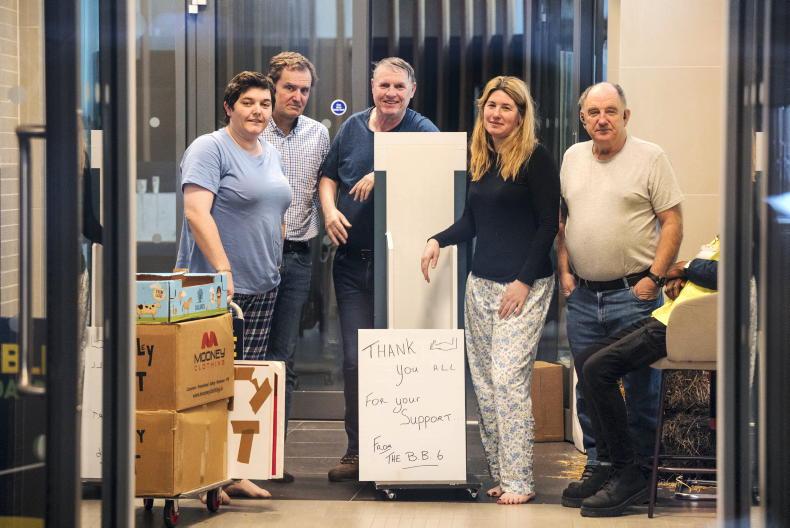
Tom Byrne (Wicklow), Richard Moeran (Cavan), Teresa Roche (Galway), Patrick McCormick (Monaghan) and Christine Friel (Donegal) pictured inside the Bord Bia building on day eight of their occupation, as part of the IFA protest calling for the resignation of Bord Bia chair Larry Murrin. \ Claire Nash
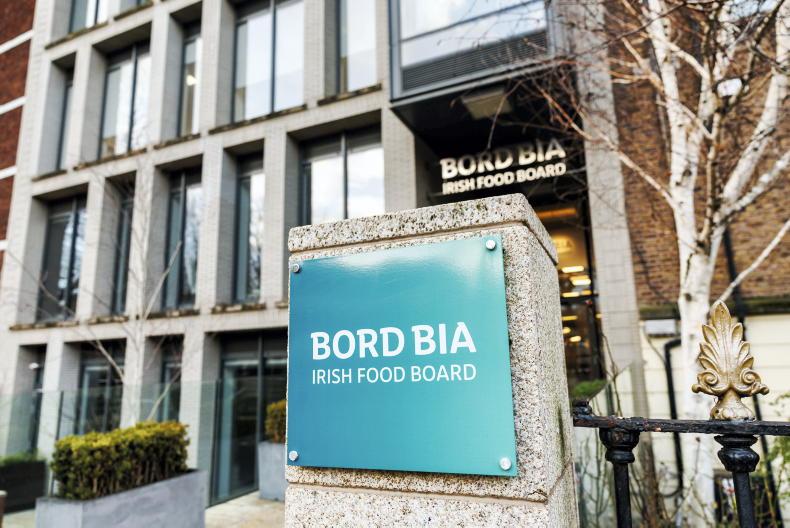
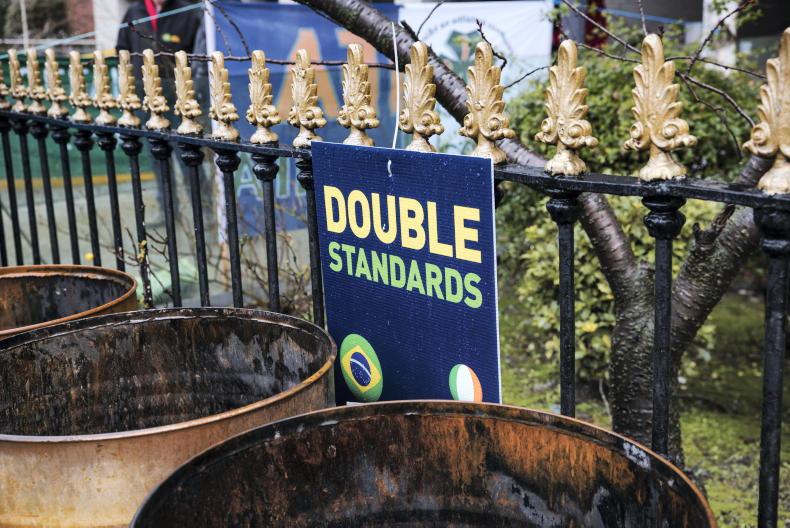
Then, on Monday 26 January, the IFA began its protest outside the Bord Bia offices in Pembroke Street in Dublin. A small group occupied the offices 10 days later, five of those remain inside still.
Within the houses of the Oireachtas, we have had a Dáil debate and a separate vote on a private members' motion from Sinn Féin.
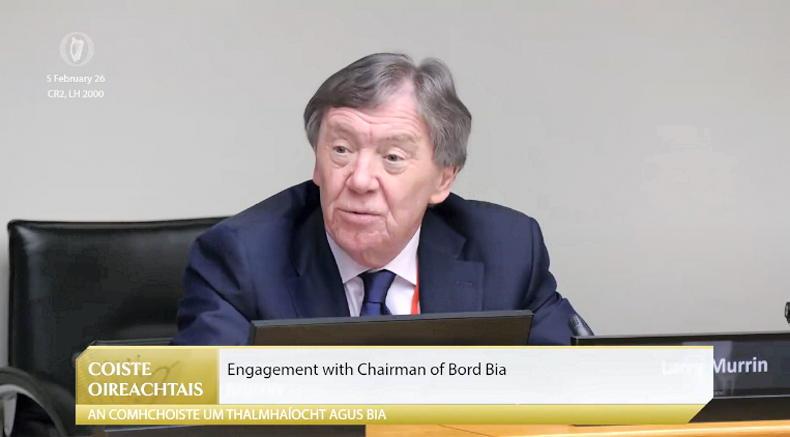
We have also had two meetings of the Joint Oireachtas Committee for Agriculture - one featuring Larry Murrin flanked by Bord Bia management, the second featuring members of the IFA and the ICSA.
Stalemate
We're now in an absolute stalemate. The IFA - and indeed all the farm organisations - are adamant that Larry Murrin's position is completely untenable and that he must go. But this can only happen in one of two ways.
Either Larry Murrin himself resigns or the Minister asks or tells him to leave his position. And right now, there seems little prospect of either of those things happening.
If anything, Martin Heydon's support for Larry Murrin - or at least his public expressions of support for Larry Murrin - have strengthened. And there are a number of reasons why this might be.
It certainly isn't because the questions around Murrin's suitability for the job have fizzled out. Genuine issues have arisen following weeks of forensic scrutiny of Dawn Farm Foods.
In particular, there are genuine concerns around how Dawn Farm Foods was described as being part of the Bord Bia food processing Quality Assurance (QA) scheme on both the Dawn Farm Foods and the Bord Bia website long after this stopped being the case.
Political context
To fully understand the Government's intransigence, we have to look at the political context this battle is occurring within. We have had a couple of big-ticket issues in recent months, both of which were "red lines" for the IFA.
The first was the nitrates derogation, so important to dairy farmers in particular. The Government and the IFA were aligned and a huge multi-ministerial effort went into pursuing a renewal of the derogation, something that was far from assured.
It was only in December that confirmation came from Brussels that the derogation would pertain for a further three years from the beginning of this year.
However, there was little backslapping, as immediately the focus turned to the Mercosur trade deal.
The Government was coming under pressure from Ursula von der Leyen to switch from outright opposition to Mercosur to abstention or support.
And there were some in Government - and certainly a bunch of Irish economists - saying that, on balance, the deal would help Europe and maybe even this country.
The negative impact of 100,000 tonnes of South American beef - probably all prime cuts - meant it was seen by all in Irish agriculture as a disaster for our sector, so dependent on exports to the EU.
There was a fairly intense debate before Christmas, but Ireland maintained its opposition and the can was kicked down the road to January.
And last month, the pressure from von der Leyen and her supporters intensified still further. Italy switched and the maths meant that Mercosur would gain approval.
Would Ireland stick or twist? Micheál Martin's comment that the issue should be considered "in the round" led to accusations from some quarters that a deal had been done - Mercosur for the nitrates directive.
This increased the pressure on Martin Heydon - and indeed the IFA - that the line would be held on the last decisive vote, even though it was pretty obvious that Ireland's opposition would be in vain.
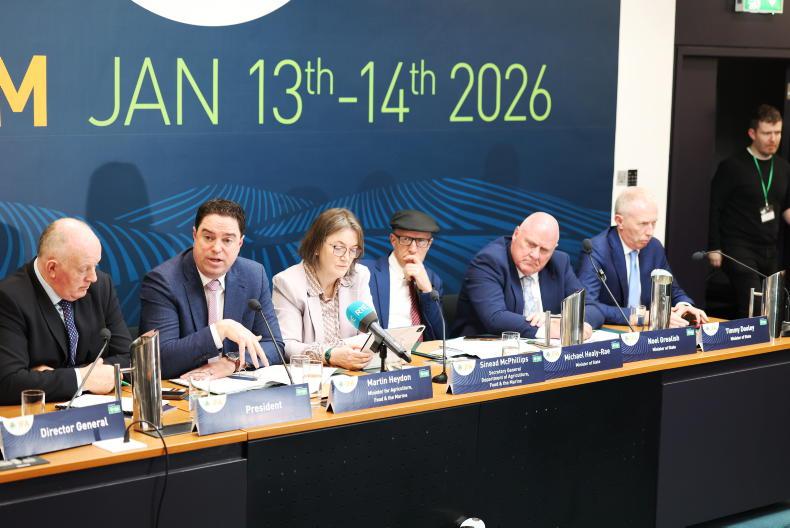
Martin Heydon addresses the IFA during the brief hiatus between the end of the Mercosur saga and the start of the Larry Murrin stand-off.
Micheál Martin's "in the round" comment could be read another way. He might not have been referring to support for Mercosur being in exchange for favours granted, like the derogation.
Rather, he might have been indicating that there were future concessions to be gained, perhaps even in relation to the upcoming CAP negotiations, were Ireland to give the European Commission president what she so desperately wanted, a win in the sphere of trade and diplomacy.
In any event, Ireland voted against Mercosur right up to the bitter end. That was on 9 January, on the eve of the massive farmer protest in Athlone.
I surmised that the 20,000 farmers who turned out were not just railing against Mercosur, but against the wider sense that farming is gaining scrutiny and oversight and losing margin and profitability.
One of the biggest oversight agencies is Bord Bia, through the QA schemes. Fifty-five-thousand farmers have to tick hundreds of boxes in order to gain QA status year to year.
It may well have been a farmer heading home from Athlone who stopped into a Subway for a snack and, senses heightened, noticed the provenance of the meat they were consuming.
In any event, we went pretty much straight from the Mercosur red line, which had come hot on the heels of the derogation red line, to the 'Larry Murrin must go' red line.
I get the impression that the Government decided that the IFA had set enough loyalty tests for them in a short space of time. This time, the answer would be no.
And here we are.
Big picture
There have been a lot of things said over the last three weeks by farmers about Government. It reflects the widely-held feeling among farmers that the demands placed on them to reach higher standards than anyone else in the world are unfair if there is not clear distinction between food produced within our system, to our standard, and food produced elsewhere in the world within a very different regulatory regime.
Larry Murrin being CEO of Dawn Farm Foods, which operates at the secondary processing level, using Brazilian product makes him an unsuitable person to chair the organisation which oversees the QA scheme in most farmers' eyes.
The volume or percentage of third country meat used matters not to farmers forced to meet the rigorous standards of the QA scheme. Nor does the reason why it is being sourced a valid excuse in farmers' eyes.
But I would be confident that Martin Heydon has been told by his cabinet colleagues not to give in on this issue, not unless a smoking gun is found.
It mustn't be forgotten that Charlie McConalogue was the only member of the last Government to have been demoted when the current cabinet was announced.
There is a perception in some parts of Government that farmers are insatiable and giving them something they have asked for only emboldens them to ask for more.
The IFA is determined to stand by its demand - the Government seems equally committed to standing by their man. I really hope someone manufactures a way for this to impasse to be navigated through. And soon.
This article was updated on Monday 16 February to reflect that Jim Woulfe is not the vice chair of the board of Bord Bia.
The wonderful Con Houlihan once wrote "I missed Italia '90; I was in Italy at the time".
Despite the football being played in Cagliari, Palermo, Genoa and Rome, much of the action and drama around Ireland's march to the World Cup quarter finals was played out at home.
I've been under the weather and confined to barracks for the last couple of weeks, so my understanding of the dynamic around the Irish Farmers' Association's (IFA) campaign to remove Larry Murrin from the chairmanship of Bord Bia is secondhand.
I might be a little out of touch as a result, but, for what it's worth, I'll try to outline just how we have got to where we are and where things might go next.
Recap
It all started in mid-January, when someone noticed that a Subway outlet somewhere in Ireland stated that their beef was coming from Ireland, the EU, the UK and Brazil.
The image was shared across social media by the Beef Plan Movement and circulated widely, incensing farmers.
When it quickly emerged that Dawn Farm Foods was the company fulfilling the Subway contract, the focus switched from the user of Brazilian beef to the provider.
And that, of course, is because the CEO of Dawn Farm Foods is Larry Murrin, who is also chair of Bord Bia.
The IFA called on Murrin to resign, with the association's president Francie Gorman looking for a Bord Bia board meeting.
This took place on 22 January and Gorman afterwards revealed he proposed that Murrin resign, gaining a seconder in Irish Creamery Milk Suppliers Association (ICMSA) president Denis Drennan.
No vote was taken, with Bord Bia CEO Jim O'Toole issuing a statement describing a consensus of support for Larry Murrin as chair.
In my opinion, as this statement concerned a board procedure, it should more properly have been released in the name of the vice-chair, who I presume took the chair when the heave against Larry Murrin commenced. For the record, former Dairygold CEO Jim Woulfe stepped into the position of acting chair for the board meeting on 22 January.
Bord Bia's board does not have the power to appoint its own chair. That responsibility is vested in the Minister for Agriculture.
That said, a motion of confidence in the chair supported by two board members is a significant event.
The IFA was unhappy with the outcome of the board meeting and with what they saw as support for Larry Murrin expressed by Taoiseach Micheal Martin and Minister for Agriculture Martin Heydon in advance of that board meeting.
For the record, what Martin Heydon said was: "Mr Murrin has discharged his duties as chairman of Bord Bia in a satisfactory manner to date."
Hardly a ringing endorsement. In fact, if I was an embattled Premier League manager and the chair made such a low-key statement in respect of my tenure, I'd be preparing to empty my desk.
The "to date" phrase in particular implies that changing circumstances could affect that evaluation. The Taoiseach's support at that time was stronger.
In the Dáil on 21 January - the day before the Bord Bia board meeting - he debated the matter with Sinn Féin leader Mary Lou McDonald.
The Taoiseach warned against going "after people wrongly and without proper perspective” and not to “undermine” food companies.
“Don’t try and drag down a good organisation, deputy. Don’t try and drag it down, now. Let’s not go for this very populist, low-level activity," he said.
"Let’s not all go like herd instincts, jump everywhere and go after people wrongly and without proper perspective or understanding of the Irish food industry, which has been a good success story for Ireland over the last number of years and continues to be.
“Bord Bia is one of the better State agencies and our food companies which are global, by the way, all over Europe and all over the world, let’s not undermine them just for the sake of chasing other people for votes and for popularity,” the Taoiseach said.
Tom Byrne (Wicklow), Richard Moeran (Cavan), Teresa Roche (Galway), Patrick McCormick (Monaghan) and Christine Friel (Donegal) pictured inside the Bord Bia building on day eight of their occupation, as part of the IFA protest calling for the resignation of Bord Bia chair Larry Murrin. \ Claire Nash
Then, on Monday 26 January, the IFA began its protest outside the Bord Bia offices in Pembroke Street in Dublin. A small group occupied the offices 10 days later, five of those remain inside still.
Within the houses of the Oireachtas, we have had a Dáil debate and a separate vote on a private members' motion from Sinn Féin.
We have also had two meetings of the Joint Oireachtas Committee for Agriculture - one featuring Larry Murrin flanked by Bord Bia management, the second featuring members of the IFA and the ICSA.
Stalemate
We're now in an absolute stalemate. The IFA - and indeed all the farm organisations - are adamant that Larry Murrin's position is completely untenable and that he must go. But this can only happen in one of two ways.
Either Larry Murrin himself resigns or the Minister asks or tells him to leave his position. And right now, there seems little prospect of either of those things happening.
If anything, Martin Heydon's support for Larry Murrin - or at least his public expressions of support for Larry Murrin - have strengthened. And there are a number of reasons why this might be.
It certainly isn't because the questions around Murrin's suitability for the job have fizzled out. Genuine issues have arisen following weeks of forensic scrutiny of Dawn Farm Foods.
In particular, there are genuine concerns around how Dawn Farm Foods was described as being part of the Bord Bia food processing Quality Assurance (QA) scheme on both the Dawn Farm Foods and the Bord Bia website long after this stopped being the case.
Political context
To fully understand the Government's intransigence, we have to look at the political context this battle is occurring within. We have had a couple of big-ticket issues in recent months, both of which were "red lines" for the IFA.
The first was the nitrates derogation, so important to dairy farmers in particular. The Government and the IFA were aligned and a huge multi-ministerial effort went into pursuing a renewal of the derogation, something that was far from assured.
It was only in December that confirmation came from Brussels that the derogation would pertain for a further three years from the beginning of this year.
However, there was little backslapping, as immediately the focus turned to the Mercosur trade deal.
The Government was coming under pressure from Ursula von der Leyen to switch from outright opposition to Mercosur to abstention or support.
And there were some in Government - and certainly a bunch of Irish economists - saying that, on balance, the deal would help Europe and maybe even this country.
The negative impact of 100,000 tonnes of South American beef - probably all prime cuts - meant it was seen by all in Irish agriculture as a disaster for our sector, so dependent on exports to the EU.
There was a fairly intense debate before Christmas, but Ireland maintained its opposition and the can was kicked down the road to January.
And last month, the pressure from von der Leyen and her supporters intensified still further. Italy switched and the maths meant that Mercosur would gain approval.
Would Ireland stick or twist? Micheál Martin's comment that the issue should be considered "in the round" led to accusations from some quarters that a deal had been done - Mercosur for the nitrates directive.
This increased the pressure on Martin Heydon - and indeed the IFA - that the line would be held on the last decisive vote, even though it was pretty obvious that Ireland's opposition would be in vain.
Martin Heydon addresses the IFA during the brief hiatus between the end of the Mercosur saga and the start of the Larry Murrin stand-off.
Micheál Martin's "in the round" comment could be read another way. He might not have been referring to support for Mercosur being in exchange for favours granted, like the derogation.
Rather, he might have been indicating that there were future concessions to be gained, perhaps even in relation to the upcoming CAP negotiations, were Ireland to give the European Commission president what she so desperately wanted, a win in the sphere of trade and diplomacy.
In any event, Ireland voted against Mercosur right up to the bitter end. That was on 9 January, on the eve of the massive farmer protest in Athlone.
I surmised that the 20,000 farmers who turned out were not just railing against Mercosur, but against the wider sense that farming is gaining scrutiny and oversight and losing margin and profitability.
One of the biggest oversight agencies is Bord Bia, through the QA schemes. Fifty-five-thousand farmers have to tick hundreds of boxes in order to gain QA status year to year.
It may well have been a farmer heading home from Athlone who stopped into a Subway for a snack and, senses heightened, noticed the provenance of the meat they were consuming.
In any event, we went pretty much straight from the Mercosur red line, which had come hot on the heels of the derogation red line, to the 'Larry Murrin must go' red line.
I get the impression that the Government decided that the IFA had set enough loyalty tests for them in a short space of time. This time, the answer would be no.
And here we are.
Big picture
There have been a lot of things said over the last three weeks by farmers about Government. It reflects the widely-held feeling among farmers that the demands placed on them to reach higher standards than anyone else in the world are unfair if there is not clear distinction between food produced within our system, to our standard, and food produced elsewhere in the world within a very different regulatory regime.
Larry Murrin being CEO of Dawn Farm Foods, which operates at the secondary processing level, using Brazilian product makes him an unsuitable person to chair the organisation which oversees the QA scheme in most farmers' eyes.
The volume or percentage of third country meat used matters not to farmers forced to meet the rigorous standards of the QA scheme. Nor does the reason why it is being sourced a valid excuse in farmers' eyes.
But I would be confident that Martin Heydon has been told by his cabinet colleagues not to give in on this issue, not unless a smoking gun is found.
It mustn't be forgotten that Charlie McConalogue was the only member of the last Government to have been demoted when the current cabinet was announced.
There is a perception in some parts of Government that farmers are insatiable and giving them something they have asked for only emboldens them to ask for more.
The IFA is determined to stand by its demand - the Government seems equally committed to standing by their man. I really hope someone manufactures a way for this to impasse to be navigated through. And soon.
This article was updated on Monday 16 February to reflect that Jim Woulfe is not the vice chair of the board of Bord Bia.







SHARING OPTIONS