


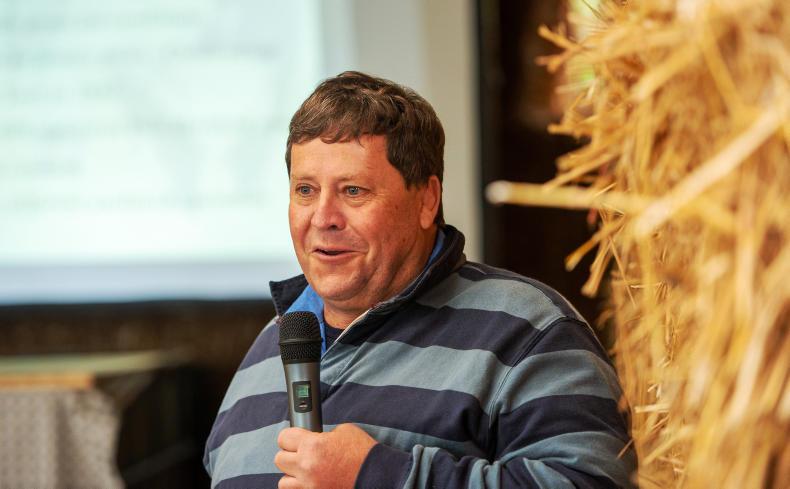
Much of the Kellys’ initial breeding decisions were done off the back of EBVs generated on Breedplan offered by ABRI (Agricultural Business Research Institute). Breedplan is a genetic evaluation system for beef cattle that produces EBVs for a range of traits and is known across the world. Speaking at the open day at Netherhall last week was the chair of the Australian ABRI board, Ian Locke. Ian was also the breeder from whom the Kellys bought their initial Hereford embryos. Ian’s father was one of the early adopters of Breedplan, which is now the national beef recording scheme in Australia.
Speaking about the benefits of the genetic evaluation system, Ian said: “We try to measure everything. If we try to measure as many things as you practically can, you find bulls that break the correlations and are outliers to the usual. So often trying to find these animals that are born light, grow fast, have great carcases and all those sorts of things. But you will never find them if you stick with correlations and just measure one thing.”
Sitting down with the Irish Farmers Journal after the event, Ian outlined that Breedplan Australia is currently looking at two major things that it thinks will help further enhance the service ABRI provides to breeders.
“Firstly, the appetite to go across breed is now very high in the commercial sector. They’re saying it’s a source of confusion when you’re trying to bring across the figures to commercial producers and they’re saying well why can’t I compare this Hereford bull to an Angus bull.”
Data gaps
“There are a lot of data gaps. We have to have animals that link across the breeds. Genotypes can actually help this occur. Usually when we talk about linkage, we’re talking about pedigree linkage, but genotypes can give you a gene linkage. Your linkage is far better with genotypes, because animals you didn’t know were related are in fact related by genes they carry.”
Ian explained that while this is needed to make better breeding decisions on a commercial basis, there are still societies with concerns.
“There are challenges. Not sure about here, but in Australia there are societies that are feeling threatened about being on the same base as the bigger, more powerful breeds. Wearing an industry hat, that’s a good thing. Highlighting the weaknesses in a breed compared to another can help breed it out. You can say this breed has a weakness here but it may be able to dip into traits in another breed to improve it.”
The second big move Breedplan Australia is looking at is a multi-country EBVs. This will see societies from different countries have an EBV run which will compare a number of countries’ animals against each other.
“Societies in particular are talking about having a combined analysis. That might not be what we see now with a once-a-month run, but it might be once a year. It might only run sires with progeny, so then we can say well we know our sires so how do they rate compared to other sires being used in the UK or used elsewhere and we might be thinking maybe there’s something there we can use.
“That multi-country EBVs is certainly something the stud people want. The commercial breeders perhaps don’t see the benefit in that now but the crossbreed EBVs are something the beef industry wants.”
Genomic base
While the genomic base in Australia may not be as advanced as Ireland yet, it is growing, with Breedplan getting genomic evaluations since November 2017.
“Genomics is like a chicken and an egg type of scenario, we need to build a reference population first but it’s hard to get people to invest when at the moment they’re getting nothing back.”
Speaking about his term so far, Ian is very happy with the progress of Breedplan and is very optimistic about the future.
“In the last five years it’s been fantastic. We’ve taking on genomics and now we move on to the next steps of multi-country and across-breed EBVs is going to be a significant task. It’s an exciting phase.
“I think we’re even grappling with indexes in different production systems, like a northern production system in Australia and a southern system is quite different. We’re starting to think about a different geographical production system.”




SHARING OPTIONS