The Irish Grassland Association was back in Charleville this year, for the annual dairy conference.
The negative mood-music surrounding the industry on the back of recent milk price drops wasn’t enough to keep farmers away, with an eager audience of over 300 turning out on the day.
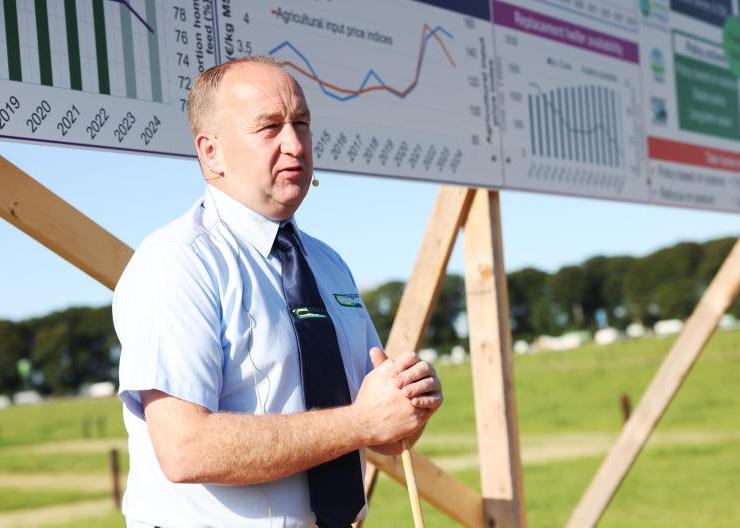
Laurence Shalloo, head of animal and grassland research opened the conference with a presentation on how the industry is placed at the moment.
As expected with the milk price drops experienced over the last five months, managing costs of production was to the fore.
“From 2012 to 2020 costs remained relatively stable with essentially no change. If anything costs actually dropped throughout that period. Since then, however, the story is not all rosy.
“Post-2020, costs increased dramatically, primarily on the back of external factors like war in Ukraine and COVID-19.
“Those costs have driven on much higher than we’d like and to be honest more than our competitors, which is really worrying,” Laurence said.
The agricultural input price index is an index posted by the CSO annually, showing where input prices stand at a certain point in time.
Throughout the eight-year period from 2012 to 2020, the actual costs at farm-level tracked slightly below the index, meaning farms were producing milk cheaper than expected.
From 2021-2024, this price index increased dramatically before peaking at 50% above 2020-levels in the year 2022.
Since then, the index has been falling, signalling a reduction in the cost of production. The index is currently at just 27% above the 2020 level, however, the actual cost of production at farm-level still remains at 43% above 2020 levels according to Laurence.
“So, what has happened at farm level, what has changed and why are we no longer tracking the price index?” he asked.
Direct costs
Overall, costs have increased by €1.36 per kilo of milk solids, since 2020. Of this figure €0.83/kgMS can be explained by variable cost increases.
“Some 75% of the increase in variable costs can be explained by two main variables. The first is forage production which incorporates silage, fertiliser, reseeding and liming costs and the second main cost is meal feeding” Laurence said.
“This is where a lot of the focus must be on farms if we’re going to try and get back in line with the agricultural price index” he continued.
Producing high quality grass will inevitably come at a cost but the utilisation of that grass is where the gains can be made.
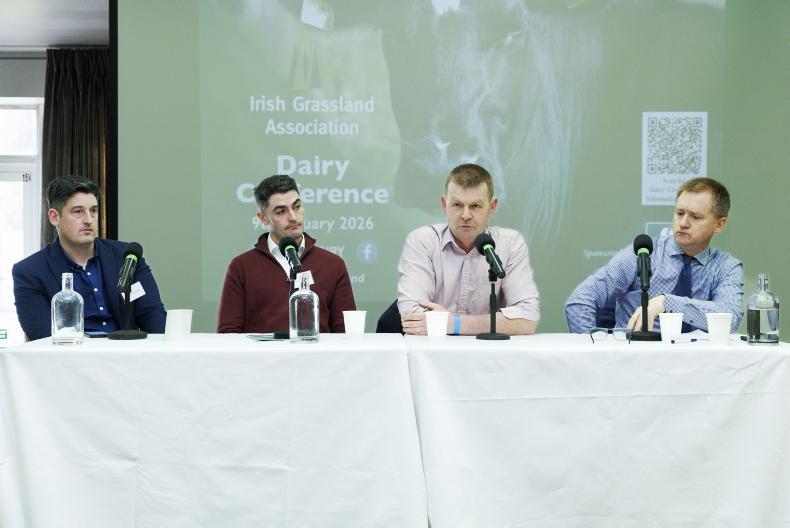
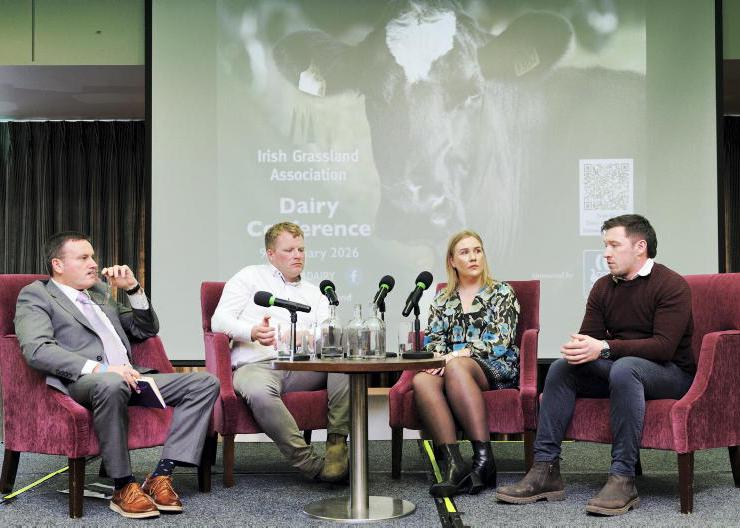
John O' Loughlin, IGA, Kevin Moran, dairy farmer, Galway, John MacNamara, dairy farmer, Limerick and Michael O' Donovan, Teagasc, Moorepark speaking during the IGA conference in Charleville, Co Cork.
In terms of concentrate feeding, an interactive poll from the audience showed that increases in meal feeding at farm level was primarily down to high milk price. Teagasc research based on recent national farm survey data still shows that the relationship between higher milk yields and profit is weak.
Therefore, feeding extra meal to drive yields is, in fact, counterproductive. The increased level of meal feeding is actually also having a negative effect on grass utilisation.
“The message is really clear; we need to be focusing on cost of production and pasture utilisation is the key driver of this.
“For every one tonne of extra grass utilised per hectare, profit will increase by €195/ha. Targeting better utilisation through optimum stocking rates and lower concentrate feeding is the key in lowering cost of production” Laurence stated.
Growing more grass
Echoing Laurence’s point, Michael O’Donovan, Teagasc grassland researcher hammered home the importance of grassland management and the importance of utilising more grass on farms to lower costs.
“At the moment there is a 4t/ha difference in the grass grown by top third of dairy farmers versus the bottom third. That’s the equivalent of one extra livestock unit per hectare.
Those farms are also achieving 1.5 more grazings per paddock and all of that is with similar levels of nitrogen applied. The difference is not explained by nitrogen but by grassland management” Michael said.
Joining Michael in the panel discussion was Kevin Moran, who is dairy farming in Galway and John MacNamara, a dairy farmer from Limerick.
Both farmers are growing over 15t/ha of grass annually using under 180kg of chemical nitrogen per hectare.
The pair spoke of the importance of doing the basics well over and controlling the controllables.
Soil fertility, reseeding, clover and regular farm walks form a major part of the everyday decision-making.
Calves
One thing that farmers can be thankful for in 2026 is calf prices. While it’s true that calf income used to be a very small part of the business, this is no longer the case.
On the topic of sexed semen, Laurence agreed it can be a big cost for farms but he sees it as one of the costs that shouldn’t be skimped on this year.
“Sexed semen gives farmers the opportunity to breed more higher value beef calves, instead of the lower value dairy bull calves, which will no doubt benefit the business in 2027.
“With the improvements made to the CBV index for breeding those dairy beef calves, a well organised breeding programme pairing sexed semen with quality beef semen could prove to be a big part of a farm’s profitability over the next number of years,” he said.
The benefit of synchronisation programmes is not something that could be spoken of with the same conviction however.
The programmes can be costly to follow with some mixed results. Continuing with synch programmes in 2026 is something that will have to be looked at on a farm-by-farm basis according to Laurence.

A large crowd watches on at the IGA dairy conference in Charleville, Co Cork.
The Irish Grassland Association was back in Charleville this year, for the annual dairy conference.
The negative mood-music surrounding the industry on the back of recent milk price drops wasn’t enough to keep farmers away, with an eager audience of over 300 turning out on the day.
Laurence Shalloo, head of animal and grassland research opened the conference with a presentation on how the industry is placed at the moment.
As expected with the milk price drops experienced over the last five months, managing costs of production was to the fore.
“From 2012 to 2020 costs remained relatively stable with essentially no change. If anything costs actually dropped throughout that period. Since then, however, the story is not all rosy.
“Post-2020, costs increased dramatically, primarily on the back of external factors like war in Ukraine and COVID-19.
“Those costs have driven on much higher than we’d like and to be honest more than our competitors, which is really worrying,” Laurence said.
The agricultural input price index is an index posted by the CSO annually, showing where input prices stand at a certain point in time.
Throughout the eight-year period from 2012 to 2020, the actual costs at farm-level tracked slightly below the index, meaning farms were producing milk cheaper than expected.
From 2021-2024, this price index increased dramatically before peaking at 50% above 2020-levels in the year 2022.
Since then, the index has been falling, signalling a reduction in the cost of production. The index is currently at just 27% above the 2020 level, however, the actual cost of production at farm-level still remains at 43% above 2020 levels according to Laurence.
“So, what has happened at farm level, what has changed and why are we no longer tracking the price index?” he asked.
Direct costs
Overall, costs have increased by €1.36 per kilo of milk solids, since 2020. Of this figure €0.83/kgMS can be explained by variable cost increases.
“Some 75% of the increase in variable costs can be explained by two main variables. The first is forage production which incorporates silage, fertiliser, reseeding and liming costs and the second main cost is meal feeding” Laurence said.
“This is where a lot of the focus must be on farms if we’re going to try and get back in line with the agricultural price index” he continued.
Producing high quality grass will inevitably come at a cost but the utilisation of that grass is where the gains can be made.
John O' Loughlin, IGA, Kevin Moran, dairy farmer, Galway, John MacNamara, dairy farmer, Limerick and Michael O' Donovan, Teagasc, Moorepark speaking during the IGA conference in Charleville, Co Cork.
In terms of concentrate feeding, an interactive poll from the audience showed that increases in meal feeding at farm level was primarily down to high milk price. Teagasc research based on recent national farm survey data still shows that the relationship between higher milk yields and profit is weak.
Therefore, feeding extra meal to drive yields is, in fact, counterproductive. The increased level of meal feeding is actually also having a negative effect on grass utilisation.
“The message is really clear; we need to be focusing on cost of production and pasture utilisation is the key driver of this.
“For every one tonne of extra grass utilised per hectare, profit will increase by €195/ha. Targeting better utilisation through optimum stocking rates and lower concentrate feeding is the key in lowering cost of production” Laurence stated.
Growing more grass
Echoing Laurence’s point, Michael O’Donovan, Teagasc grassland researcher hammered home the importance of grassland management and the importance of utilising more grass on farms to lower costs.
“At the moment there is a 4t/ha difference in the grass grown by top third of dairy farmers versus the bottom third. That’s the equivalent of one extra livestock unit per hectare.
Those farms are also achieving 1.5 more grazings per paddock and all of that is with similar levels of nitrogen applied. The difference is not explained by nitrogen but by grassland management” Michael said.
Joining Michael in the panel discussion was Kevin Moran, who is dairy farming in Galway and John MacNamara, a dairy farmer from Limerick.
Both farmers are growing over 15t/ha of grass annually using under 180kg of chemical nitrogen per hectare.
The pair spoke of the importance of doing the basics well over and controlling the controllables.
Soil fertility, reseeding, clover and regular farm walks form a major part of the everyday decision-making.
Calves
One thing that farmers can be thankful for in 2026 is calf prices. While it’s true that calf income used to be a very small part of the business, this is no longer the case.
On the topic of sexed semen, Laurence agreed it can be a big cost for farms but he sees it as one of the costs that shouldn’t be skimped on this year.
“Sexed semen gives farmers the opportunity to breed more higher value beef calves, instead of the lower value dairy bull calves, which will no doubt benefit the business in 2027.
“With the improvements made to the CBV index for breeding those dairy beef calves, a well organised breeding programme pairing sexed semen with quality beef semen could prove to be a big part of a farm’s profitability over the next number of years,” he said.
The benefit of synchronisation programmes is not something that could be spoken of with the same conviction however.
The programmes can be costly to follow with some mixed results. Continuing with synch programmes in 2026 is something that will have to be looked at on a farm-by-farm basis according to Laurence.
A large crowd watches on at the IGA dairy conference in Charleville, Co Cork.





SHARING OPTIONS