For many farms in the south and the east of the country, 2025 meant another challenging
summer.
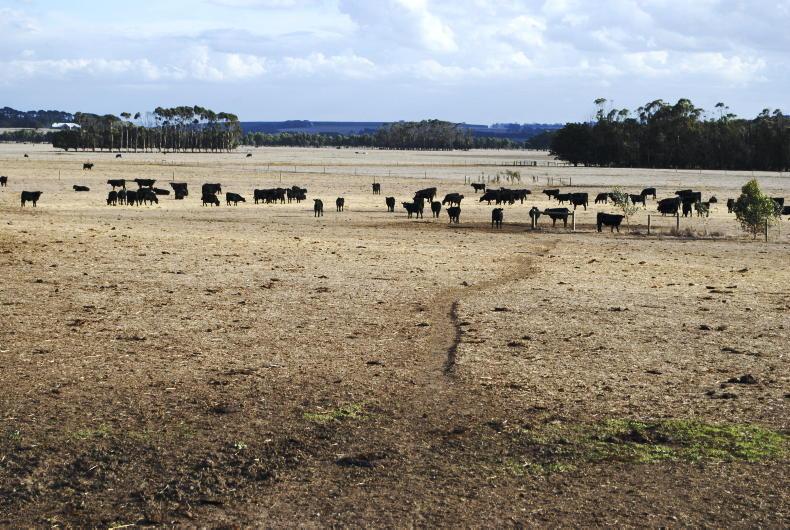
Long spells of dry weather throughout July and August meant high levels of soil moisture deficit and severely restricted growth rates.
Many farms capable of growing well over 14t DM/ha saw dry matter production drop below 11t DM/ha.
Unfortunately, 2025 was not a once-off for a lot of these affected farms and this has been the case in at least three of the last five years.
Hopefully this is not going to be the norm into the future but it’s highly likely we will continue to see more frequent drought occurrences on free-draining farms.
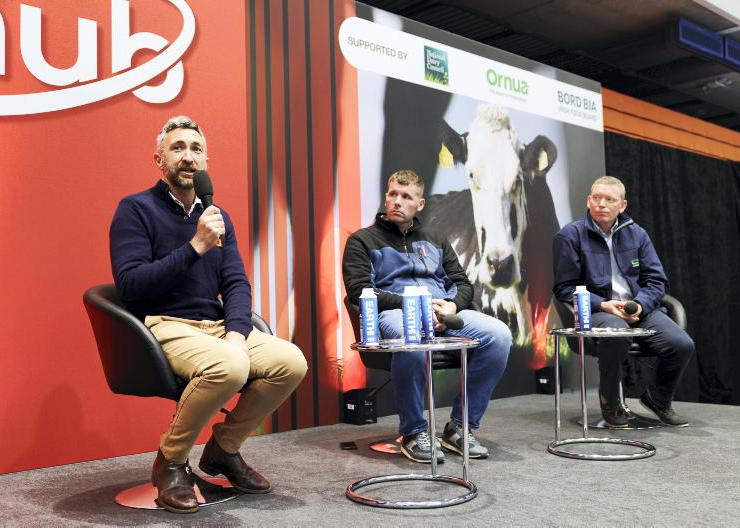
At Dairy Day 2025 a panel consisting of Teagasc’s Brendan Horan, Waterford farmer Mike Ahern and New Zealand farmer Simon Lynskey gave their insights and advice for managing the farm through a dry summer.
Here are the top 10 points from the discussion.
1 Stocking rate
The most effective way of reducing the risk of lower grass growth is to align the number of cows with the amount of available grass on the farm. This was one of the key messages from Teagasc’s Brendan Horan.
Firstly, a calculation is required to see what dry matter is required per cow each year.
The calculation should be done based on the five-year average grass production.
A 525kg cow for example producing 500kg of milk solids annually will require in the region of 5.7t of dry matter feed according to Brendan.
“Typically, one tonne of that feed is fed in the form of grass silage. With 500kg to 700kg of meal fed per cow, the remaining demand is around four tonnes of grass dry matter,” Brendan said.
At 2.5 cows/ha, with a demand of four tonne of grazed grass per cow, a farm will need to utilise 10t DM/ha available on the milking platform. This figure rises to 12.5t DM/ha if silage is also being taken from the platform.
All of the grass grown is not utilisable on a farm. The average utilisation figure taken across the year is usually 85%. Therefore, a farm would need to grow 4.7t DM/cow to utilise four tonnes. At 2.5 cows/ha that means growing 11.8t DM/ha, to utilise 10t DM/ha as grazed grass.
2 Nitrogen
The reduction in chemical nitrogen being applied to Irish soils is without doubt having an effect on annual dry matter production on farms across the country, but it’s not responsible for the levels of reduction being seen in the mid-season, according to Brendan.
Teagasc research using 250kg of chemical N/ha is still seeing the production drop significantly in periods of drought.
3 Reseeding
Older swards will struggle to grow grass in prolonged periods of moisture deficits.
Perennial ryegrass in the sward dies out and is replaced by weed grasses with poor nutritional value, according to Brendan.
Reseeding is the best way of overcoming that issue.
Mike Ahern said he now sees it as a “non-negotiable that at least 10% of the farm each year must be reseeded”.
“The reseeded fields this year and last year, they’re the ones that were still green when everything else was still yellow,” he said.
Stocking rate must be corrected first to give the farm scope to reseed at least 10% of the milking platform each year.
4 Soil Fertility
Having good soil fertility and applying the right nutrients at the right time will help to maximise the capability of the soil to grow grass in drought conditions.
Both Mike and Simon have excellent soil fertility on their farms with soil indexes of three and four for P and K and optimum soil pH’s across most of the farm. This is the first port of call to ensure soils are maximised in terms of grass production.
Sulphur can also play an important role in sustaining growth on free-draining soils. Sulphur is best applied little and often in the first half of the year, according to the panel.
5 Cull cows
The early culling of empty cows will help to reduce demand of the herd and this is something Simon Lynskey will not compromise on.
This is a common practice in New Zealand and something that Irish farmers regularly practiced in the past but it has become less popular in recent times.
“We book the cull cow truck for the day after scanning. We’re scanning six weeks after the end of mating and anything that’s not in-calf is gone the next day,” said Simon.
In the Irish system that would mean cows leaving the farm in mid-August for a farm running a 10-week breeding season.
While it won’t solve the issues with growth in July and early August, this approach will allow farmers to graze harder and use the supplement in those months knowing there will be more grass available in early autumn with a reduced demand for additional feed.
6 Supplemental feeds
There are a range of supplemental feeds available, but most farmers are taking the easier approach of feeding extra meal in the parlour, according to Brendan.
The cost of this meal is 42c kg/DM. That’s four times the cost of grazed grass at 11c kg/DM and one and a half times the cost of silage and palm kernel, which are both costing around 28c kg/DM.
For Mike, the target of meal fed per cow is set at the beginning of the year and this dictates what’s fed daily.
“We set the limit of 900kg/cow across the year.
“On a 300-day lactation that’s a maximum of 3kg/day that can be fed.
“If grass is in short supply, we fill the gap with other forages like grass and maize silage,” he said.
With several outblocks required on Mike’s farm to support the 3.2 cows/ha milking platform stocking rate, Mike decided maize and silage were the cheapest supplement he could make.
He plans to reduce stocking rate going forward but these crops have kept cows going over the last number of years in a more cost-effective manner than meal.
7 Rotation length
A regular debate during periods of drought is what to do with rotation length.
Should the farm hold average farm cover at a certain level or just extend out the rotation length and graze what’s there.
Simon’s approach is to push some paddocks forward, from earlier in the rotation as a form of standing silage to extend round length.
“Any covers over 1,500kg DM/ha, we skip over and defer for grazing later in the round,” he said.
Grass quality will suffer in this context but Simon’s argument is that he’s only going to be paying the contractor to come in and cut it anyway.
In periods of drought, Mike’s approach is to extend rotation length to 25 or 26 days and fill the gaps in the wedge with supplement.
According to Brendan, this is an area that needs a lot more research in an Irish context to discover what is best practice.
8 Clover
Clover in swards will help replace the reduced chemical nitrogen being spread on farms but it won’t save the farm in drought periods, according to the panel.
Some species of clover, particularly red clover are deep-rooted and therefore they will be able to grow better in dry conditions, as they can access moisture deeper in the soil.
Red clover however, is uncommon in grazing swards in Ireland and white clover does not have the same deep-rooting potential.
As a result, swards incorporating white clover are not more persistent in drought conditions than perennial rye-grass swards.
9 Workload
With prolonged periods of dry weather comes increased levels of supplementation in the form of silage, zero-grazed grass or other alternative feeds.
With this comes an increased labour demand.
Supplement must be fed out during the day to different groups of animals on top of all the normal daily tasks.
This has a major effect on farmers both mentally and physically, particularly those who don’t have enough scale to employ people.
10 Forage crops
“Forage crops are something that’s still only in the very early trial phase but showing some promise,” according to Brendan Horan.
There is ongoing Teagasc research comparing different forage crops as an option to be fed during the summer months.
Such crops include stubble turnips, forage rape and hybrid brassicas.
These are high-yielding crops which would be sown in April and could be grazed in late summer.
The main difficulty with such crops is that in good grass growing years, it’s likely that grass paddocks will have to be made into silage, while cows are grazing the crops.
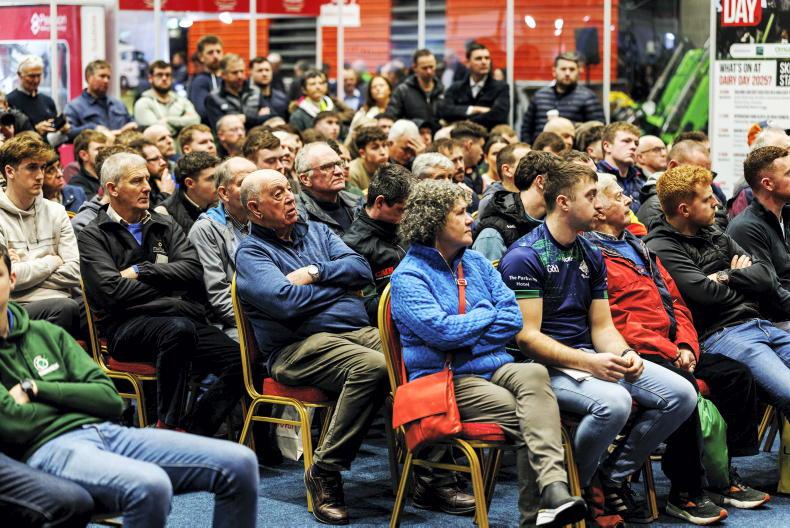
Dairy Day 2025 at UL Sports Arena, in Limerick. \ Philip Doyle
For many farms in the south and the east of the country, 2025 meant another challenging
summer.
Long spells of dry weather throughout July and August meant high levels of soil moisture deficit and severely restricted growth rates.
Many farms capable of growing well over 14t DM/ha saw dry matter production drop below 11t DM/ha.
Unfortunately, 2025 was not a once-off for a lot of these affected farms and this has been the case in at least three of the last five years.
Hopefully this is not going to be the norm into the future but it’s highly likely we will continue to see more frequent drought occurrences on free-draining farms.
At Dairy Day 2025 a panel consisting of Teagasc’s Brendan Horan, Waterford farmer Mike Ahern and New Zealand farmer Simon Lynskey gave their insights and advice for managing the farm through a dry summer.
Here are the top 10 points from the discussion.
1 Stocking rate
The most effective way of reducing the risk of lower grass growth is to align the number of cows with the amount of available grass on the farm. This was one of the key messages from Teagasc’s Brendan Horan.
Firstly, a calculation is required to see what dry matter is required per cow each year.
The calculation should be done based on the five-year average grass production.
A 525kg cow for example producing 500kg of milk solids annually will require in the region of 5.7t of dry matter feed according to Brendan.
“Typically, one tonne of that feed is fed in the form of grass silage. With 500kg to 700kg of meal fed per cow, the remaining demand is around four tonnes of grass dry matter,” Brendan said.
At 2.5 cows/ha, with a demand of four tonne of grazed grass per cow, a farm will need to utilise 10t DM/ha available on the milking platform. This figure rises to 12.5t DM/ha if silage is also being taken from the platform.
All of the grass grown is not utilisable on a farm. The average utilisation figure taken across the year is usually 85%. Therefore, a farm would need to grow 4.7t DM/cow to utilise four tonnes. At 2.5 cows/ha that means growing 11.8t DM/ha, to utilise 10t DM/ha as grazed grass.
2 Nitrogen
The reduction in chemical nitrogen being applied to Irish soils is without doubt having an effect on annual dry matter production on farms across the country, but it’s not responsible for the levels of reduction being seen in the mid-season, according to Brendan.
Teagasc research using 250kg of chemical N/ha is still seeing the production drop significantly in periods of drought.
3 Reseeding
Older swards will struggle to grow grass in prolonged periods of moisture deficits.
Perennial ryegrass in the sward dies out and is replaced by weed grasses with poor nutritional value, according to Brendan.
Reseeding is the best way of overcoming that issue.
Mike Ahern said he now sees it as a “non-negotiable that at least 10% of the farm each year must be reseeded”.
“The reseeded fields this year and last year, they’re the ones that were still green when everything else was still yellow,” he said.
Stocking rate must be corrected first to give the farm scope to reseed at least 10% of the milking platform each year.
4 Soil Fertility
Having good soil fertility and applying the right nutrients at the right time will help to maximise the capability of the soil to grow grass in drought conditions.
Both Mike and Simon have excellent soil fertility on their farms with soil indexes of three and four for P and K and optimum soil pH’s across most of the farm. This is the first port of call to ensure soils are maximised in terms of grass production.
Sulphur can also play an important role in sustaining growth on free-draining soils. Sulphur is best applied little and often in the first half of the year, according to the panel.
5 Cull cows
The early culling of empty cows will help to reduce demand of the herd and this is something Simon Lynskey will not compromise on.
This is a common practice in New Zealand and something that Irish farmers regularly practiced in the past but it has become less popular in recent times.
“We book the cull cow truck for the day after scanning. We’re scanning six weeks after the end of mating and anything that’s not in-calf is gone the next day,” said Simon.
In the Irish system that would mean cows leaving the farm in mid-August for a farm running a 10-week breeding season.
While it won’t solve the issues with growth in July and early August, this approach will allow farmers to graze harder and use the supplement in those months knowing there will be more grass available in early autumn with a reduced demand for additional feed.
6 Supplemental feeds
There are a range of supplemental feeds available, but most farmers are taking the easier approach of feeding extra meal in the parlour, according to Brendan.
The cost of this meal is 42c kg/DM. That’s four times the cost of grazed grass at 11c kg/DM and one and a half times the cost of silage and palm kernel, which are both costing around 28c kg/DM.
For Mike, the target of meal fed per cow is set at the beginning of the year and this dictates what’s fed daily.
“We set the limit of 900kg/cow across the year.
“On a 300-day lactation that’s a maximum of 3kg/day that can be fed.
“If grass is in short supply, we fill the gap with other forages like grass and maize silage,” he said.
With several outblocks required on Mike’s farm to support the 3.2 cows/ha milking platform stocking rate, Mike decided maize and silage were the cheapest supplement he could make.
He plans to reduce stocking rate going forward but these crops have kept cows going over the last number of years in a more cost-effective manner than meal.
7 Rotation length
A regular debate during periods of drought is what to do with rotation length.
Should the farm hold average farm cover at a certain level or just extend out the rotation length and graze what’s there.
Simon’s approach is to push some paddocks forward, from earlier in the rotation as a form of standing silage to extend round length.
“Any covers over 1,500kg DM/ha, we skip over and defer for grazing later in the round,” he said.
Grass quality will suffer in this context but Simon’s argument is that he’s only going to be paying the contractor to come in and cut it anyway.
In periods of drought, Mike’s approach is to extend rotation length to 25 or 26 days and fill the gaps in the wedge with supplement.
According to Brendan, this is an area that needs a lot more research in an Irish context to discover what is best practice.
8 Clover
Clover in swards will help replace the reduced chemical nitrogen being spread on farms but it won’t save the farm in drought periods, according to the panel.
Some species of clover, particularly red clover are deep-rooted and therefore they will be able to grow better in dry conditions, as they can access moisture deeper in the soil.
Red clover however, is uncommon in grazing swards in Ireland and white clover does not have the same deep-rooting potential.
As a result, swards incorporating white clover are not more persistent in drought conditions than perennial rye-grass swards.
9 Workload
With prolonged periods of dry weather comes increased levels of supplementation in the form of silage, zero-grazed grass or other alternative feeds.
With this comes an increased labour demand.
Supplement must be fed out during the day to different groups of animals on top of all the normal daily tasks.
This has a major effect on farmers both mentally and physically, particularly those who don’t have enough scale to employ people.
10 Forage crops
“Forage crops are something that’s still only in the very early trial phase but showing some promise,” according to Brendan Horan.
There is ongoing Teagasc research comparing different forage crops as an option to be fed during the summer months.
Such crops include stubble turnips, forage rape and hybrid brassicas.
These are high-yielding crops which would be sown in April and could be grazed in late summer.
The main difficulty with such crops is that in good grass growing years, it’s likely that grass paddocks will have to be made into silage, while cows are grazing the crops.
Dairy Day 2025 at UL Sports Arena, in Limerick. \ Philip Doyle








SHARING OPTIONS