Auto-enrolment: from 1 January 2026, all employees between the age of 23 and 60 who earn more than €20,000 per year are entitled to join a pension scheme.
Some farmers already have employees on pension schemes which are administered through payroll, so they automatically apply. For all other employers who have eligible employees, they will need to set up a pension plan.
The simplest, cheapest and probably the best way is through the state fund called My Future Fund. For the first three years, the employer pays in 1.5%, the employee pays in 1.5% and the state pays in 0.5%. These contributions will subsequently increase over time and after 10 years the employer and employee contribution is 6% each, which is hefty.
Employers don’t have to go with My Future Fund but privately run schemes won’t have the state contribution and will likely have fees attached, whereas there are no additional fees with My Future Fund. Employers have to register with My Future Fund, and that can be done on the fund website.
Milk quality: this is a really important time of the year for milk quality, as mastitis can spread quickly when cows are fully housed, and TBC and lactose levels can also go out of range quite easily. SCC will increase in late lactation cows anyway, as there is less milk volume to dilute the cells.
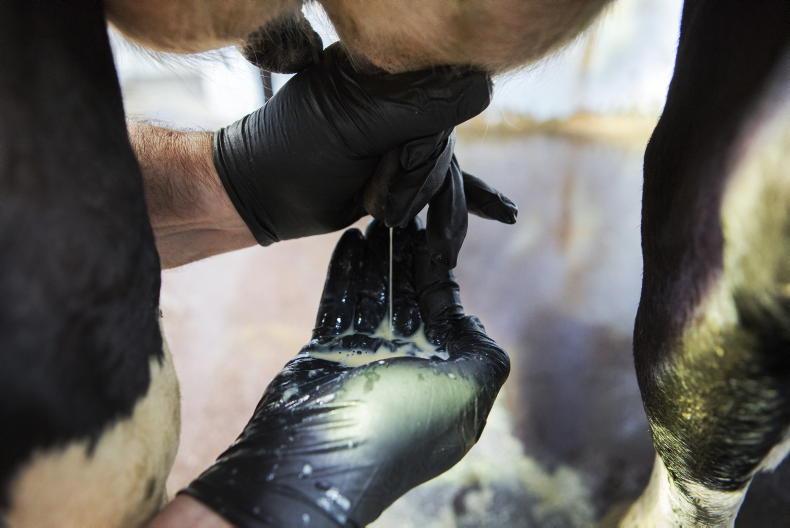
Going to once a day milking can make it worse. It’s good practice to strip cows at each milking to check for clots. Make sure cubicle beds are kept clean and disinfected with cubicle lime or some other disinfectant. Keep scraper passages clean by running scrapers four or five times per day. Longer passages may need to be scraped more often.
If low lactose is a problem it’s a symptom that there are too many low yielding cows in the herd and some of these should be dried off. Lactose levels are important if farmers are to pick up some of the out-of-season milk payments. TBC can also increase at this time of year, sometimes because milk is stored on farms for longer, but also too because hygiene standards can slip. If cows’ teats are dirty they need to be washed and dried prior to milking.
EPA licence: a couple of farmers have been in contact in recent weeks to highlight the fact that on larger farms, wells need to be registered with the EPA. Not registering wells came up as a non-compliance on recent Department of Agriculture inspections and resulted in a deduction to BISS payments.
The regulations state that any well where more than 25m3 of water is being abstracted per day is required to be registered with the EPA. A farm with 180 cows and 50 yearlings and 50 calves is deemed to exceed this daily usage figure and therefore all wells or abstraction points should be registered. Registering can only be done online through the EDEN portal on the EPA website, where a new account needs to be set up before a well can be registered.
Information on how to use the EDEN portal is available on the EPA website. Once a well is registered it doesn’t have to be registered again. There are no costs involved.
Auto-enrolment: from 1 January 2026, all employees between the age of 23 and 60 who earn more than €20,000 per year are entitled to join a pension scheme.
Some farmers already have employees on pension schemes which are administered through payroll, so they automatically apply. For all other employers who have eligible employees, they will need to set up a pension plan.
The simplest, cheapest and probably the best way is through the state fund called My Future Fund. For the first three years, the employer pays in 1.5%, the employee pays in 1.5% and the state pays in 0.5%. These contributions will subsequently increase over time and after 10 years the employer and employee contribution is 6% each, which is hefty.
Employers don’t have to go with My Future Fund but privately run schemes won’t have the state contribution and will likely have fees attached, whereas there are no additional fees with My Future Fund. Employers have to register with My Future Fund, and that can be done on the fund website.
Milk quality: this is a really important time of the year for milk quality, as mastitis can spread quickly when cows are fully housed, and TBC and lactose levels can also go out of range quite easily. SCC will increase in late lactation cows anyway, as there is less milk volume to dilute the cells.
Going to once a day milking can make it worse. It’s good practice to strip cows at each milking to check for clots. Make sure cubicle beds are kept clean and disinfected with cubicle lime or some other disinfectant. Keep scraper passages clean by running scrapers four or five times per day. Longer passages may need to be scraped more often.
If low lactose is a problem it’s a symptom that there are too many low yielding cows in the herd and some of these should be dried off. Lactose levels are important if farmers are to pick up some of the out-of-season milk payments. TBC can also increase at this time of year, sometimes because milk is stored on farms for longer, but also too because hygiene standards can slip. If cows’ teats are dirty they need to be washed and dried prior to milking.
EPA licence: a couple of farmers have been in contact in recent weeks to highlight the fact that on larger farms, wells need to be registered with the EPA. Not registering wells came up as a non-compliance on recent Department of Agriculture inspections and resulted in a deduction to BISS payments.
The regulations state that any well where more than 25m3 of water is being abstracted per day is required to be registered with the EPA. A farm with 180 cows and 50 yearlings and 50 calves is deemed to exceed this daily usage figure and therefore all wells or abstraction points should be registered. Registering can only be done online through the EDEN portal on the EPA website, where a new account needs to be set up before a well can be registered.
Information on how to use the EDEN portal is available on the EPA website. Once a well is registered it doesn’t have to be registered again. There are no costs involved.









SHARING OPTIONS