


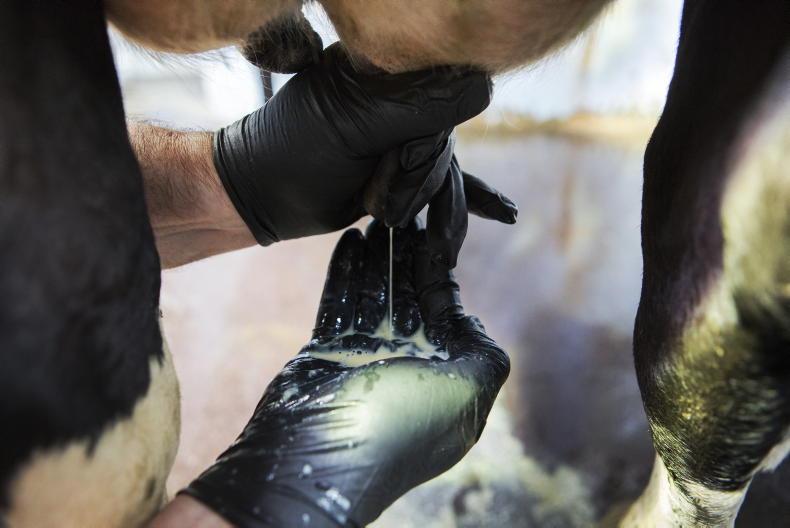
Early lactation mastitis can have a significant negative effect on both cows and heifers in early lactation, as it costs both milk and time.
Animal Health Ireland’s (AHI) 1-2-3 process can be used by all dairy farmers in order to get on top of issues early.
The advice comes at a good time as farmers enter a crucial time of year, where the root cause of most mastitis issues start.
1. Find them
The first step is identifying the offenders. A CMT test should be performed on every cow post-calving, before their milk starts entering the tank.
If mastitis is found, take a sterile sample to get tested. Knowing the bacteria causing the issue will help to determine the best course of action and treatment requirements.
Keeping records of cows that show up as clinical cases is important. An early milk recording before St Patrick's Day will help to identify the problem cows.
The majority of these cases will have started at dry-off or during the dry period and keeping records can help inform future management over this period if post-calving mastitis is a problem across the herd.
2. Deal with them
In the case of clinical mastitis where symptoms such as clots and udder inflammation are clearly visible, prompt treatment is needed.
Choosing the right antibiotic based on the infection type is important and this can be done in consultation with the vet. An anti-inflammatory injection given early will also help to start the recovery process.
According to AHI, if more than 20% of the cases in the herd require a second course of antibiotics, the treatment protocol will need reviewing.
Subclinical mastitis are cases that show up in the CMT test or during milk recording with an SCC over 200,000. The clinical symptoms are not obvious, so treatment is not always necessary.
Some of the freshly-calved heifers may have a high SCC in the days after calving, but may just need a few days for it to drop.
Best advice is to repeat the CMT two or three days later to see if there is any improvement.
Any cows that had a high SCC in the previous lactation and received an antibiotic dry cow treatment at dry-off but the SCC has still remained high in the 60 days post-calving can be considered chronically infected and are unlikely to respond to treatments. Culling is the best way to overcome chronic cases.
Don’t breed off chronic cows, as high cell counts and susceptibility to mastitis has been shown to be genetic.
3. Prevent the spread
Stopping the spread of mastitis starts with limiting the bacteria that can enter the teat end during and after milking.
The main sources of bacteria are other cows and the environment the cows are in. Dirty cubicles, yards or parlours are a recipe for disaster.
So too is poor hygiene at milking. Dirty gloves and hands or dirty clusters are also a big no-no. Keeping hygiene at a high standard will inevitably reduce the number of infections.
There are a few basics that everyone should be adhering to - ensure that clean clusters are going on to a clean and dry teat, clip tails and udders, wear gloves and aprons and wash the yard thoroughly twice a day.
Where cows are still in the shed - which is the case for a lot of farms at the moment - cleaning and liming cubicles twice a day is essential.
The parlour can be a busy place in the spring, with heifers still learning the ropes, freshly calved cows joining the herd and different groups of animals.
Try not to let standards slip in the madness, as infections in the first two months of the lactation will go a long way to determining the state of play for the rest of the year.
For more information, check out the CellCheck programme on AHI's website.




SHARING OPTIONS