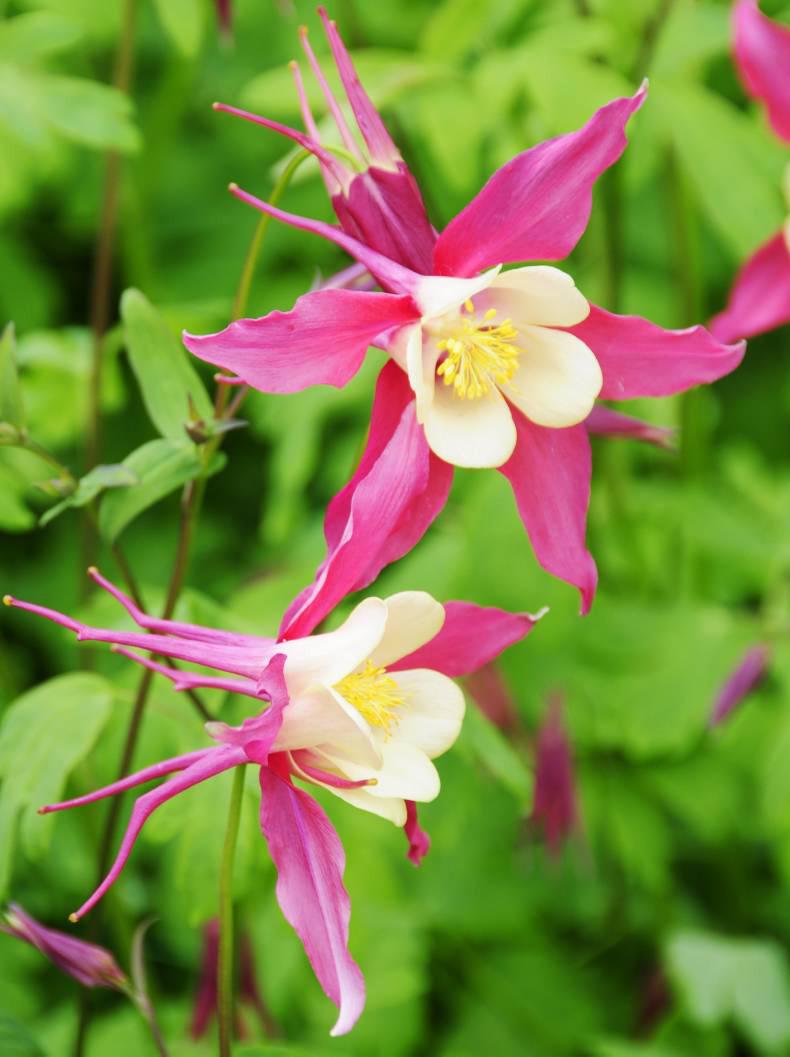
Columbine is also known as granny’s bonnet, and charming though these names are, it is probably better known as aquilegia, which is its correct botanical name. Aquilegia was very popular in traditional cottage gardens because it produces seeds freely and these seeds germinate readily, even when just scattered about on the ground. Cottage gardens specialised in flowers that cost no money to grow and could readily be swapped or passed on to friends and neighbours.
As it happens, aquilegia is a native wild flower, though a rare one, occurring mainly in the centre of the country, and carrying dark purple-blue flowers. There are lots of seemingly “wild” columbine plants that appear sometimes by roadsides, but these are really just garden escapes. A plant that is native is likely to succeed well in gardens because it has adapted to local climate and soil over thousands of years. And that explains aquilegia’s readiness to grow in gardens.
Popular choice
The flowers are each made up of five petals and five pointed tubes, flaring at the mouth and often with a long spur extending out of the back of the flower. The end of the tube holds a tiny drop of sweet nectar to attract pollinators. The foliage is blue-green in colour and of a seaweed-like appearance. It forms a rosette of leaves at ground level and, in spring, it starts growing early and soon pushes up a tall flower stem that can reach to over 60 or 70cm.
The flowers are borne at the top of the stems, which branch to form slender flower stalks, and the flower is carried in nodding fashion, its spurs tilted upwards and the flower front facing down – although some flowers do not nod quite as much. This nodding appearance gives the flowers a certain elegant lightness. There is also a form called Aquilegia vulgaris var stellata, which has a starry flower shape with no tubes. This kind is more recent but has become popular in gardens. There is a well-known variety of this kind called ‘Norah Barlow’, a wine-red colour. These star-flowered kinds are fertile and produce seeds in the same way as the standard type.
While the wild sorts are blue or purple, the range of colours is much greater in the large kinds – ranging from yellow, orange and red to purple, blue, pink, white and often intermediate colours and mixed colours, many two-toned. Columbines can be bought as plants, or can be sown in seed trays or even outdoors in a finely raked seedbed in the open soil this month or next. The young plants can be moved to permanent positions in late summer or autumn, disturbing them as little as possible because they sometimes die back if moved with too much root damage.
Left to go to seed, the large-flowered varieties tend to backcross with each other and eventually revert to the basic, short-spurred type. Although these plants have smaller flowers, what they lack in size, they make up in numbers. Self-sowing can create a lovely effect, with new plants coming up near the parents and often in differing colour shades.
Sometimes colours appear that were not planted or sown, arising from the genetic material. It is possible to select preferred colours, by rooting out the unwanted kind as soon as flowers appear and before their pollen can be transferred.
Aquilegia likes good soil but not too rich, which makes the plants leafy. Soil with a good content of organic material is ideal, because this creates good drainage but stays moist and cool. Plants do poorly in thin, dry soil, being short and flowering badly. Self-sowing freely, columbine generally only has to be planted once, and it will appear in drifts or as single, isolated plants. However, it is not weed-like, and if seeding is not wanted, the seed-heads can be cutaway before the seeds are ripe, still green in the pod.
Trees, shrubs and roses
Spray roses against blackspot disease, especially in the damper parts of the country, but only after wet weather. Prune early summer shrubs as they go out of flower, if they are too big or need shaping. It is best to thin out shrubs rather than shorten back every branch.
Flowers
Bedding plants should be planted up about now, and there is still plenty of time. Be sure to water the young plants immediately after planting out and every few days, until they are actively growing, unless there is heavy rain. A liquid feed will encourage rapid establishment.
Lawns
Continue mowing. The heaviest mowing of the year will tail off fairly soon. Keep the edges around kerbs and flower beds or borders trimmed to maintain a neat appearance. If you wish to control lawn weeds, good results will be achieved with lawn weedkillers now.
Fruit, vegetables and herbs
Repeat sow vegetables sown earlier in the year, such as lettuce, peas and carrots. Thin out vegetables that need it, and control weeds early. There is still time to sow winter and Savoy cabbage varieties for winter and early spring use. Plant out sweetcorn and courgettes.
Greenhouse and house plants
Continue to feed greenhouse plants strongly and to water well. Plant tomatoes, chilli peppers, cucumbers and sweet peppers as soon as possible, if not already done, because these need to make rapid growth now. House plants can be re-potted now if they tend to dry quickly.
Thyme in flower
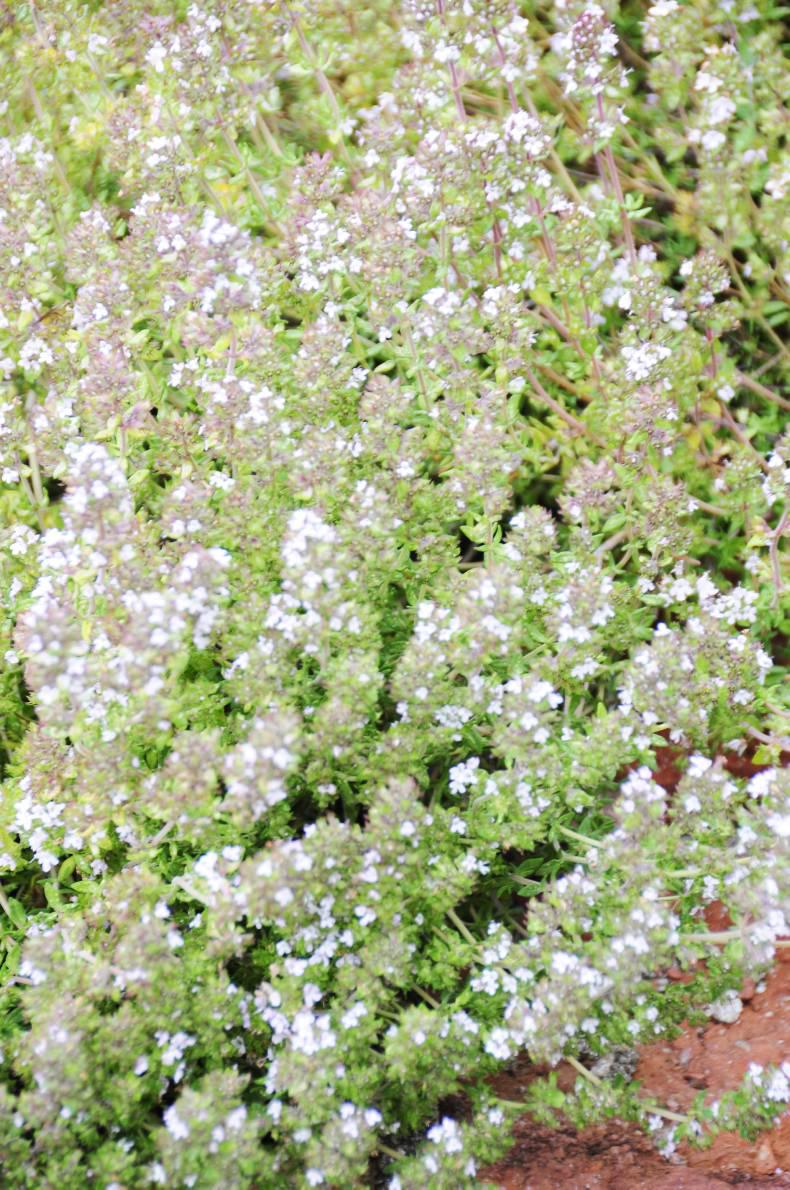
Thyme comes into flower in early summer, which is fine for the decorative sorts, but thyme for use as a kitchen herb tends to put its growth effort into flowers and seeds and less into growing new shoots for use. Just as it flowers, the flowers can be snipped off in a few minutes using hedge-clippers. Do not cut back too hard or the little shrub might die off — only clip a little below the flowers. Even with clipping back, the thyme plant gets tired and straggly after a few years but cuttings can be taken to raise new plants as replacements.
Read more
The sweet scent of spring in the garden
Columbine is also known as granny’s bonnet, and charming though these names are, it is probably better known as aquilegia, which is its correct botanical name. Aquilegia was very popular in traditional cottage gardens because it produces seeds freely and these seeds germinate readily, even when just scattered about on the ground. Cottage gardens specialised in flowers that cost no money to grow and could readily be swapped or passed on to friends and neighbours.
As it happens, aquilegia is a native wild flower, though a rare one, occurring mainly in the centre of the country, and carrying dark purple-blue flowers. There are lots of seemingly “wild” columbine plants that appear sometimes by roadsides, but these are really just garden escapes. A plant that is native is likely to succeed well in gardens because it has adapted to local climate and soil over thousands of years. And that explains aquilegia’s readiness to grow in gardens.
Popular choice
The flowers are each made up of five petals and five pointed tubes, flaring at the mouth and often with a long spur extending out of the back of the flower. The end of the tube holds a tiny drop of sweet nectar to attract pollinators. The foliage is blue-green in colour and of a seaweed-like appearance. It forms a rosette of leaves at ground level and, in spring, it starts growing early and soon pushes up a tall flower stem that can reach to over 60 or 70cm.
The flowers are borne at the top of the stems, which branch to form slender flower stalks, and the flower is carried in nodding fashion, its spurs tilted upwards and the flower front facing down – although some flowers do not nod quite as much. This nodding appearance gives the flowers a certain elegant lightness. There is also a form called Aquilegia vulgaris var stellata, which has a starry flower shape with no tubes. This kind is more recent but has become popular in gardens. There is a well-known variety of this kind called ‘Norah Barlow’, a wine-red colour. These star-flowered kinds are fertile and produce seeds in the same way as the standard type.
While the wild sorts are blue or purple, the range of colours is much greater in the large kinds – ranging from yellow, orange and red to purple, blue, pink, white and often intermediate colours and mixed colours, many two-toned. Columbines can be bought as plants, or can be sown in seed trays or even outdoors in a finely raked seedbed in the open soil this month or next. The young plants can be moved to permanent positions in late summer or autumn, disturbing them as little as possible because they sometimes die back if moved with too much root damage.
Left to go to seed, the large-flowered varieties tend to backcross with each other and eventually revert to the basic, short-spurred type. Although these plants have smaller flowers, what they lack in size, they make up in numbers. Self-sowing can create a lovely effect, with new plants coming up near the parents and often in differing colour shades.
Sometimes colours appear that were not planted or sown, arising from the genetic material. It is possible to select preferred colours, by rooting out the unwanted kind as soon as flowers appear and before their pollen can be transferred.
Aquilegia likes good soil but not too rich, which makes the plants leafy. Soil with a good content of organic material is ideal, because this creates good drainage but stays moist and cool. Plants do poorly in thin, dry soil, being short and flowering badly. Self-sowing freely, columbine generally only has to be planted once, and it will appear in drifts or as single, isolated plants. However, it is not weed-like, and if seeding is not wanted, the seed-heads can be cutaway before the seeds are ripe, still green in the pod.
Trees, shrubs and roses
Spray roses against blackspot disease, especially in the damper parts of the country, but only after wet weather. Prune early summer shrubs as they go out of flower, if they are too big or need shaping. It is best to thin out shrubs rather than shorten back every branch.
Flowers
Bedding plants should be planted up about now, and there is still plenty of time. Be sure to water the young plants immediately after planting out and every few days, until they are actively growing, unless there is heavy rain. A liquid feed will encourage rapid establishment.
Lawns
Continue mowing. The heaviest mowing of the year will tail off fairly soon. Keep the edges around kerbs and flower beds or borders trimmed to maintain a neat appearance. If you wish to control lawn weeds, good results will be achieved with lawn weedkillers now.
Fruit, vegetables and herbs
Repeat sow vegetables sown earlier in the year, such as lettuce, peas and carrots. Thin out vegetables that need it, and control weeds early. There is still time to sow winter and Savoy cabbage varieties for winter and early spring use. Plant out sweetcorn and courgettes.
Greenhouse and house plants
Continue to feed greenhouse plants strongly and to water well. Plant tomatoes, chilli peppers, cucumbers and sweet peppers as soon as possible, if not already done, because these need to make rapid growth now. House plants can be re-potted now if they tend to dry quickly.
Thyme in flower
Thyme comes into flower in early summer, which is fine for the decorative sorts, but thyme for use as a kitchen herb tends to put its growth effort into flowers and seeds and less into growing new shoots for use. Just as it flowers, the flowers can be snipped off in a few minutes using hedge-clippers. Do not cut back too hard or the little shrub might die off — only clip a little below the flowers. Even with clipping back, the thyme plant gets tired and straggly after a few years but cuttings can be taken to raise new plants as replacements.
Read more
The sweet scent of spring in the garden





SHARING OPTIONS