


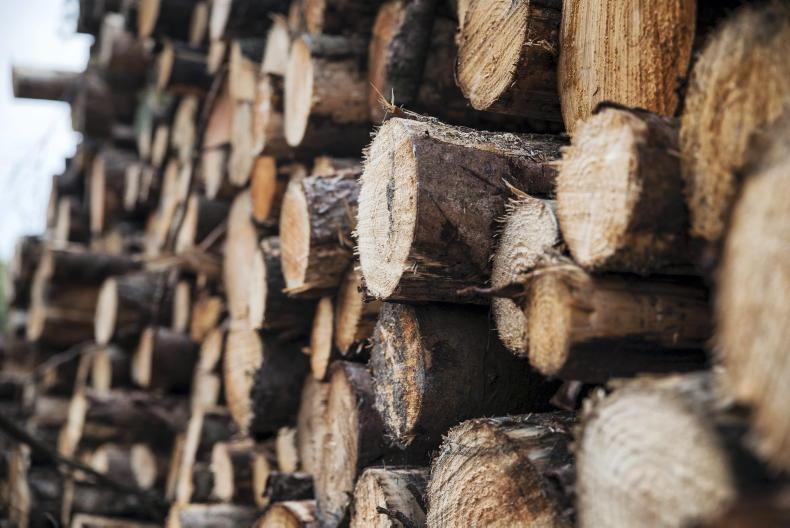
Farmers’ share of the State’s payout to private forestry owners in the form of annual premia is on the decline, as non-farmer entities’ portion of this State expenditure is growing, according to new Department of Agriculture figures.
The trend comes as the Oireachtas has heard calls for increased transparency in land ownership, especially in heavily afforested areas of the country.
2025 saw the Department pay out a total of €33.4m to farmers in annual forestry payments, where the equivalent for non-farmers was €9.8m.
This put non-farmers claiming the equivalent of one-third of the total premia drawn down under the forestry programme.
In 2020, non-farmers’ share of the forestry premium pot stood at just 14%, meaning that these landowners effectively doubled their share of the State’s annual woodland payout.
The total premia paid out to farmers came to €50.4m in 2020, with the equivalent for non-farmers coming to just €7.2m.
The value paid out to farmers has decreased every year since, while the funding headed to non-farmer claimants increased each year.
The figures came from Minister of State Michael Healy-Rae this week in response to questions asked by Sinn Féin Sligo-Leitrim TD Martin Kenny on non-farmer interests in the forestry sector.
Leitrim concerns
Concern was voiced by independent Leitrim Cllr Eddie Mitchell on the impact large-scale forestry plantations are having in his home county at a sitting of the Oireachtas agriculture committee, with land availability on the agenda last Wednesday.
Leitrim is the most heavily afforested county in the country, having surpassed Wicklow for the top spot in recent years.
Cllr Mitchell called for increased transparency in the land market, particularly around lands afforested by Coillte but which later changed hands.
“We don’t know who owns the forestry,” the councillor told the committee.
“I am familiar with Leitrim. We started planting a lot of Leitrim in the 1980s. It was done by Coillte and a lot of that land is still in public ownership. But we have seen 5,000ha of land leave Coillte.
“Who owns that land? Where is that land? Who is going to control that land in the future when you think about mining and all of these other interests.”
Deputy Kenny said that “whole communities have been wiped out” amid a trend of entire farms being planted before entire townlands.
This has led to school closures and a drop in the provision of services in areas that had been farmed but which are now under forestry, according to the Sinn Féin TD.
“Then, there is no one to farm because even those who are farming have their services withdrawn,” he said.


SHARING OPTIONS