Although herbicides within the same mode of action share a similar resistance risk, the specific target-site resistance (TSR) or non-target-site resistance (NTSR) mechanisms present in field populations determines the pattern of cross-resistance.
Consequently, resistance to one product does not necessarily mean resistance to all herbicides within the same chemical class, as seen in resistant grass weed populations tested in our studies.
It is, therefore, incorrect to generalise resistance across all ACCase or ALS herbicides, without first identifying the underlying mutation or resistance mechanism.
Italian ryegrass
Five resistant Italian ryegrass populations were sprayed at the two to four leaf stage with eight ACCase and six ALS herbicides. IRG-R1 to IRG-R3 carried TSR to both ACCase and ALS herbicides, while IRG-R4 and IRG-R5 carried NTSR to ACCase herbicides and TSR to ALS herbicides (Figure 1).
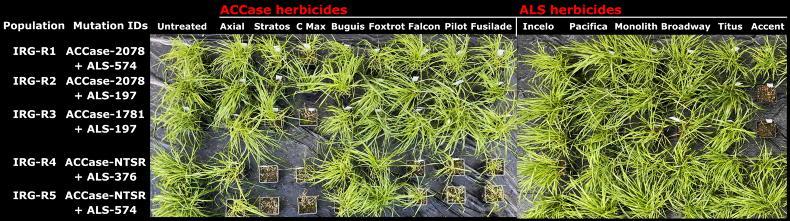
Figure 1: Symptoms of selected resistant Italian ryegrass populations following recommended rates of ACCase and ALS herbicides (Incelo, containing mesosulfuron + thiencarbazone, is currently not registered for use in Ireland). Resistance mechanisms affect how well herbicides control these populations. Some plants survive most herbicides, while others remain sensitive to specific products such as ACCase Stratos, Centurion (C Max) or ALS herbicide Accent.
IRG-R1 showed resistance to all ACCase and ALS herbicides.IRG-R2 was resistant to all herbicides except the ALS herbicide Accent.IRG-R3 was resistant to all herbicides except ACCase Centurion and ALS Accent.IRG-R4 and IRG-R5 were resistant to all herbicides except ACCase Stratos and Centurion.Blackgrass
Four resistant blackgrass populations were sprayed at the two to four leaf stage, with eight ACCase and six ALS herbicides. BG-R1 to BG-R4 carried TSR to both ACCase and ALS herbicides (Figure 2).
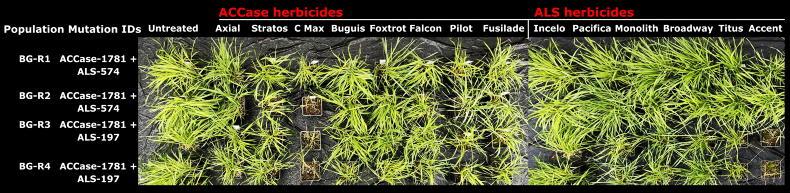
Figure 2: Symptoms of selected resistant blackgrass populations following recommended rates of ACCase and ALS herbicides (Incelo, containing mesosulfuron + thiencarbazone, is currently not registered for use in Ireland). Populations with TSR to both ACCase and ALS herbicides showed varying responses: some survived most herbicides, while others remained sensitive to specific products such as ACCase Centurion (C Max) or the ALS herbicide Accent.
BG-R1 and BG-R2 carried similar TSR profiles. BG-R1 was resistant to all ACCase and ALS herbicides, while BG-R2 remained sensitive to ACCase Centurion, suggesting Centurion’s efficacy may vary between resistant populations.BG-R3 and BG-R4 carried similar TSR profiles and were resistant to all ACCase and ALS herbicides, except ACCase Centurion and ALS Accent.Spring wild oats
Six resistant wild oat populations carrying different TSR mutations were sprayed at the three to four leaf stage with seven ACCase herbicides (Figure 3).
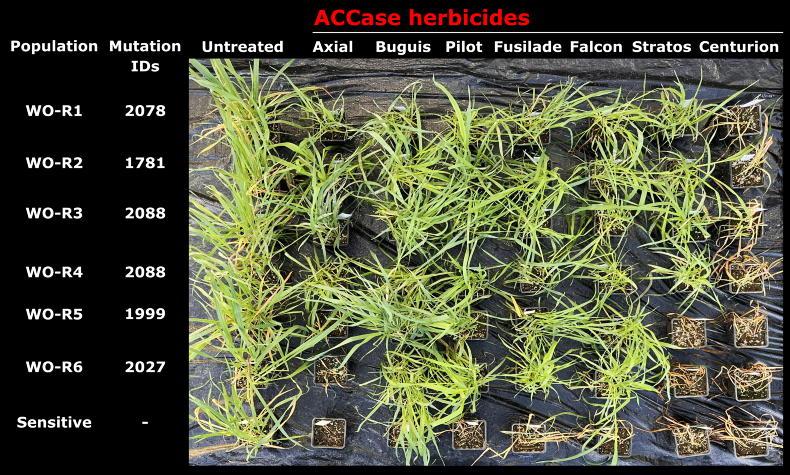
Figure 3: Symptoms of resistant wild oats populations following recommended rates of ACCase herbicides. All populations carried ACCase TSR, but Centurion remained effective in all cases. Axial and Stratos may also provide control, depending on the specific TSR mutation present.
WO-R1 to WO-R4 responded similarly, showing resistance to all herbicides except Centurion. WO-R5 was resistant to all FOP-based herbicides (Buguis, Pilot, Fusilade and Falcon) and showed a degree of tolerance to Axial, although Axial would still control most resistant plants. This population remained sensitive to Stratos and Centurion.WO-R6 was resistant to all FOP-based herbicides, but remained sensitive to Axial, Stratos and Centurion. Annual meadow grass
Two ALS-resistant and one ALS-sensitive annual meadow grass populations were sprayed at the two to four leaf stage, with five ACCase and six ALS herbicides (Figure 4).
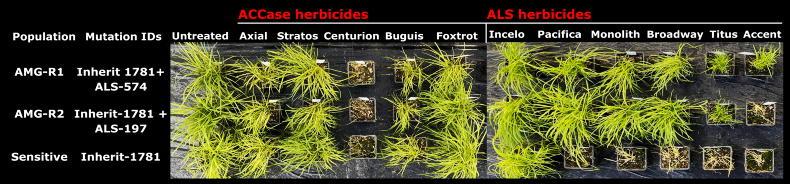
Figure 4: Symptoms of ALS-resistant (AMG-R1 and AMG-R2) and ALS-sensitive annual meadow grass populations following recommended rates of ACCase and ALS herbicides (Incelo, containing mesosulfuron + thiencarbazone, is currently not registered for use in Ireland). All populations carry inherited ACCase TSR, but Centurion remained effective. AMG-R1 survived most ALS herbicides, while AMG-R2 remained sensitive to ALS Accent.
All populations carry inherited ACCase mutations, giving them natural tolerance to all ACCase herbicides except Centurion.AMG-R1 was resistant to all ALS herbicides tested.AMG-R2 was resistant to all ALS herbicides except ALS Accent.Key findings
Resistance to one herbicide does not always mean resistance to all products in the same group. For the first time, we tested ALS Titus (Rimsulfuron) and Accent (Nicosulfuron). Accent is unique among ALS herbicides.Some herbicides may still be effective even where resistance exists, including:DIM-based herbicides are less affected by NTSR.ACCase Clethodim (unaffected by 1781 mutation) and ALS Accent (unaffected by 197 mutation) are unique options and can provide initial control in break crops.Where field resistance is identified early, herbicide choice should be guided by resistance testing and integrated control methods, including drastic actions if necessary to eliminate populations and protect effective herbicides.
Vijaya Baskar, Teagasc.
Although herbicides within the same mode of action share a similar resistance risk, the specific target-site resistance (TSR) or non-target-site resistance (NTSR) mechanisms present in field populations determines the pattern of cross-resistance.
Consequently, resistance to one product does not necessarily mean resistance to all herbicides within the same chemical class, as seen in resistant grass weed populations tested in our studies.
It is, therefore, incorrect to generalise resistance across all ACCase or ALS herbicides, without first identifying the underlying mutation or resistance mechanism.
Italian ryegrass
Five resistant Italian ryegrass populations were sprayed at the two to four leaf stage with eight ACCase and six ALS herbicides. IRG-R1 to IRG-R3 carried TSR to both ACCase and ALS herbicides, while IRG-R4 and IRG-R5 carried NTSR to ACCase herbicides and TSR to ALS herbicides (Figure 1).
Figure 1: Symptoms of selected resistant Italian ryegrass populations following recommended rates of ACCase and ALS herbicides (Incelo, containing mesosulfuron + thiencarbazone, is currently not registered for use in Ireland). Resistance mechanisms affect how well herbicides control these populations. Some plants survive most herbicides, while others remain sensitive to specific products such as ACCase Stratos, Centurion (C Max) or ALS herbicide Accent.
IRG-R1 showed resistance to all ACCase and ALS herbicides.IRG-R2 was resistant to all herbicides except the ALS herbicide Accent.IRG-R3 was resistant to all herbicides except ACCase Centurion and ALS Accent.IRG-R4 and IRG-R5 were resistant to all herbicides except ACCase Stratos and Centurion.Blackgrass
Four resistant blackgrass populations were sprayed at the two to four leaf stage, with eight ACCase and six ALS herbicides. BG-R1 to BG-R4 carried TSR to both ACCase and ALS herbicides (Figure 2).
Figure 2: Symptoms of selected resistant blackgrass populations following recommended rates of ACCase and ALS herbicides (Incelo, containing mesosulfuron + thiencarbazone, is currently not registered for use in Ireland). Populations with TSR to both ACCase and ALS herbicides showed varying responses: some survived most herbicides, while others remained sensitive to specific products such as ACCase Centurion (C Max) or the ALS herbicide Accent.
BG-R1 and BG-R2 carried similar TSR profiles. BG-R1 was resistant to all ACCase and ALS herbicides, while BG-R2 remained sensitive to ACCase Centurion, suggesting Centurion’s efficacy may vary between resistant populations.BG-R3 and BG-R4 carried similar TSR profiles and were resistant to all ACCase and ALS herbicides, except ACCase Centurion and ALS Accent.Spring wild oats
Six resistant wild oat populations carrying different TSR mutations were sprayed at the three to four leaf stage with seven ACCase herbicides (Figure 3).
Figure 3: Symptoms of resistant wild oats populations following recommended rates of ACCase herbicides. All populations carried ACCase TSR, but Centurion remained effective in all cases. Axial and Stratos may also provide control, depending on the specific TSR mutation present.
WO-R1 to WO-R4 responded similarly, showing resistance to all herbicides except Centurion. WO-R5 was resistant to all FOP-based herbicides (Buguis, Pilot, Fusilade and Falcon) and showed a degree of tolerance to Axial, although Axial would still control most resistant plants. This population remained sensitive to Stratos and Centurion.WO-R6 was resistant to all FOP-based herbicides, but remained sensitive to Axial, Stratos and Centurion. Annual meadow grass
Two ALS-resistant and one ALS-sensitive annual meadow grass populations were sprayed at the two to four leaf stage, with five ACCase and six ALS herbicides (Figure 4).
Figure 4: Symptoms of ALS-resistant (AMG-R1 and AMG-R2) and ALS-sensitive annual meadow grass populations following recommended rates of ACCase and ALS herbicides (Incelo, containing mesosulfuron + thiencarbazone, is currently not registered for use in Ireland). All populations carry inherited ACCase TSR, but Centurion remained effective. AMG-R1 survived most ALS herbicides, while AMG-R2 remained sensitive to ALS Accent.
All populations carry inherited ACCase mutations, giving them natural tolerance to all ACCase herbicides except Centurion.AMG-R1 was resistant to all ALS herbicides tested.AMG-R2 was resistant to all ALS herbicides except ALS Accent.Key findings
Resistance to one herbicide does not always mean resistance to all products in the same group. For the first time, we tested ALS Titus (Rimsulfuron) and Accent (Nicosulfuron). Accent is unique among ALS herbicides.Some herbicides may still be effective even where resistance exists, including:DIM-based herbicides are less affected by NTSR.ACCase Clethodim (unaffected by 1781 mutation) and ALS Accent (unaffected by 197 mutation) are unique options and can provide initial control in break crops.Where field resistance is identified early, herbicide choice should be guided by resistance testing and integrated control methods, including drastic actions if necessary to eliminate populations and protect effective herbicides.
Vijaya Baskar, Teagasc.






SHARING OPTIONS