It seems just unbelievable that despite all the information that has been published in recent months that nothing has changed to prevent the importation of grass weeds into this country.
Meanwhile, millions of weed seeds are likely being imported each month and the tillage sector faces further risks, cost being the first, loss of income as a result and the very possible scenario that land will vacate tillage production due to grass weed infestation.
This is at a time when the Government and the Department of Agriculture have a target to increase the area of land in tillage to 400,000ha by 2030. So, while the Department is struggling to maintain tillage area, a lack of action on grass weeds could actually result in a loss of land.
In 2025, from January to November (inclusive) 20,266t of straw were imported from Britain, 16,878t of straw were imported from Northern Ireland – most of which is likely to have originated from Britain and 17,542t were imported from Spain.
In total, almost 55,400t were imported in 11 months. That’s over 2,900 lorry loads coming in with no checks and driving all over the country with no traceability.
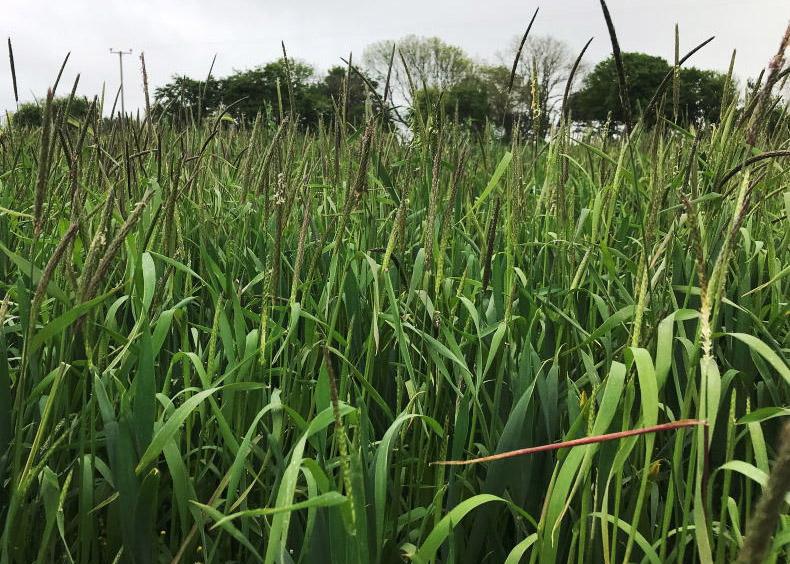
Britain has serious blackgrass and Italian ryegrass problems. These weeds are now the norm on farm and farmers have had to learn to live with them at huge cost.
Whole fields are lost to these weeds in the east of England. Farmers spray off cereal crops in June to control these weeds or plant fields to summer cover crops instead of cash crops to try and get them under control.
From numerous cultivations to numerous sprays and massive herbicide bills and labour bills for rogueing crops these grass weeds have added severe stress to farms.
Spain has a serious poppy problem. In Ireland we are familiar with resistant poppies, but we still have some tools to control them. When those weeds come to Ireland, we won’t have the tools to control them as other herbicide resistance is already built up.
Last November, the Irish Farmers Journal broke the story that blackgrass, wild oats and many other weeds had been found in cover crops seed (some, not all seeds).
Some seed producers implement a higher voluntary standard which tests seed for these weeds and labels them free of grass weeds. Not all do.
The Department inspects this HVS, but in relation to other seed, the Department does not have to prevent seed with these weed seeds from entering the country, even though some are noxious weeds.
It said at the time: “There is free movement of certified seed within the EU and the Department is not required to carry out control checks on each consignment of imported certified seed.”
Certified seed in Europe does not have to be free of these weed seeds. Ireland’s seed standards are higher than most countries, but this good work can be quickly undone by imports.
To be clear, Ireland and the EU have lost and continue to lose herbicides that give good control of blackgrass.
We do not have as many options as farmers in the UK do for example.
In the east of England, where blackgrass is a major problem farmers could be applying four herbicides to control grass weeds and still don’t achieve full control of the weeds. Some of the products available in the UK have not yet come to Ireland.
The extra spend to control these weeds is estimated at an additional €160-170/ha. This would make most crops unprofitable on owned land.
Questions for the Department
What controls are in place to prevent noxious weeds coming into Ireland? What checks are carried out on straw coming into the country? Who has to be notified when straw enters the country?
There are no EU sanitary or phytosanitary (SPS) requirements for the movement of straw within the EU.
While straw imports from third countries are subject to sanitary requirements including notification to the Department, the import of straw from outside the EU is not subject to phytosanitary checks under EU Plant Health Regulations.
As noxious weeds are deemed a threat to Irish agriculture is it illegal to import these weeds?
The 1936 Noxious Weeds Act, as amended, as purely domestic legislation, cannot take precedence over EU rules on the free movement of goods and any applicable EU legislation setting down phytosanitary requirements for the movement of goods between member states and for the importation of goods into the EU.
Given the major biosecurity risk posed by straw in relation to grass weeds, are there plans in the DAFM to implement rules to prevent grass weeds and other pests being imported in straw?
There is free movement of straw within the EU, while the import of straw from outside the EU is not subject to phytosanitary checks under EU Plant Health Regulations. There is no legal basis therefore to prohibit the import of straw.
To minimise the risk associated with herbicide resistant weeds, the Noxious Weeds Act has been amended to include blackgrass. Furthermore, DAFM has been proactive on the issue of blackgrass for many years. It is over 10 years since DAFM agreed a higher voluntary standard with the Irish seed Industry for seed grown and certified here in Ireland.

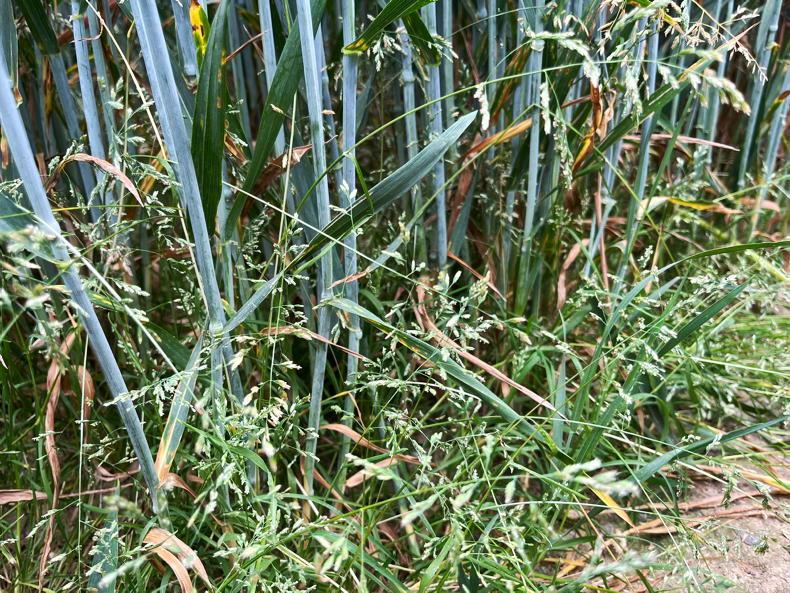
Italian Ryegrass Blackgrass
This higher voluntary standard has a zero tolerance for blackgrass, and other problematic weeds, at all stages of the certification process.
In 2023, with the increasing interest in cover crops, a higher voluntary standard for cover crops was also agreed with the Irish Seed Trade Association.
This higher voluntary standard is based on imported seed lots being sampled and tested to globally recognised standards for the presence of blackgrass, sterile brome and wild oats. Cover crop seed that meets this standard can be declared as higher voluntary standard.
The Department fully understands the concerns on the importation of straw and the potential for it to contain herbicide-resistant weed seeds. It is a legitimate concern for farmers. Industry can minimise the importation of straw by co-operating across sectors.
When we see outbreaks of animal diseases or viruses in this country or very importantly in other countries, we quite rightly see the speedy implementation of restrictions on animals crossing borders and moving out of farms.
This makes total sense to limit the spread of the disease, to limit the number of sick animals and to reduce the impact on as many farms as possible to keep the disease under control.
These restrictions are also implemented to prevent loss of income as a result of disease outbreaks on farms.
Importantly, farmers impacted by some of these diseases are also financially compensated. These payments do not cover all losses.
No money will cover the cost of building up a herd of animals for a given farm, but some supports are in place.
Since publishing details on straw imports and the estimated number of blackgrass seeds being imported into the country as a result we have received numerous correspondence to the Irish Farmers Journal.
A common one is that we would not need to import straw if there was no Straw Incorporation Measure. This is not true.
Firstly, if you want straw and you order it before harvest and are willing to pay a fair price for it, you will get straw.
Secondly, there is straw in sheds across the country at present. There are ample straw supplies. And lastly, farmers are actually paying more money for Spanish straw than they would for Irish straw.
Some of the English straw is cheaper, but understandably so. It is coming from fields that are infested with blackgrass that should have been chopped and which other English farmers likely won’t buy.
Some farmers say the Spanish straw is precision chopped, tightly packed and extremely dry. To this many will say have you asked your straw producer to chop the straw, to produce this type of product?
Irish agriculture needs to stick together. Sectors need to work together. Many think the livestock sector will function without tillage. Some livestock farms do, some work off all imported feed and maybe imported straw as well.
It seems like an unsustainable and risky model. We should not underestimate the value of a native grain supply.
When pressures come on supply chains, weather hits and more concentrates are needed an Irish supply is essential to have grain on hand.
The boat could take six weeks. And in recent years we have seen things impact the speed at which boats get here, like weather and the pandemic.
Department
We cannot continue to say that EU rules supersede Irish rules. If there is an outbreak of an animal disease appropriate restrictions are put in place. This too should happen for seed, straw and other possible weed seed carriers like grain.
What is the point in having higher voluntary standard seed here in Ireland if we allow seed and straw with grass weed seeds in it to be imported.
Our seed industry will disappear.
We will not have blackgrass-free fields in a few years’ time to produce clean seed. It is not acceptable for the Department to say that we can’t do anything because the EU calls for free trade. We are an island nation.
If an animal carries a disease or virus then trade can be stopped between countries.
This should be the same for straw, seed and feed.
The products aren’t even being checked. Something needs to change. Do you think the French farmers would allow herbicide resistant blackgrass to be imported in seed from Ireland to France?
Farm organisations will have to start to work on lobbying the Government for rule changes and to get a derogation from EU rules to protect our tillage and seed production industries.
If we can get a derogation to spread more nitrogen or an emergency use on a pesticide then we can get rules amended to allow imports to be checked and if they contain these weeds then they cannot enter the country.
Tillage farmers may have to lobby their representatives on this. Irish farmers are working at smaller scales to the rest of Europe.
Our climate allows blackgrass to thrive in wet conditions and cannot afford the excessive herbicide bill that comes with grass weeds reduction.
To be clear those herbicides do not offer full control, only a reduction in numbers. There is no simple answer to grass weed control and there is no answer in a can.
It seems just unbelievable that despite all the information that has been published in recent months that nothing has changed to prevent the importation of grass weeds into this country.
Meanwhile, millions of weed seeds are likely being imported each month and the tillage sector faces further risks, cost being the first, loss of income as a result and the very possible scenario that land will vacate tillage production due to grass weed infestation.
This is at a time when the Government and the Department of Agriculture have a target to increase the area of land in tillage to 400,000ha by 2030. So, while the Department is struggling to maintain tillage area, a lack of action on grass weeds could actually result in a loss of land.
In 2025, from January to November (inclusive) 20,266t of straw were imported from Britain, 16,878t of straw were imported from Northern Ireland – most of which is likely to have originated from Britain and 17,542t were imported from Spain.
In total, almost 55,400t were imported in 11 months. That’s over 2,900 lorry loads coming in with no checks and driving all over the country with no traceability.
Britain has serious blackgrass and Italian ryegrass problems. These weeds are now the norm on farm and farmers have had to learn to live with them at huge cost.
Whole fields are lost to these weeds in the east of England. Farmers spray off cereal crops in June to control these weeds or plant fields to summer cover crops instead of cash crops to try and get them under control.
From numerous cultivations to numerous sprays and massive herbicide bills and labour bills for rogueing crops these grass weeds have added severe stress to farms.
Spain has a serious poppy problem. In Ireland we are familiar with resistant poppies, but we still have some tools to control them. When those weeds come to Ireland, we won’t have the tools to control them as other herbicide resistance is already built up.
Last November, the Irish Farmers Journal broke the story that blackgrass, wild oats and many other weeds had been found in cover crops seed (some, not all seeds).
Some seed producers implement a higher voluntary standard which tests seed for these weeds and labels them free of grass weeds. Not all do.
The Department inspects this HVS, but in relation to other seed, the Department does not have to prevent seed with these weed seeds from entering the country, even though some are noxious weeds.
It said at the time: “There is free movement of certified seed within the EU and the Department is not required to carry out control checks on each consignment of imported certified seed.”
Certified seed in Europe does not have to be free of these weed seeds. Ireland’s seed standards are higher than most countries, but this good work can be quickly undone by imports.
To be clear, Ireland and the EU have lost and continue to lose herbicides that give good control of blackgrass.
We do not have as many options as farmers in the UK do for example.
In the east of England, where blackgrass is a major problem farmers could be applying four herbicides to control grass weeds and still don’t achieve full control of the weeds. Some of the products available in the UK have not yet come to Ireland.
The extra spend to control these weeds is estimated at an additional €160-170/ha. This would make most crops unprofitable on owned land.
Questions for the Department
What controls are in place to prevent noxious weeds coming into Ireland? What checks are carried out on straw coming into the country? Who has to be notified when straw enters the country?
There are no EU sanitary or phytosanitary (SPS) requirements for the movement of straw within the EU.
While straw imports from third countries are subject to sanitary requirements including notification to the Department, the import of straw from outside the EU is not subject to phytosanitary checks under EU Plant Health Regulations.
As noxious weeds are deemed a threat to Irish agriculture is it illegal to import these weeds?
The 1936 Noxious Weeds Act, as amended, as purely domestic legislation, cannot take precedence over EU rules on the free movement of goods and any applicable EU legislation setting down phytosanitary requirements for the movement of goods between member states and for the importation of goods into the EU.
Given the major biosecurity risk posed by straw in relation to grass weeds, are there plans in the DAFM to implement rules to prevent grass weeds and other pests being imported in straw?
There is free movement of straw within the EU, while the import of straw from outside the EU is not subject to phytosanitary checks under EU Plant Health Regulations. There is no legal basis therefore to prohibit the import of straw.
To minimise the risk associated with herbicide resistant weeds, the Noxious Weeds Act has been amended to include blackgrass. Furthermore, DAFM has been proactive on the issue of blackgrass for many years. It is over 10 years since DAFM agreed a higher voluntary standard with the Irish seed Industry for seed grown and certified here in Ireland.
Italian Ryegrass Blackgrass
This higher voluntary standard has a zero tolerance for blackgrass, and other problematic weeds, at all stages of the certification process.
In 2023, with the increasing interest in cover crops, a higher voluntary standard for cover crops was also agreed with the Irish Seed Trade Association.
This higher voluntary standard is based on imported seed lots being sampled and tested to globally recognised standards for the presence of blackgrass, sterile brome and wild oats. Cover crop seed that meets this standard can be declared as higher voluntary standard.
The Department fully understands the concerns on the importation of straw and the potential for it to contain herbicide-resistant weed seeds. It is a legitimate concern for farmers. Industry can minimise the importation of straw by co-operating across sectors.
When we see outbreaks of animal diseases or viruses in this country or very importantly in other countries, we quite rightly see the speedy implementation of restrictions on animals crossing borders and moving out of farms.
This makes total sense to limit the spread of the disease, to limit the number of sick animals and to reduce the impact on as many farms as possible to keep the disease under control.
These restrictions are also implemented to prevent loss of income as a result of disease outbreaks on farms.
Importantly, farmers impacted by some of these diseases are also financially compensated. These payments do not cover all losses.
No money will cover the cost of building up a herd of animals for a given farm, but some supports are in place.
Since publishing details on straw imports and the estimated number of blackgrass seeds being imported into the country as a result we have received numerous correspondence to the Irish Farmers Journal.
A common one is that we would not need to import straw if there was no Straw Incorporation Measure. This is not true.
Firstly, if you want straw and you order it before harvest and are willing to pay a fair price for it, you will get straw.
Secondly, there is straw in sheds across the country at present. There are ample straw supplies. And lastly, farmers are actually paying more money for Spanish straw than they would for Irish straw.
Some of the English straw is cheaper, but understandably so. It is coming from fields that are infested with blackgrass that should have been chopped and which other English farmers likely won’t buy.
Some farmers say the Spanish straw is precision chopped, tightly packed and extremely dry. To this many will say have you asked your straw producer to chop the straw, to produce this type of product?
Irish agriculture needs to stick together. Sectors need to work together. Many think the livestock sector will function without tillage. Some livestock farms do, some work off all imported feed and maybe imported straw as well.
It seems like an unsustainable and risky model. We should not underestimate the value of a native grain supply.
When pressures come on supply chains, weather hits and more concentrates are needed an Irish supply is essential to have grain on hand.
The boat could take six weeks. And in recent years we have seen things impact the speed at which boats get here, like weather and the pandemic.
Department
We cannot continue to say that EU rules supersede Irish rules. If there is an outbreak of an animal disease appropriate restrictions are put in place. This too should happen for seed, straw and other possible weed seed carriers like grain.
What is the point in having higher voluntary standard seed here in Ireland if we allow seed and straw with grass weed seeds in it to be imported.
Our seed industry will disappear.
We will not have blackgrass-free fields in a few years’ time to produce clean seed. It is not acceptable for the Department to say that we can’t do anything because the EU calls for free trade. We are an island nation.
If an animal carries a disease or virus then trade can be stopped between countries.
This should be the same for straw, seed and feed.
The products aren’t even being checked. Something needs to change. Do you think the French farmers would allow herbicide resistant blackgrass to be imported in seed from Ireland to France?
Farm organisations will have to start to work on lobbying the Government for rule changes and to get a derogation from EU rules to protect our tillage and seed production industries.
If we can get a derogation to spread more nitrogen or an emergency use on a pesticide then we can get rules amended to allow imports to be checked and if they contain these weeds then they cannot enter the country.
Tillage farmers may have to lobby their representatives on this. Irish farmers are working at smaller scales to the rest of Europe.
Our climate allows blackgrass to thrive in wet conditions and cannot afford the excessive herbicide bill that comes with grass weeds reduction.
To be clear those herbicides do not offer full control, only a reduction in numbers. There is no simple answer to grass weed control and there is no answer in a can.





SHARING OPTIONS