


The Irish dairy sector is at a crossroads. With little change to overall milk output over the last four years, the milk pool is now either going to contract, stay the same or get bigger. With more and more farmers talking about getting out of dairying, many suspect that the sector will shrink over the next decade.
Notwithstanding the positive news about the nitrates derogation, the age profile of farmers is such that people are going to retire from dairying in greater numbers than before. Also, the wave of new entrants that brought such positivity and enthusiasm to dairying between 2012 and 2022 has slowed substantially with new entrant numbers now in very small numbers.
This means that as farmers retire, they are not being replaced by entrants. From a farming perspective, this change in dynamics creates opportunities for those that want to farm to get into dairying or for those that are already farming to grow their businesses as there will be more opportunities.
The way I see it, there are two likely outcomes: dairy farm numbers are going to reduce and output fall as farm size remains largely the same. Or, dairy farm numbers reduce and output stays largely the same as farms get bigger.
It’s fair to say that neither are very desirable options, but if you were to choose one, you would say that maintaining output is important from a rural development, export and local employment point of view.
What is likely to happen is that, over time, dairy farms are going to join together either through land purchase, leasing or partnership.
We have seen this happen in Ireland before and it has happened at scale across Europe, particularly in the Netherlands, Germany and Denmark.
Investments
This stark message on the future direction of dairy farming in Ireland has implications for farmers planning investments. Not all farmyards where there are cows being milked will be milking cows in five, 10 or 15 years.
While the land may still be under dairy cows and the housing still used for winter accommodation, the actual milking facilities could be on a different farm.
1. Build with scale in mind
If investing money in new facilities, make sure it will be fit for purpose in the decades ahead. This does not mean that farmers should build facilities way bigger than the current or likely future requirements, but it does mean that facilities are built in the right location and can be easily expanded, if necessary.
For example, there are big sunk costs when building on a greenfield site such as site clearance, electricity and water connection, etc. Most farmers will build a new parlour close to the existing yard for convenience, but perhaps this is not the best place to build if additional land is likely to become available? Perhaps the best place to build a greenfield milking parlour is closer to the centre of the farm if this is the case
Secondly, wherever the parlour is located, make sure that it can be increased in size without too much cost or without impacting on other buildings.
The big mistake many farmers make is to build a parlour too close to another shed, meaning it cannot be increased in length. It is much more efficient to add units to a swing-over parlour than to double-up an existing parlour just to make more units fit into a smaller space.
2. Don’t over-capitalise
Given the fact that the dynamics of dairy farming in Ireland is going to change, farmers should avoid over-capitalising on investments. The key point here is that high-tech gadgets actually do very little to improve speed and efficiency of milking. Aside from the obvious benefits of automatic cluster removers and automatic wash units, other technologies don’t offer the same level of time freedom, but most come at a big cost.
In my view, farmers would be better off targeting money in areas that will give a faster return, such as good layout and good handling facilities for cows.
3. Look at all of the options
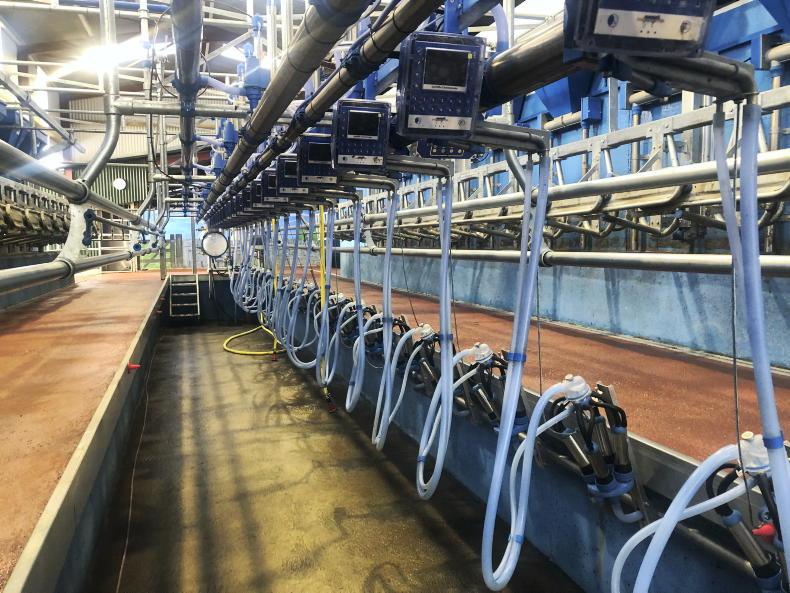
Herringbone, rotary and robots are all options for many farmers when it comes to deciding on what milking facility to invest in. The latter option is becoming more popular, but farmers are reminded to do their homework on running costs and service agreements before committing to a system.
Another option for some farmers would be to switch milking frequency. A growing number of farmers are now once a day milking for some or all of the season while others are milking 10 times in seven days. These are all options for those looking to reduce time spent milking, but may not want to make a big investment for now.



SHARING OPTIONS